ISKCON Revival Movement

THE FINAL ORDER
Proves Srila Prabhupada Is ISKCON's Initiating Guru
By:
Krishnakant
Foreword by Dr. Kim Knott
Professor of Religious Studies, Leeds University, U.K.
Originally requested for
submission to
a select committee of ISKCON's GBC in October 1996.
Contents
• Foreword
by Dr. Kim Knott
• Preface
•
Introduction
• The
Evidence
•
Objections Relating Directly to the Form and Circumstances of the Order
• The
"Appointment Tape"
•
Other Related Objections
•
Conclusion
•
What is a ritvik?
• Relevant Quotes from Srila Prabhupada's Teachings:
• Does the Guru need to be physically present?
• Follow the Instruction not the body
• The Books are enough
• Srila Prabhupada is our Eternal Guru
Appendices:
• July 9th,
1977 Letter "To All GBC, and Temple Presidents"
• July
10th, 1977 Letter
• July 11th,
1977 Letter
•
July 21st, 1977 Letter
• July
31st, 1977 Letter
• Srila
Prabhupada’s Declaration of Will (June, 1977) &
• Codicil
(5th November, 1977)
• Room
conversations
• Tamal
Krishna’s Pyramid House confessions
by
Dr Kim Knott,
Senior Lecturer in Religious
Studies, University of Leeds, UK.
Whilst researching a recent paper on 'Insider and Outsider Perceptions of Srila Prabhupada', I found myself trying briefly to do justice to the different views held by devotees concerning disciplic succession and the role of gurus following Prabhupada's disappearance in 1977. Naturally, I had been aware before this of the periods of crisis surrounding the fall of individual gurus and the waves of shock and sadness experienced by their initiated disciples, godbrothers and godsisters. I had hoped like many, that guru-reforms in the late-1980s would solve ISKCON's leadership and initiation difficulties. Looking again at the issue when preparing the paper, I read some of the arguments for and against the present system, as well as the work of other scholars on questions of guru and succession. It was clearly still a live issue. In the very latest scholarship on 'The Parampara Institution' in volume 5 of Journal of Vaisnava Studies, Jan Brzezinski discusses various aspects of this, stressing the importance of qualified, charismatic leadership in the future of ISKCON. His is just one view, but it is indicative of the power of this subject to motivate interest inside and outside the Movement.
Late in 1996 I was asked to read The Final Order, to give my opinions and to discuss the questions posed within it. Reading it, I was left in no doubt that this was a matter of very great significance to ISKCON and about which many devotees felt deeply. It seemed to me that it raised important theological questions concerning spiritual authority and its transmission, the relationship of the disciple and Krishna's representative, the guru, and the proper objects of devotional worship. As an outsider, I am quite unable to judge the matter (and unable to weigh the evidence presented here against the evidence for the present acharya system). However, I am able to commend what is presented here as a serious attempt to argue the case that Srila Prabhupada established a system of ritvik gurus whom he intended would initiate disciples on his behalf. I hope it will be read carefully and discussed widely, not because I support or condemn its position, but because the profound issues it raises demand consideration at all levels. Every devotee has a real stake in the matter.
No doubt it is unwise for an outsider to involve herself by writing such a foreword, but my motives remain my interest in the Movement and goodwill to all its devotees.
Kim Knott, February 1997
It is now more than a decade since the first edition of The Final Order was printed in 1996. Originally I described The Final Order as a "discussion paper on Srila Prabhupada's instructions for initiation within ISKCON". No one who knows the Movement would deny that the paper has provoked a good deal of "discussion", and thus it has succeeded in its aim to bring this issue into the spotlight.
It would be hard now for ISKCON's leadership to credibly claim oblivion to the legal documents, personally signed by Srila Prabhupada, that clearly set out his intention to remain the sole initiating (diksa) guru for the spiritual Movement he founded. It is these legal documents that constitute the core of The Final Order paper that has now been distributed all over the world, and is available on the world wide web. There are still countries where The Final Order has yet to be translated (as of September 2008, the following translations were available: French, Spanish, German, Russian, Chinese, Hindi, Bengali, Kannada, Czech, Italian, Hungarian, with more underway); added to this ISKCON leaders have placed a blanket ban on its distribution in all ISKCON centres. For these reasons there remain large numbers of ISKCON's rank and file who have yet to read the paper, in spite of all the media coverage and controversy. But at least for ISKCON's executive leadership and gurus, ignorance of Srila Prabhupada's order on spiritual initiation is no longer an excuse. In the introduction to The Final Order we stated that:
"We consider it highly unlikely that anyone is deliberately disobeying, or causing others to disobey, a direct order from our Founder-Acarya."
Given the GBC's evasion, obfuscation, violent suppression and downright dishonesty over The Final Order, the above point may now need revising.
There is now a worldwide organisation called the ISKCON Revival Movement (IRM) that holds The Final Order as its foundation, and was set up specifically to promote its conclusions. It has a website with over 100 papers (www.iskconirm.com) by the same author and publishes a quarterly colour magazine called Back to Prabhupada which is distributed free of charge to thousands of subscribers worldwide. There has been worldwide media coverage of the IRM's activities, including numerous press articles and items on the BBC. The IRM has also made presentations at major academic conferences, including the International Cultic Studies Association, CESNUR and the American Academy of Religion. In addition, the author of The Final Order has been published by various academic and educational publishers including Columbia University Press, Firma KLM, Continuum International Publishing and Facts on File. Through these media the IRM has gained widespread acceptance amongst the scholarly community as a force for reform within ISKCON. Since the formation of the IRM, a growing number of ISKCON devotees and centres around the world have now accepted the conclusions of The Final Order.
Frequently Asked Questions about the ISKCON Revival Movement (IRM)
1. What is the IRM?
The IRM is a body composed of ISKCON devotees from all over the world who want to see the Society put back on track, in line with the directives of its Founder, Srila Prabhupada.
2. Why does the IRM exist?
The spiritual purity and general prestige of ISKCON has undergone a massive deterioration since the physical departure of its Founder on November 14th 1977. Srila Prabhupada single-handedly established ISKCON in 1966 as a great gift to the world, and when he left it was an expanding dynamic force, a beacon of light for humanity. Sadly today it is disintegrating, a fact admitted in a memo sent in May 2000 by the then GBC Chairman Ravindra Svarupa das:
"Therefore the question remains: What, then, will we do? How will we deal with our polarized and disintegrating Society?"
This decline can be traced back to various deviations from the instructions and standards given by Srila Prabhupada, the chief of which being his displacement as the sole diksa guru for ISKCON. The ISKCON Revival Movement seeks to restore ISKCON to its former glory, purity and philosophical chastity through the re-institution of all the instructions and standards that Srila Prabhupada gave, beginning with his role as the sole authority and diksa guru for ISKCON. The IRM's position is set out in The Final Order and No Change in ISKCON Paradigm position papers. Both these papers are also available on our website: www.iskconirm.com
3. Is the IRM separate from ISKCON?
It is a movement within a movement, composed of ISKCON members who seek to reform and revive the Society.
4. Is the aim of the IRM to form a new movement?
No. It is to re-establish the original ISKCON that Srila Prabhupada left us. Once this is achieved the IRM shall be dissolved.
5. What difference would Srila Prabhupada's restoration as the sole diksa guru make?
Firstly, it is the most basic axiom of spiritual life that we can only make advancement by properly following the orders of the guru. If the guru asks for milk and we bring him water, how will he be pleased? And if the guru is not pleased, how will we ever approach Lord Krishna?
For nearly three decades ISKCON has not been doing what Srila Prabhupada ordered. Since Srila Prabhupada left us physically we have not allowed him to initiate even one person via his ritvik, or representational, system. This is the only system of initiation he ever authorised to continue within the Society. If ISKCON members once more start to follow his order, then naturally they will please Lord Krishna, and all spiritual success should naturally follow. Also, with everyone having the same direct relationship as Srila Prabhupada's disciples, factionalism will be eliminated. For the first time in nearly thirty years there will be united team spirit, with everyone working for the same goal—the service and glorification of Srila Prabhupada and Sri Krishna. Many ISKCON "gurus" have fallen prey to gross sinful activities; and when they leave they often take with them hundreds of thousands of dollars and many of their followers. This continual loss of properties, faith and personnel will be eliminated as faith is only placed in Srila Prabhupada, and not in fallible substitutes. Money currently siphoned off by the 80 or so "gurus" from their disciples in daksina (gifted money) will instead go to temples, making them healthy and strong.
6. How can the IRM be so sure its position is correct, and the GBC's is not?
The IRM consider their position correct since it is based on signed, legal documents that were directed to the whole Movement. On the other hand, the GBC have presented at least three completely contradictory official positions (none of which are supported by legal documents) and thus do not technically have a position, not to speak of a correct one. We should point out that not only do these various accounts contradict each other, but on occasion contradict themselves too. For example, if we just take the simple question of when Srila Prabhupada was meant to have authorised his replacement as diksa guru for ISKCON, we get the following answer from the following three official GBC papers:
a) On My Order Understood (GBC, 1995): Srila Prabhupada gave the order for gurus at the same time as the order for devotees to act on his behalf, and this occurred on July 7th, 1977 (p. 28 in Gurus and Initiation in ISKCON, GBC 1995).
b) Disciple Of My Disciple (H.H. Umapati Swami, 1997): Eleven diksa gurus were all set up and ready on May 28th, 1977 since "ritvik" means "officiating acarya" which means "diksa guru".
c) Prabhupada's Order (Badrinarayan das, 1998): On July 9th, 1977 the eleven were fully functioning as gurus but simply observing the etiquette in Srila Prabhupada's presence.
Above we see the GBC have given three different dates for when Srila Prabhupada allegedly sanctioned his replacement. a) refers to a garden conversation, b) refers to a meeting between Srila Prabhupada and some of his senior disciples, whilst c) refers to the signed directive on initiation after which this book is named. Thus each GBC position paper tells a very different tale. To make matters worse:
In February 2004, at their annual meeting in Mayapur, the GBC officially withdrew the paper On My Order Understood, privately admitting it contained "lies" and "stretched the truth". It was this very paper that The Final Order set out originally to challenge (please see Introduction, p. xiii) and the fact it has now been withdrawn so ignominiously can only further vindicate the IRM's position.
Quite clearly the GBC are confused over when successor diksa Gurus were authorised. The IRM argues that this is inevitable since Srila Prabhupada never created any replacement diksa Gurus, only ritviks; and it was this ritvik system he left running with no order for it to be stopped. On this basis we argue that the GBC must first decide on a position, and only then will we be able to judge its efficacy.
The sad thing is that, even to this day, anyone who questions the GBC's miasma of discordant testimony is ruthlessly hounded from the Society.
Krishnakant
September 2008
If you would like further information on the IRM, including a free subscription to our magazine, or wish to ask questions on the contents of The Final Order, then please email the author at:
or
visit our website at:
This book is a humble attempt to present the instructions Srila Prabhupada left the Governing Body Commission ("GBC") on how he intended initiations to continue within the International Society for Krishna Consciousness ("ISKCON"). Although we will refer to several papers and articles that have been published by senior ISKCON devotees on this subject, the main points of reference will be the GBC's most recent official handbook on initiation entitled Gurus And Initiation In ISKCON (to be referred to henceforward as "GII"), and the paper On My Order Understood which is mentioned under section 1.1 of the 'Laws of ISKCON':
"The GBC approves of the paper entitled 'On My Order Understood' which establishes as ISKCON law the final siddhanta on Srila Prabhupada's desire for continuing the disciplic succession after the departure of His Divine Grace. [See Part II: GBC Position Papers in this volume.]" (GII, p.1)
In GII it is the GBC's clearly stated intention to remove incoherence and contradiction from ISKCON's codes and laws surrounding gurus, disciples and guru-tattva in general, thus establishing a final siddhanta (philosophical conclusion). We sincerely pray that this paper is in pursuance of those very same aims.
In the interest of ever greater consistency and philosophical chastity, we feel there are still one or two discrepancies, not fully addressed in GII, which might benefit from further investigation and discussion. Although some of the issues thrown up in confronting these discrepancies may seem quite radical, even painful to deal with, we feel that tackling them now will greatly minimise future confusion and potential deviation. It is not unprecedented that guru systems in ISKCON have come under quite radical review. In the past, symbols have been removed, ceremonies curtailed and paradigms shifted—all without too much long term disruption.
In the whole scheme of things ISKCON is undoubtedly the most important Society on the planet. It is therefore imperative that constant vigilance is maintained in ensuring it does not stray even one millionth of a hair's breadth from the managerial and philosophical parameters set out by our Founder-Acarya. Srila Prabhupada constantly stressed that we must not change, invent or speculate; but simply carry on expanding that which he so carefully and painstakingly established. What better time to closely scrutinise the way we are carrying on Srila Prabhupada's mission than this, his Centennial year (1996)?
It is our strong conviction that the present guru system within ISKCON should be brought fully in line with Srila Prabhupada's last signed directive on the matter; his final order on initiation, issued on July 9th, 1977 (please see Appendices, p.108). Sometimes people question the stress placed on this letter over and above other letters or teachings. In our defence we shall simply repeat an axiom the GBC itself uses in the GII handbook:
"In logic, later statements supersede earlier ones in importance."
(GII, p.25)
Since the July 9th letter really is the final instruction on initiation within ISKCON, addressed as it was to the entire Movement, it must be viewed in a category of its own. It will be shown that the full acceptance and implementation of this order does not in any way clash with the teachings of Srila Prabhupada.
We have no interest in conspiracy theories, nor do we intend to dredge up the gory details of unfortunate individuals' spiritual difficulties. What is done is done. We can certainly learn from previous mistakes, but we would rather help pave the way for a positive future of re-unification and forgiveness, than dwell too long on past scandal. As far as the author is concerned, the vast majority of devotees in ISKCON are sincerely striving to please Srila Prabhupada; thus we consider it highly unlikely that anyone is deliberately disobeying, or causing others to disobey, a direct order from our Founder-Acarya. Nevertheless, somehow or other, it does seem as though certain aberrations of epistemology and managerial detail have found their way into general ISKCON currency over the last nineteen years. In identifying these grey areas we pray we may be of some assistance in rooting out unnecessary obstructions to our devotional service to Srila Prabhupada and Krishna.
In this book we shall be presenting as evidence signed documentation, issued personally by Srila Prabhupada, and conversation transcripts, all of which are accepted as authentic by the GBC. We shall then look carefully at both the content and the context of these materials to see if they should be taken literally, or whether modifying instructions exist which might reasonably alter their meaning or applicability. We shall also discuss all relevant philosophical issues raised in connection with this evidence, and answer all of the most common objections raised against a literal acceptance of the July 9th initiation policy document. And finally we shall look at how the "officiating acarya system", as outlined in the July 9th order, might be implemented with the minimum disturbance.
We shall base all our arguments solely on the philosophy and instructions given by Srila Prabhupada in his books, letters, lectures and conversations. We humbly beg the mercy of all Vaisnavas that we may not cause offence to anyone or in any way disrupt the vital mission of His Divine Grace A.C. Bhaktivedanta Swami Srila Prabhupada.
Anyone who knew Srila Prabhupada would often note his meticulous nature. His fastidious attention to every detail of his devotional service was one of Srila Prabhupada's most distinguishing characteristics; and for those who served him closely, was profound evidence of his deep love and devotion to Lord Sri Krishna. His whole life was dedicated to carrying out the order of his spiritual master, Srila Bhaktisiddhanta, and in that duty he was uncannily vigilant. He left nothing to chance, always correcting, guiding and chastising his disciples in his effort to establish ISKCON. His mission was his life and soul.
It would certainly have been entirely out of character for Srila Prabhupada to leave an important issue, such as the future of initiation in his cherished Society, up in the air, ambiguous, or in any way open to debate or speculation. This is particularly so in light of what happened to his own spiritual master's mission, which, as he would often point out, was destroyed largely through the operation of an unauthorised guru system. Bearing this in mind, let us begin with facts that no one disputes:
On July 9th 1977, four months before his physical departure, Srila Prabhupada set up a system of initiations employing the use of "ritviks", or "representatives of the acarya". Srila Prabhupada instructed that this "officiating acarya" system was to be instituted immediately, and run from that time onwards, or "henceforward" (please see Appendices, p.108). This management directive, which was sent to all Governing Body Commissioners and Temple Presidents of the International Society for Krishna Consciousness, instructed that from that time on new disciples would be given spiritual names and have their beads and gayatri mantras from the 11 named ritviks. The ritviks were to act on Srila Prabhupada's behalf, new initiates all becoming disciples of Srila Prabhupada. Srila Prabhupada thus handed over to the ritviks total power of attorney over who could receive initiation, he made it clear that from that time onwards he was no longer to be consulted (for details of a ritvik's duties, please see the section entitled "What is a Ritvik?" on p. 90).
Immediately after Srila Prabhupada's physical departure on November 14th 1977, the GBC suspended this ritvik system. By Gaura Purnima 1978, the 11 ritviks had assumed the roles of zonal acarya diksa gurus, initiating disciples on their own behalf. Their mandate for doing so was an alleged order from Srila Prabhupada that they alone were to succeed him as initiating acaryas. Some years later this zonal acarya system was itself challenged and replaced, not by the restoration of the ritvik system, but by the addition of dozens more gurus, along with an elaborate system of checks and balances to deal with those that deviated; the rationale for this change being that the order to become guru was not, as we had first been told, only applicable to the 11, but was a general instruction for anyone who strictly followed, and received a two-thirds majority vote from the GBC body.
The above account is not a political opinion, it is historical fact, accepted by everyone, including the GBC.
As mentioned above, the July 9th letter was sent to all GBCs and Temple Presidents, and remains to this day the only signed instruction on the future of initiation Srila Prabhupada ever issued to the whole Society. Commenting on the July 9th order, HH Jayadvaita Swami recently wrote:
"Its authority is beyond question [...] Clearly, this letter establishes a ritvik-guru system."
(Jayadvaita Swami, Where the Ritvik People are Wrong, 1996)
The source of the controversy arises from two modifications which were subsequently superimposed over this otherwise clear and authoritative directive:
Modification a): That the appointment of representatives or ritviks was only temporary, specifically to be terminated on the departure of Srila Prabhupada.
Modification b): Having ceased their representational function, the ritviks would automatically become diksa gurus, initiating persons as their own disciples, not Srila Prabhupada's.
The reforms to the zonal acarya system, which took place around 1987, kept intact these two assumptions. The same assumptions, in fact, that underpinned the very system it replaced. We refer to a) and b) above as modifications since neither statement appears in the July 9th letter itself, nor in any policy document issued by Srila Prabhupada subsequent to this order.
The GBC's paper, GII, clearly upholds the above-mentioned modifications:
"When Srila Prabhupada was asked who would initiate after his physical departure he stated he would "recommend" and give his "order" to some of his disciples who would initiate on his behalf during his lifetime and afterwards as "regular gurus", whose disciples would be Srila Prabhupada's grand-disciples." (GII, p.14)
Over the years increasing numbers of devotees have begun questioning the legitimacy of these basic assumptions. For many, they have never been properly substantiated, and hence an uneasy sense of doubt and mistrust has grown both within and outside the Society. At present, books, papers, email-outs and websites offer almost daily updates on ISKCON and its allegedly deviant guru system. Anything that can bring about some sort of resolution to this controversy has got to be positive for anyone who truly cares about Srila Prabhupada's Movement.
One point everyone is agreed on is that Srila Prabhupada is the ultimate authority for all members of ISKCON, so whatever his intended order was, it is our duty to carry it out. Another point of agreement is that the only signed policy statement on the future of initiation, which was sent to all the Society's leaders, was the July 9th order.
It is significant to note that in GII the existence of the July 9th letter is not even acknowledged, even though this is the only place where the original eleven "acaryas" are actually mentioned. This omission is puzzling, especially given that GII is supposed to offer the "final siddhanta" on the entire issue.
Let us then look closely at the July 9th order to see if there is indeed anything that supports assumptions a) and b) above:
The order itself
As previously mentioned, the July 9th order states that the ritvik system should be followed "henceforward". The specific word used, "henceforward", only has one meaning, viz. "from now onwards". This is both according to Srila Prabhupada's own previous usage of the word and the meaning ascribed to it by the English language. Unlike other words, the word "henceforward" is unambiguous since it only possesses one dictionary definition. On the other 86 occasions that we find on Folio where Srila Prabhupada has used the word "henceforward", nobody raised even the possibility that the word could mean anything other than "from now onwards". "From now onwards" does not mean "from now onwards until I depart". It simply means "from now onwards". There is no mention in the letter that the system should stop on Srila Prabhupada's departure, neither does it state that the system was to only be operational during his presence. Furthermore, the argument that the whole ritvik system "hangs" on one word—"henceforward" —is untenable, since even if we take the word out of the letter, nothing has changed. One still has a system set up by Srila Prabhupada four months before his departure with no subsequent instruction to terminate it. Without such a counter instruction this letter must be seen as Srila Prabhupada's final instruction on initiation, and should therefore be followed.
Supporting instructions
There were other statements made by Srila Prabhupada, and his secretary, in the days following the July 9th letter, which clearly indicate that the ritvik system was intended to continue without cessation (all emphases added):
"...the process for initiation to be followed in the future." (July 11th, 1977)
"...continue to become ritvik and act on my charge." (July 19th, 1977)
"...continue to be rittik and act on my behalf." (July 31st, 1977)
(Please see Appendices).
In these documents we find words such as "continue'"and "future" which along with the word "henceforward" all point to the permanency of the ritvik system. There is no statement from Srila Prabhupada that even hints that this system was to terminate on his departure.
Subsequent instructions
Once the ritvik system was up and running, Srila Prabhupada never issued a subsequent order to stop it, nor did he ever state that it should be disbanded on his departure. Perhaps aware that such a thing may mistakenly or otherwise occur, he put in the beginning of his final Will that the "system of management" in place within ISKCON must continue and could not be changed—an instruction left intact by a codicil added just nine days before his departure. Surely this would have been the perfect opportunity to disband the ritvik system had that been his intention. That the use of ritviks to give initiates' names was a "system of management" can be illustrated by the following:
In 1975 one of the preliminary GBC resolutions sanctioned that the GBC would have sole responsibility for managerial affairs. Below are some of the managerial issues the GBC dealt with that year:
"In order to receive first initiation, one must have been a full time member for 6-months. For second initiation, there should be at least another one year after first initiation."
(GBC Resolution No. 9, March 1975)
"Method of initiating sannyasi".
(GBC Resolution No. 2, March 1975)
These resolutions were personally approved by Srila Prabhupada. They demonstrate conclusively that the methodology for conducting initiations was deemed a "system of management". If the whole methodology for conducting initiations is considered a "system of management"by Srila Prabhupada, then one element of initiation, viz. the use of ritviks to give spiritual names, has to fall under the same terms of reference.
Thus changing the ritvik system of initiation was in direct violation of Srila Prabhupada's final Will.
Another instruction in Srila Prabhupada's Will, which indicates the intended longevity of the ritvik system, is where it states that the executive directors for his permanent properties in India could only be selected from amongst Srila Prabhupada's "initiated disciples":
"...a successor director or directors may be appointed by the remaining directors, provided the new director is my initiated disciple..."
(Srila Prabhupada's Declaration of Will, June 4th, 1977)
This is something that could only occur if a ritvik system of initiation remained in place after Srila Prabhupada's departure, since otherwise the pool of potential directors would eventually dry up.
Furthermore, every time Srila Prabhupada spoke of initiations after July 9th he simply reconfirmed the ritvik system. He never gave any hint that the system should stop on his departure or that there were gurus, waiting in the sidelines, ready to take on the role of diksa. Thus, at least as far as direct evidence is concerned, there appears to be nothing to support assumptions a) and b) referred to previously. As stated, these assumptions—that the ritvik system should have stopped at departure, and that the ritviks must then become diksa gurus—form the very basis of ISKCON's current guru system. If they prove to be invalid then there will certainly need to be a radical re-think by the GBC.
The above sets the scene. The instruction itself, supporting instructions and subsequent instructions only support the continuation of the ritvik system. It is admitted by all concerned that Srila Prabhupada did not give any order to terminate the ritvik system on his physical departure. It is further accepted by all concerned that Srila Prabhupada did set up the ritvik system to operate from July 9th onwards. Thus we have a situation whereby the acarya:
1) has given a clear instruction to follow a ritvik system;
2) has not given an instruction to stop following the ritvik system upon his physical departure.
Consequently, for a disciple to stop following this order, with any degree of legitimacy, demands he provide some solid grounds for doing so. The only thing that Srila Prabhupada actually told us to do was to follow the ritvik system. He never told us to stop following it, or that one could only follow it in his physical presence. The onus of proof will naturally fall on those who wish to terminate any system put in place by our acarya, and left to run henceforward. This is an obvious point; one can not just stop following the order of the guru whimsically:
"...the process is that you cannot change the order of spiritual master."
(Srila Prabhupada Cc. Lecture, 2/2/1967, San Francisco)
A disciple does not need to justify continuing to follow a direct order from the guru, especially when he has been told to continue following it. That is axiomatic —this is what the word 'disciple' means:
"When one becomes disciple, he cannot disobey the order of the
spiritual master."
(Srila Prabhupada Bg. Lecture, 11/2/1975, Mexico)
Since there is no direct evidence stating that the ritvik system should have been abandoned on Srila Prabhupada's physical departure, the case for abandoning it could therefore only be based on indirect evidence. Indirect evidence may arise out of special circumstances surrounding the literal direct instruction. These extenuating circumstances, should they exist, may be used to provide grounds for interpreting the literal instruction. We will now examine the circumstances surrounding the July 9th order, to see if such modifying circumstances might indeed have been present, and whether there is inferentially anything to support assumptions a) and b).
Objections Relating Directly to the Form and
Circumstances
of Srila Prabhupada's Final Order
| 1) "The July 9th letter clearly implies that it was only set up for whilst Srila Prabhupada was physically present." |
There is nothing in the letter that says the instruction was only meant for whilst Srila Prabhupada was physically present. In fact, the only information given supports the continuation of the ritvik system after Srila Prabhupada's departure. It is significant to note that within the July 9th letter it is stated three times that those initiated would become Srila Prabhupada's disciples. The GBC in presenting evidence for the current guru system have argued vigorously that Srila Prabhupada had already made it clear that, as far as he was concerned, it was an inviolable law that no one could initiate in his presence. Thus the necessity to state Srila Prabhupada's ownership of future disciples must indicate that the instruction was intended to operate during a time period when the ownership could even have been an issue, namely after his departure.
For some years Srila Prabhupada had been using representatives to chant on beads, perform the fire yajna, give gayatri mantra, etc. No one had ever questioned whom such new initiates belonged to. Right at the beginning of the July 9th letter it is emphatically stated that those appointed are "representatives" of Srila Prabhupada. The only innovation this letter contained then was the formalisation of the role of the representatives; hardly something which could be confused with a direct order for them to become fully-fledged diksa gurus. Srila Prabhupada's emphasis on disciple ownership would therefore have been completely redundant were the system to operate only in his presence, especially since as long as he was present he could personally ensure that no one claimed false ownership of the disciples. As mentioned above, this point is hammered home three times in a letter which itself was quite short and to the point.
"So as soon as one thing is three times stressed, that means final."
(Srila Prabhupada Bg. Lecture, 27/11/1968, Los Angeles)
The July 9th letter states that the names of newly initiated disciples were to be sent "to Srila Prabhupada". Could this indicate that the system was only to run while Srila Prabhupada was physically present? Some devotees have argued that since we can no longer send these names to Srila Prabhupada, the ritvik system must therefore be invalid.
The first point to note is the stated purpose behind the names being sent to Srila Prabhupada, i.e. so they could be included in his "Initiated Disciples"book. We know from the July 7th conversation (please see Appendices, p.128) that Srila Prabhupada had nothing to do with entering the new names into this book; it was done by his secretary. Further evidence that the names should be sent for inclusion in the book, and not specifically to Srila Prabhupada, is given in the letter written to Hamsadutta, the very next day, where Tamal Krsna Goswami explains his new ritvik duties to him:
"... you should send their names to be included in Srila Prabhupad's "Initiated Disciples" book."
(Letter to Hamsadutta from Tamal Krsna Goswami, 10/7/1977)
There is no mention made here of needing to send the names to Srila Prabhupada. This procedure could easily have continued after Srila Prabhupada's physical departure. Nowhere in the final order does it state that if the "Initiated Disciples" book becomes physically separated from Srila Prabhupada all initiations must be suspended.
The next point is that the procedure of sending the names of newly initiated disciples to Srila Prabhupada in any case relates to a post-initiation activity. The names could only be sent after the disciples had already been initiated. Thus an instruction concerning what is to be done after initiation cannot be used to amend or in any way interrupt pre-initiation, or indeed initiation procedures (the ritvik's role being already fulfilled well before the actual initiation ceremony takes place). Whether or not names can be sent to Srila Prabhupada has no bearing on the system for initiation, since at the point where new names are ready to be sent, the initiation has already occurred.
The last point is that if sending the names to Srila Prabhupada were a vital part of the ceremony, then even before Srila Prabhupada's departure, the system would have been invalid, or at least run the constant risk of being so. It was generally understood that Srila Prabhupada was ready to leave at any time, thus the danger of not having anywhere to send the names was present from day one of the order being issued. In other words, taking the possible scenario that Srila Prabhupada leaves the planet the day after a disciple has been initiated through the ritvik system, according to the above proposition the disciple would not actually have been initiated simply because of the speed by which mail is delivered. We find no mention in Srila Prabhupada's books that the transcendental process of diksa, which may take many lifetimes to complete, can be obstructed by the vicissitudes of the postal service. Certainly there would be nothing preventing the names of new initiates being entered into His Divine Grace's "Initiated Disciples" book even now. This book could then be offered to Srila Prabhupada at a fitting time.
| 2) "The letter does not specifically say 'this system will continue after Srila Prabhupada's departure'; therefore, it was right to stop the ritvik system at Srila Prabhupada's departure." |
Please consider the following points:
- The July 9th letter also does not specifically state: 'The ritvik system should end on Srila Prabhupada's departure'. Yet it was terminated immediately on his departure.
- The letter also does not state: 'The ritvik system should run while Srila Prabhupada is still present'. Yet it was run while he was still present.
- The letter also does not state: 'The ritvik system should only run until the departure of Srila Prabhupada'. Yet it was only allowed to run till his departure.
- The letter also does not state: 'The ritvik system must stop'. Yet it was stopped.
In summary, the GBC insists on the following:
- The ritvik system must stop.
- The ritvik system must stop on Srila Prabhupada's departure.
Neither of the above stipulations appears in the July 9th letter, nor any other signed order; yet they form the very foundation of both the zonal acarya system and the current "Multiple Acarya Successor System", or M.A.S.S. as we shall refer to it. (In this context we use the word acarya in its strongest sense, that of initiating spiritual master, or diksa guru).
To argue that since the letter is not specific about the time period in which it is to run, it must therefore stop on departure, is completely illogical. The letter does not specify that the ritvik system should be followed on July 9th either, so according to this logic it should never have been followed at all. Even accepting that "henceforward" can at least stretch to the end of the first day of the order being issued, it does not say it should be followed on July 10th, so perhaps it should have stopped then.
The demand for the ritvik system to only operate within a pre-specified time period is contradicted by accepting its operation for 126 separate 24 hour time periods (i.e. four months), since none of these 126 separate time periods is specified in the letter, yet everyone seems quite happy that the system ran during this time frame. Unless we take the word "henceforward" literally to mean "indefinitely", we could stop the system at any time after July 9th, so why choose departure?
There is no example, either in Srila Prabhupada's 86 recorded uses, nor in the entire history of the English language, where the actual word "henceforward" has ever meant:
"Every time period until the departure of a person who issued the order."
Yet according to current thinking this is what the word must have meant when it was used in the July 9th letter. The letter simply states that the ritvik system is to be followed "henceforward". So why was it stopped?
If an instruction is impossible to perform, for example giving Srila Prabhupada his daily massage after his physical departure, then obviously there can be no question of doing it. The duty of a disciple is simply to follow an order until it is impossible to follow any longer, or until the spiritual master changes the order. The question then is whether it is feasible to follow a ritvik system without the physical presence of the person who set it up.
In fact, the ritvik system was set up specifically to be operational without any physical involvement from Srila Prabhupada whatsoever. Had the ritvik system continued after his departure, it would be identical in every respect to how it was practised whilst Srila Prabhupada was present. After July 9th, Srila Prabhupada's involvement became non-existent, and so even at that stage it was operating as though he had already left. This being the case, we cannot classify the ritvik system dysfunctional, or inoperable, on the grounds of Srila Prabhupada's departure, since his departure does not in any way affect the running of the system. In other words, since the system was specifically set up to operate as if Srila Prabhupada was not on the planet, his leaving the planet can not in itself render the system invalid.
| 4)"The fact that the order was 'only' issued in a letter, and not in a book, gives us a licence to interpret it indirectly." |
This "letters v books" argument does not apply in this case since this was no ordinary letter. Generally, Srila Prabhupada wrote a letter in response to a specific query from an individual disciple, or to offer individualised guidance or chastisement. Naturally, in these cases the devotee's original query, situation or deviation may give grounds for interpretation. Not everything in Srila Prabhupada's letters can be applied universally. However, the final order on initiation is not open to any such interpretation since it was not written in response to a specific query from a particular individual, or to address a disciple's individual situation or behaviour. The July 9th letter was a procedural instruction, or management policy document, which was sent to every leader in the Movement.
The letter follows the format of any important instruction that Srila Prabhupada issued and wanted followed without interpretation—he had it put in writing, he approved it, and then sent it to his leaders. For example, he had one sent on April 22nd, 1972, addressed to "ALL TEMPLE PRESIDENTS":
"The zonal secretaries duty is to see that the spiritual principles are being upheld very nicely in all the Temples of his zone. Otherwise each Temple shall be independent and self-supporting."
(Srila Prabhupada Letter to All Temple Presidents, 22/4/1972)
Srila Prabhupada did not publish a new book each time he issued an important instruction, regardless of whether the instruction was to continue past his departure. Thus, the form in which the instruction was issued does not make it prey for indirect interpretations, nor in any way diminish its validity.
| 5)"Maybe there was some special background surrounding the issuing of the order that precludes its application after Srila Prabhupada's departure?" |
If such circumstances did exist, Srila Prabhupada would have stated them in the letter, or in an accompanying document. Srila Prabhupada always gave enough information to enable the correct application of his instructions. He certainly did not operate on the assumption that his Temple Presidents were all mystic mind readers, and that he therefore only needed to issue fragmented and incomplete directives which would later be made sense of telepathically. For example, had Srila Prabhupada intended the ritvik system to stop on his departure he would have added the following seven words to the July 9th letter—"This system will terminate on my departure". A quick look at the letter tells us he wanted it to continue "henceforward" (please see Appendices, p.108).
Sometimes it is argued that the ritvik system was only set up because Srila Prabhupada was sick.
Devotees may or may not have been aware of the extent of Srila Prabhupada's illness; but how could they possibly be expected to deduce from a letter that says nothing about his health, that this was the only reason it was issued? When did Srila Prabhupada say that any instruction he issued must always be interpreted in conjunction with his latest medical report? Why should the recipients of the final order on initiation not have assumed the letter was a general instruction to be followed, without interpretation?
Srila Prabhupada had already announced that he had come to Vrindavan to leave his body. Being tri-kala-jna (cognizant of past, present and future) he was most likely aware of his departure in four months time. He had set in motion the final instructions for the continuation of his Movement. He had already drawn up his Will and other documents relating to the BBT (Bhaktivedanta Book Trust) and GBC, specifically to provide guidance for after his imminent departure. The one matter that had not yet been settled was how initiations would operate when he left. At this point, there was still uncertainty as to how things were to run. The July 9th order clarified for everyone precisely how initiations were to proceed in his absence.
In summary, you cannot modify an instruction with information that those to whom the instruction was given did not have access to. Why would Srila Prabhupada purposely issue an instruction that he knew in advance no one could follow correctly, since he had not given them the relevant information within the instruction? If the ritvik system was only set up because he was ill, Srila Prabhupada would have said so in the letter or in some accompanying document. There is no record of Srila Prabhupada ever behaving in such a purposely ambiguous and uninformative manner, especially when instructing the entire Movement. Srila Prabhupada never signed anything in a cavalier fashion, and when one considers the magnitude of the instruction in question, it is inconceivable that he would have left out any vital information.
| 6)"Does not the 'Appointment Tape' contain relevant information that clearly frames the July 9th order as being only applicable whilst Srila Prabhupada was physically present on the planet?" |
In the GBC's handbook GII, the sole evidence offered in support of modifications a) & b) is extracted from a conversation which took place on May 28th, 1977. The paper appears to concede that there is no other instructional evidence which directly relates to the function of ritviks after Srila Prabhupada's departure:
"Although Srila Prabhupada did not repeat his earlier statements it was understood that he expected these disciples to initiate in the future." (GII, p.35)
Since it is the sole evidence, there is a section exclusively dedicated to the May 28th conversation on page 33 of this book. Suffice to say it was not referred to in the July 9th letter, nor did Srila Prabhupada demand that a copy of the taped conversation be sent out with the final order. From this we can deduce with absolute confidence that it cannot contain a scrap of modifying information vital to the understanding of the final order. As a point of fact, the May 28th conversation was not released till several years after Srila Prabhupada's departure. Thus once more we are expected to modify a clear written instruction with information which was not accessible to the very people who were issued the instruction. As will be seen later, the May conversation has nothing in it to
contradict the final order.
As a general point, later instructions from the guru will always supersede previous instructions; the final order is the final order, and must be followed:
"I may say many things to you, but when I say something directly, "Do it," your first duty is to do that. You cannot argue, "Sir, you said me like this before." No, that is not your duty. What I say now, you do it. That is obedience. You cannot argue."
(Srila Prabhupada SB Lecture, 15/4/1975, Hyderabad)
Just as in the Bhagavad-gita Lord Krsna gave so many instructions to Arjuna, He spoke of all types of yoga from Dhyana to Jnana, but all this was superseded by the final order:""You just give up everything and become My devotee, My worshipper" – should be taken as the final order of the Lord, and one should follow that principle."
(Teachings of Lord Caitanya, Chapter 11)
The final order given by Sankaracarya,"bhaja Govinda", was also meant to supersede many of his earlier statements—all of them, in fact. As mentioned in the introduction to this book, the GBC itself recognises this as an axiomatic principle of logic:
"In logic, later statements supersede earlier ones in importance."
(GII, p. 25)
It is not possible to have a "later" statement than the last one. Therefore we must follow the ritvik system by the GBC's own logic.
| 7)"Srila Prabhupada stated many times that all his disciples must become gurus. Surely this proves that Srila Prabhupada did not intend the ritvik system to be permanent?" |
Srila Prabhupada never appointed or instructed anyone to be diksa guru for after his departure. Evidence for this claim has never been produced; indeed many senior leaders within ISKCON have conceded the point:
"And it's a fact that Srila Prabhupada never said "Alright here is the next acarya, or here is the next eleven acaryas and they are authorized gurus for the Movement, for the world". He did not do that."
(Jayadvaita Swami, ISKCON South London, 1993)
Srila Prabhupada unequivocally stated that the diksa guru must be a mahabhagavata (most advanced stage of God-realisation) and be specifically authorised by his own spiritual master. He had always strongly condemned the assumption of guruship by those who were not suitably qualified and authorised. We quote below from Srila Prabhupada's books where the qualifications of the diksa guru are stated:
"Maha-bhagavata-srestho brahmano vai gurur nrnam
sarvesam eva lokanam asau pujyo yatha harih
maha-kula-prasuto' pi sarva-yajnesu diksitah
sahasra-sakhadhyayi ca na guruh syad avaisnavah
The guru must be situated on the topmost platform of devotional service. There are three classes of devotees, and the guru must be accepted from the topmost class."
(Cc. Madhya-lila, 24.330, purport)
"When one has attained the topmost position of maha-bhagavata, he is to be accepted as a guru and worshipped exactly like Hari, the Personality of Godhead. Only such a person is eligible to occupy the post of a guru."
(Cc. Madhya-lila, 24.330, purport)
Aside from the qualification, Srila Prabhupada also taught that specific authorisation from the predecessor acarya was also essential before anyone could act as a diksa guru:
"On the whole, you may know that he is not a liberated person, and therefore, he cannot initiate any person to Krishna Consciousness. It requires special spiritual benediction from higher authorities."
(Srila Prabhupada Letter to Janardana, 26/4/1968)
"One should take initiation from a bona fide spiritual master coming in the disciplic succession who is authorized by his predecessor spiritual master. This is called diksa-vidhana."
(SB, 4.8.54, purport)
Indian man: When did you begin to become the spiritual leader of Krsna Consciousness?
Srila Prabhupada: What is that?
Brahmananda: He's asking when did you become the spiritual leader of Krsna Consciousness?
Srila Prabhupada: When my Guru Maharaja ordered me. This is the guru parampara.
Indian man: Did it...
Srila Prabhupada: Try to understand. Don't go very speedily. A guru can become guru when he's ordered by his guru. That's all. Otherwise nobody can become guru.
(Srila Prabhupada Bg. Lecture, 28/10/1975)
Thus, according to Srila Prabhupada, one can only become a diksa guru when both the qualification and authorisation are in place. Srila Prabhupada had not authorised any such gurus, nor had he stated that any of his disciples were qualified to initiate. Rather, just prior to July 9th, he agreed that they were still "conditioned souls", and that vigilance was essential lest persons pose themselves as guru (please see Appendices, April 22nd, 1977 conversation).
Evidence used to support an alternative to the ritvik system falls into three basic
categories:
- Srila Prabhupada's frequent call for everyone to become guru, often made in conjunction with the "amara ajnaya guru hana" verse from the Caitanya-caritamrta.
- The half-dozen or so personal letters where Srila Prabhupada mentions his disciples acting as diksa guru after his departure.
- Other statements in Srila Prabhupada's books and lectures where the principle of disciples going on to be diksa guru is mentioned.
Looking first at category 1):
The instruction for everyone to become guru is found in the following verse in the Caitanya-caritamrta, which was often quoted by Srila Prabhupada:
"Instruct everyone to follow the orders of Lord Sri Krsna as they are given in Bhagavad-gita and Srimad-Bhagavatam. In this way become a spiritual master and try to liberate everyone in this land."
(Cc. Madhya-lila, 7.128)
However, the type of guru which Lord Caitanya is encouraging everyone to become is clearly established in the detailed purports following this verse:
"That is, one should stay at home, chant the Hare Krsna mantra and preach the instructions of Krsna as they are given in Bhagavad-gita and Srimad-Bhagavatam."
(Cc. Madhya-lila, 7.128, purport)
"One may remain a householder, a medical practitioner, an engineer or whatever. It doesn't matter. One only has to follow the instruction of Sri Caitanya Mahaprabhu, chant the Hare Krsna maha-mantra and instruct relatives and friends in the teachings of Bhagavad-gita and Srimad-Bhagavatam [...] It is best not to accept any disciples."
(Cc. Madhya-lila, 7.130, purport)
We can see that these instructions do not demand that the gurus in question first attain any particular level of realisation before they act. The request is immediate. From this it is clear everyone is simply encouraged to preach what they may know, and in so doing become siksa, or instructing, gurus. This is further clarified by the stipulation for the siksa guru to remain in that position, and not then go on to become a diksa guru:
"It is best not to accept any disciples." (Cc. Madhya-lila, 7.130, purport)
To accept disciples is the main business of a diksa guru, whereas a siksa guru simply needs to carry on his duties and preach Krsna Consciousness as best he can. It is clear from Srila Prabhupada's purports that, in the above verse, Lord Caitanya is actually authorising siksa gurus, not diksa gurus.
This is also made abundantly clear in the many other references where Srila Prabhupada encourages everyone to become guru:
"yare dekha, tare kaha, krsna-upadesa. [Cc. Madhya 7.128]. You haven't got to manufacture anything. What Krsna has already said, you repeat. Finish. Don't make addition, alteration. Then you become guru [...] I may be fool, rascal [...] So we have to follow this path, that you become guru, deliver your neighbourhood men, associates, but speak the authoritative words of Krsna. Then it will act [...] Anyone can do it. A child can do it."
(Srila Prabhupada Evening darshan, 11/5/1977, Hrishikesh, emphasis added)
"Because people are in darkness, we require many millions of gurus to enlighten them. Therefore Caitanya Mahaprabhu's mission is, He said, that 'Every one of you become guru.'"
(Srila Prabhupada Lecture, 21/5/1976, Honolulu)
"You simply say [...] 'Just always think of Me.' Krsna said. 'And just become My devotee. Just worship Me and offer obeisances.' Kindly do these things." So if you can induce one person to do these four things, you become guru. Is there any difficulty?"
(Srila Prabhupada Conversation, 2/8/1976, New Mayapur)
"Real guru is he who instructs what Krsna has said. [...] You have simply to say, 'This is this.' That's all. Is it very difficult task?"
(Srila Prabhupada Lecture, 21/5/1976, Honolulu)
"...'But I have no qualification. How can I become guru?'There is no need of qualification [...] 'Whomever you meet, you simply instruct what Krsna has said. That's all. You become guru.'"
(Srila Prabhupada Lecture, 21/5/1976, Honolulu)
(Astonishingly, some devotees have used such quotes as those above as a justification for "minimally qualified diksa gurus"*(1), an entity never once mentioned in any of Srila Prabhupada's books, letters, lectures or conversations).
An example of a guru who has no qualification, other than repeating what he has heard, could be found on any bhakta induction course in ISKCON. It is perfectly clear therefore that the above are actually invitations to become instructing spiritual masters or siksa gurus. We know this since Srila Prabhupada has already explained for us in his books the far more stringent requirements for becoming a diksa guru:
"When one has attained the topmost position of maha-bhagavata, he is to be accepted as a guru and worshiped exactly like Hari, the Personality of Godhead. Only such a person is eligible to occupy the post of a guru."
(Cc. Madhya-lila, 24.330, purport)
"One should take initiation from a bona fide spiritual master coming in the disciplic succession who is authorized by his predecessor spiritual master. This is called diksa-vidhana."
(SB, 4.8.54, purport)
In the above quote Srila Prabhupada states that the order to become an initiating guru has to be received specifically from one's own guru. The general instruction from Lord Caitanya had been present for 500 years. It is obvious then that Srila Prabhupada did not consider "amara ajnaya guru hana" to refer specifically to diksa, otherwise why would we need yet another specific order from our immediate acarya? This general instruction from Lord Caitanya must be referring to siksa, not diksa, guru. Diksa guru is the exception, not the rule. Whereas Srila Prabhupada envisaged millions of siksa gurus, comprising of men, women and children.
Looking now at category 2):
There were a handful of overly confident devotees, anxious to initiate their own disciples in Srila Prabhupada's presence, whom Srila Prabhupada wrote letters to. These letters are used to support the M.A.S.S.. Srila Prabhupada had a fairly standard approach when dealing with such ambitious individuals. Generally he told them to keep rigidly trained up, and in the future, after his physical departure, they may accept disciples:
"The first thing, I warn Achyutananda, do not try to initiate. You are not in a proper position now to initiate anyone. [...] Don't be allured by such maya. I am training you all to become future Spiritual Masters, but do not be in a hurry."
(Srila Prabhupada Letter to Acyutananda and Jaya Govinda, 21/8/1968)
"Sometime ago you asked my permission for accepting some disciples, now the time is approaching very soon when you will have many disciples by your strong preaching work."
(Srila Prabhupada Letter to Acyutananda, 16/5/1972)
"I have heard that there is some worship of yourself by the other devotees. Of course it is proper to offer obeisances to a Vaishnava, but not in the presence of the spiritual master. After the departure of the spiritual mastr, [sic] it will come to that stage, but now wait. Otherwise it will create factions."
(Srila Prabhupada Letter to Hamsadutta, 1/10/1974)
"Keep trained up very rigidly and then you are bonafide Guru, and you can accept disciples on the same principle. But as a matter of etiquette it is the custom that during the lifetime of your Spiritual master you bring the prospective disciples to him, and in his absence or disappearance you can accept disciples without any limitation. This is the law of disciplic succession. I want to see my disciples become bona fide Spiritual Master and spread Krishna consciousness very widely. That will make me and Krishna very happy."
(Srila Prabhupada Letter to Tusta Krsna, 2/12/1975)
It is interesting to note that whilst GII quotes the above "law" in support of the M.A.S.S. doctrine, in the very same document it is asserted that it is actually not a law at all:
"There are many such instances in the scriptures about disciples giving initiation in the presence of guru, [...] In the scriptures there is no specific instruction about a disciple not giving initiation when his guru is present."
(GII, p. 23)
Eagerness to accept worship and followers is actually a disqualification for a spiritual master. We can only marvel at the power of the false ego, that even in the presence of the most powerful acarya the planet had ever seen, some personalities still felt amply qualified to initiate their own disciples right under Srila Prabhupada's nose! *(2)
It is apparent that in writing to these devotees, telling them they could take disciples if they just held on a little longer, Srila Prabhupada was simply trying to keep them in devotional service. In so doing there was at least the possibility that, in time, their ambitious mentalities might become purified.
Humble devotees who diligently performed their service in selfless sacrifice to their spiritual master would never have received a letter describing their glowing future as diksa gurus. Why would Srila Prabhupada only seriously promise diksa guruship to those who were most ambitious, and hence least qualified?
As far as statements to the effect that they would be free to initiate after his departure, that is true. Just as in England one is free to drive a car once one is 17 years old. However, we must not forget those two little provisos. First, one must be qualified to drive, and second one must be authorised by the driving license authority. The reader may draw his own parallels.
Another letter which is quoted to support the M.A.S.S. states:
"By 1975, all of those who have passed all of the above examinations will be specifically empowered to initiate and increase the number of the Krishna Consciousness population."
(Srila Prabhupada Letter to Kirtanananda, 12/1/1969)
Does the above statement validate the termination of the final order on initiation?
Since this is an attempt to terminate the ritvik system through the use of personal letters, we shall invoke here Srila Prabhupada's "law of disciplic succession". The first part of the "law" states that a disciple must not act as initiating acarya in his own guru's physical presence. Since this was the "law", clearly the above letter could not be referring to Srila Prabhupada's disciples initiating on their own behalf; Srila Prabhupada was still on the planet in 1975. We can therefore only conclude that he was already contemplating some sort of "officiating" initiation system as early as 1969. As it turned out, by 1975, Srila Prabhupada had indeed "empowered", or authorised, devotees such as Kirtanananda to chant on beads and conduct initiations on his behalf. The above letter appears then to be predicting the future use of representatives for the purpose of initiation. Later he called these representatives "ritviks", and formalised their function in the July 9th order. Again, it would be foolhardy to suggest that Srila Prabhupada was actually authorising Kirtanananda to act as a sampradaya initiating acarya as long as he passed a few exams.
"Any one following the order of Lord Chaitanya under the guidance of His bonafide representative, can become a spiritual master and I wish that in my absence all my disciples become the bonafide spiritual master to spread Krishna Consciousness throughout the whole world."
(Srila Prabhupada Letter to Madhusudana, 2/11/1967)
Using the quote above, it has been argued that since Srila Prabhupada mentions his disciples becoming spiritual masters in his absence, he must have been referring to diksa, since they were already siksa gurus. However Srila Prabhupada may simply have been reiterating his general encouragement for all his disciples to become good siksa spiritual masters, and that they should continue becoming good siksa spiritual masters also in his absence. There is definitely no mention in the above quote of his disciples initiating or accepting their own disciples. The term "bona fide spiritual master to spread Krsna Consciousness throughout the whole world" is equally applicable to a siksa guru.
Even if such letters as these did allude to some other type of guru system, they still could not be used to modify the final July 9th order since these instructions were not repeated to the rest of the Movement. The letters in question were not even published until 1986. It is occasionally alleged that some of these personal letters were leaked out to other members of the Society. This may or may not have been the case, but the important point to note is that the mechanics of such distribution appears never to have been set up or personally approved by Srila Prabhupada. We have seen no evidence that Srila Prabhupada ever ordered his private correspondence to be distributed to all and sundry. He once casually suggested his letters could be published "if there was time", but he never intimated that without these documents no-one would know how to properly operate the M.A.S.S. on his departure.
To form a case regarding what should have been done in 1977, one can only use evidence that was readily available in an authorised form at that time. If such letters really held the key to how he planned initiations to be run for up to ten thousand years, surely Srila Prabhupada would have made their publication, and mass distribution, a matter of utmost urgency. There was, after all, the reasonable possibility that not all his leaders had read his private correspondence, and as a result not gained a clear understanding of precisely how initiations were to run after his departure. We know this to be more than a possibility since the entire GBC still had no idea what Srila Prabhupada was planning as late on as May 28th, 1977 (please see May 28th conversation in Appendices, p.127).
In light of the above, any attempt to modify the July 9th order on the basis of this handful of letters can only be deemed recklessly inappropriate. Had such letters been vital appendices to his final order then Srila Prabhupada would certainly have made that clear in the order itself or in some accompanying document.
In the end, the only position granted to anyone as far as initiations were concerned, was as representatives of the acarya, ritviks.
Finally we shall look at category 3):
There are various statements in Srila Prabhupada's books and lectures which have been extracted to justify the disbanding of the ritvik system. We shall now examine this evidence.
In Srila Prabhupada's books, all we find are the qualifications of a diksa guru stated in general terms. There is no specific mention of his own disciples continuing to go on to become diksa gurus. Rather, the quotes merely reiterate the point that one must be highly qualified and authorised before even attempting to become diksa guru:
"One who is now the disciple is the next spiritual master. And one cannot be a bona fide and authorized spiritual master unless one has been strictly obedient to his spiritual master."
(SB, 2.9.43, purport)
The above injunction hardly gives carte-blanche for anyone to initiate just because their guru has left the planet. The concept of the guru leaving the planet is not even mentioned here; only the idea that they must be authorised and have been strictly obedient. We also know that they must have first attained the platform of maha-bhagavata.
Some devotees point to the section in Easy Journey to Other Planets (p.32) dealing with "monitor gurus" as evidence supporting the M.A.S.S., and the resultant dismantling of the ritvik system. However, this clever classroom analogy is clearly defining the position of siksa, not diksa, gurus. In this passage the monitor acts on behalf of the teacher. He is not a teacher himself. He may become qualified as a teacher, but that is a process, and is not described as automatic on the departure of the teacher (who obviously corresponds to the diksa guru). A monitor guru can only have, by definition, siksa disciples; and a limited number at that. Once such a monitor has become qualified, i.e. attained the platform of maha-bhagavata, and then been authorised by his predecessor acarya, there is no sense in calling him a monitor any longer; he will be a teacher in his own right. Once he is a teacher in his own right, he may accept unlimited disciples. So the monitor is the siksa guru, the teacher is the diksa guru, and by strictly following the diksa guru, the siksa guru may gradually rise to the platform necessary before diksa authorisation can theoretically take place. Furthermore, a monitor merely assists the teacher whilst the teacher is present. This again would be at variance with the "law" of disciplic succession, used to support the M.A.S.S. system, were the monitors actually diksa gurus. In other words, a monitor is not an entity that comes into being to replace or succeed the teacher, but exists to run in parallel or alongside him.
Certainly the monitor system in no way supports the GBC's a) and b) assumptions: that the ritvik system was meant to stop at Srila Prabhupada's departure, and that the ritviks could then automatically become diksa gurus.
There are other occasions, outside of Srila Prabhupada's personal letters, which are quoted as giving authorisation for his disciples to become diksa gurus:
"Now, tenth, eleventh, twelfth... My Guru Maharaja is tenth from Caitanya Mahaprabhu, I am eleventh, you are the twelfth. So distribute this knowledge."
(Srila Prabhupada Lecture, 18/5/1972, Los Angeles)
"At the same time, I shall request them all to become spiritual master. Every one of you should be spiritual master next."
(Srila Prabhupada Vyasa-Puja Address, 5/9/1969, Hamburg)
The first quote clearly mentions that Srila Prabhupada's disciples are already the twelfth—"you are the twelfth". Thus this is not some authorisation for them to become diksa gurus in the future, but merely a statement that they are already carrying on the message of the parampara. The second quote is in a similar vein. It undoubtedly mentions that his disciples are next in line. But as the first quote states, that succession had already taken place by dint of the disciples' vigorous preaching. Either way, there is no clear, explicit order to take disciples, but simply to preach. Just because he was asking his disciples to become spiritual masters next, does not mean he wanted them to become initiating spiritual masters next. To insist that he did mean this is pure speculation. In fact, we know it is wrong since the final order made it clear that his disciples were only to act as representatives of the acarya, and not in any type of initiating or diksa capacity.
To argue that such statements must override the final order is insupportable, and easily counteracted by quoting other statements made by Srila Prabhupada, specifically in relation to what would happen after his departure, which completely contradict the proposition being made:
Reporter: "What will happen to the movement in the United States when you die?"
Srila Prabhupada: "I will never die."Devotees: "Jaya! Haribol!" (Laughter.)
Srila Prabhupada: "I shall live for my books, and you will utilise."
(Srila Prabhupada Press Conference, 16/7/1975)
Here was a clear opportunity for Srila Prabhupada to lay out his plans for the M.A.S.S. were that to be his intention. But instead of stating that his disciples will succeed him as diksa gurus, he says he shall never die and his books will do the necessary. From the above exchange it can be understood Srila Prabhupada is a living spiritual master who continues to impart transcendental knowledge (the main constituent of diksa) through his books; and that this will continue for as long as ISKCON exists. The role of his disciples was to facilitate the process.
"Don't become premature acarya. First of all follow the orders of acarya, and you become mature. Then it is better to become acarya. Because we are interested in preparing acarya, but the etiquette is, at least for the period the guru is present, one should not become acarya. Even if he is complete he should not, because the etiquette is, if somebody comes for becoming initiated, it is the duty of such person to bring that prospective candidate to his acarya."
(Srila Prabhupada Cc. Lecture, 6/4/1975)
The quote above does mention the principle of his disciples going on to become acarya. However, the whole emphasis is that they should not do it now. In fact Srila Prabhupada only seems to mention the principle of his disciples becoming acarya if he is cautioning them not to do it in his presence. This is in a similar vein to the personal letters mentioned above. This is clearly not a specific order for any particular individuals to take their own disciples, but rather a general statement of principle. As will be seen later in the "Appointment Tape" (p. 33), which is used in GII as principle evidence for the M.A.S.S. system, Srila Prabhupada still had not given the diksa guru order even as late as May 1977 ("On my order, [...] But by my order, [...] When I order"). And this situation remained unchanged until his departure. Furthermore, later on in the same lecture, he encourages his disciples to channel these acarya ambitions in the following manner:
"And to become acarya is not very difficult. [...] amara ajnaya guru hana tara ei desa, yare dekha tare kaha krsna upadesa: "By following My order, you become guru." [...] Then, in future... Suppose you have got now ten thousand. We shall expand to hundred thousand. That is required. Then hundred thousand to million; and million to ten million."
(Srila Prabhupada Cc. Lecture, 6/4/1975, Mayapur)
It has already been demonstrated that Lord Caitanya's instruction was for everyone to preach vigorously, make lots of Krsna conscious followers, but not to take disciples. This point is reinforced where Srila Prabhupada encourages his disciples to make many more devotees. It is significant that Srila Prabhupada states "suppose you have got now ten thousand..." (i.e. in Srila Prabhupada's presence). From this it is clear he is talking about Krsna conscious followers, not "disciples of his disciples", since the main point of the lecture was that they should not initiate in his presence. The implication being then, that just as at that time there may have been around ten thousand followers of Krsna Consciousness, so in the future millions more would be added. The ritvik system was to ensure that when these followers became suitably qualified for initiation, they could receive diksa from Srila Prabhupada, just as they could when he gave the above lecture.
In conclusion
There is no evidence of Srila Prabhupada issuing specific orders for his disciples to become diksa gurus, thus setting up an alternative to the ritvik system.
What we do have is a handful of (at the time) unpublished personal letters, sent only to individuals desirous of becoming diksa gurus even in Srila Prabhupada's presence, sometimes having only recently joined the Movement. In such cases they are told to wait until Srila Prabhupada leaves the planet before they fulfil their ambitions. The very fact that they were unpublished at the time of the July 9th letter means that they were not intended to have any direct bearing on the future of initiation within ISKCON.
Furthermore, Srila Prabhupada's books and conversations only contain instructions for his disciples to be siksa gurus. Though the general principle of a disciple becoming a diksa guru is mentioned, Srila Prabhupada does not specifically order his disciples to initiate and take their own disciples.
The above quotes can in no way supplant the explicit instruction of July 9th, an order that was distributed to the whole Movement as a specific policy document. There is clearly no equivalent document outlining the M.A.S.S.
Thus the idea that Srila Prabhupada had taught far and wide that all his disciples should become diksa gurus, immediately on his departure, shortly after or indeed ever, is nothing but a myth.
It is commonly stated that Srila Prabhupada did not need to spell out in the July 9th letter what was to be done about future initiations, since he had already explained again and again in his books, letters, lectures, and conversations precisely what he wanted to happen. Sadly this assertion, apart from being totally false, merely raises further absurdities:
- If Srila Prabhupada's previous teachings on how he wanted to continue initiations in his absence were really so crystalline clear that he saw no need to issue a specific directive on the matter, why then did the GBC send a special delegation to his bedside in the first place? A delegation whose principal objective it was to find out what was to be done about initiations "particularly" at that time when he was no longer with them! (Please see "Appointment tape", p. 33). Srila Prabhupada was in ill health, about to leave his body, and here we have his most senior men asking him elementary questions which he had supposedly already answered scores of times over the preceding decade.
- If Srila Prabhupada had clearly spelled out the M.A.S.S. system, why did he leave so little instruction on how to set it up that shortly after his departure his most senior men felt compelled to question Sridhar Maharaja (of the Gaudiya Math) on how to operate it?
- If it really was so clear to everyone precisely how Srila Prabhupada wanted everyone to become diksa guru, then why did the GBC set up the zonal acarya system where diksa guruship was strictly limited, and allow it to run for almost an entire decade?
Although we have been somewhat critical of the GBC's paper GII, there is one passage in it relating to this issue which we feel totally encapsulates the mood that will re-unite Srila Prabhupada's family:
"A disciple's only duty is to worship and serve his spiritual master. His mind should not be agitated over how he may become a guru. A devotee who sincerely wants to make spiritual advancement should try to become a disciple, not a spiritual master."
(GII, p. 25, GBC 1995, emphasis added).
We could not agree more.
- (1) This interpretation is advocated in Ajamila das' paper "Regular or Ritvik", published in the GBC's ISKCON Journal, 1990.
- (2) We would like to point out that most of the devotees mentioned above have since recognised their faults, and thus we apologise for any offense or embarrassment we may have caused. Perhaps they may appreciate the fact that personal letters sent by Srila Prabhupada, to specifically address their individual anarthas, are currently being used to support the M.A.S.S. within ISKCON.
| 8)"Maybe there is some sastric principle in Srila Prabhupada's books that forbids the granting of diksa when the guru is not on the same planet as the disciple?" |
There is no such statement in Srila Prabhupada's books, and since Srila Prabhupada's books contain all essential sastric principles, such a restriction simply can not exist in our philosophy.
The use of a ritvik system after Srila Prabhupada's departure would actually be in line with Srila Prabhupada's many instructions stating the immateriality of physical association in the guru-disciple relationship (please see Appendices). After reading these quotes one can see how some members of the GBC have presented a somewhat different picture over the years:
"Srila Prabhupada has taught us that the disciplic succession is a living affair [...] The law of the disciplic succession is that one approaches a living spiritual master—Living in the sense of being physically present." (Sivarama Swami, ISKCON Journal, p. 31, GBC 1990)
It is hard to reconcile the above assertion with statements such as:
"Physical presence is not important."
(Srila Prabhupada Room Conversation, 6/10/1977, Vrndavana)
or
"Physical presence is immaterial".
(Srila Prabhupada Letter, 19/1/1967)
Of course, we must have a guru who is external, since in the conditioned stage pure reliance on the Supersoul is not possible, but nowhere does Srila Prabhupada teach that this physical guru must also be physically present:
"Therefore we must take advantage of the vani, not the physical
presence."
(Cc. Antya-lila, concluding words)
Srila Prabhupada practically demonstrated this principle by initiating large numbers of his disciples without ever meeting them physically at all. This fact in itself proves that diksa can be obtained without any physical involvement from the guru. There is nothing in sastra, or from Srila Prabhupada, linking diksa with physical presence. Therefore, the continuation of the ritvik system is perfectly consistent with both sastra and the example our acarya set whilst he was physically present.
In one of the main sections on diksa in Srila Prabhupada's books, it is stated that the only requirement for receiving it is the agreement of the guru. This agreement was totally delegated to the ritviks:
"So without waiting for me, wherever you consider it is right... That will depend on discretion."
(Srila Prabhupada Room Conversation, 7/7/1977, Vrndavana)
Srila Prabhupada instructs us that:
"As far as the time of diksa (initiation) is concerned, everything depends on the position of the guru. [...] If the sad-guru, the bona fide spiritual master, agrees, one can be initiated immediately, without waiting for a suitable time or place."
(Cc. Madhya-lila, 24.331, purport)
It is significant to note that there is no stipulation that the diksa guru and the prospective disciple must have physical contact, or that the diksa guru has to be physically present to give his agreement (it is also interesting that Srila Prabhupada equates the term sad-guru with the term diksa guru). Srila Prabhupada has stated many times that the requirement for being initiated is simply to abide by the rules and regulations he had taught over and over again:
"This is the process of initiation. The disciple must admit that he will no longer commit sinful activity [...] He promises to execute the order of the spiritual master. Then the spiritual master takes care of him and elevates him to spiritual emancipation."
(Cc. Madhya-lila, 24.256, purport)
Devotee: How important is formal initiation?
Srila Prabhupada: Formal initiation means to accept, officially, to abide by the orders of Krsna and His representative. That is formal initiation.
(Srila Prabhupada Lecture, 22/2/1973, Auckland)
Srila Prabhupada: Who is my disciple? First of all let him follow strictly the disciplined rules.
Disciple: As long as one is following, then he is...
Srila Prabhupada: Then he is all right.
(Srila Prabhupada Morning Walk, 13/6/1976, Detroit)
"...unless there is discipline, there is no question of disciple. Disciple means one who follows the discipline."
(Srila Prabhupada Morning Walk, 8/3/1976, Mayapur)
Does the definition of the word diksa imply a connection with the guru being physically present on the planet?
"Diksa is the process by which one can awaken his transcendental knowledge and vanquish all reactions caused by sinful activity. A person expert in the study of the revealed scriptures knows this process as diksa."
(Cc. Madhya-lila, 15.108, purport)
Please also see "Diksa" diagram, p. 92.
There is nothing in this definition of diksa that in any way implies that the guru needs to be on the same planet as the disciple in order for it to work properly. Conversely, Srila Prabhupada's instructions and personal example prove categorically that the elements that constitute diksa can be utilised without the need for the guru's physical involvement:
"Reception of spiritual knowledge is never checked by any material condition."
(SB, 7.7.1, purport)
"The potency of transcendental sound is never minimized because the vibrator is apparently absent."
(SB, 2.9.8, purport)
Thus, all the elements of diksa—transcendental knowledge, the receiving of the mantra etc.—can be effectively delivered without the guru's physical presence.
In summary, it can be shown conclusively that there is no sastric principle mentioned in any of Srila Prabhupada's books that precludes the granting of diksa once the guru leaves the earth planet. Although historical precedent is sometimes cited as an objection, historical precedent is not a sastric principle. Though historical precedent may serve as evidence of the application of a sastric principle, the lack of an historical precedent does not necessarily prove that a sastric principle has been violated. Thus, our philosophy is based on following sastric injunctions, not historical tradition. This is the very thing that distinguishes ISKCON from virtually every other Gaudiya Vaisnava group. There are many influential smarta brahmanas in India who strongly criticise the lack of adherence to tradition exhibited by Srila Prabhupada.
Sastric statements, along with the practical example of Srila Prabhupada himself, fully support the principle that diksa is not dependent in any way on the guru's physical presence.
| 9) "Since this instruction would lead to the setting up of a system that is unprecedented, and has no historical basis, it should be rejected." |
This can not be a reason to reject the July 9th order since Srila Prabhupada set many precedents—reducing the number of required rounds of japa from sixty-four to sixteen, performing marriages, allowing women to live in the temples, giving gayatri mantra by tape, etc. Indeed, it is a distinguishing feature of acaryas in our line that, practically without exception, they set their own historical precedents. As acaryas, it is their prerogative to do this; albeit in accordance with sastric principles. As already stated, the use of ritviks without the guru's physical presence on the planet does not violate any sastric principle. Srila Prabhupada's books contain all essential sastric principles, and since there is no mention in his books of the guru needing to be on the planet at the time of initiation, it cannot be a principle. Thus the historical precedent of continuing to use ritviks after his departure can only be a change in detail, not in principle.
Srila Prabhupada did many things, particularly connected with initiation, which were unprecedented, yet we do not reject them (please see box on page 48). It may be argued that he explained some of these changes in his books. This is true, but there were many he did not explain in his books. Besides, there was no need to give detailed explanations of the ritvik system in his books since he had
practically demonstrated prototypes of it for many years, with the final touches of how it was to continue fully elucidated in the July 9th order. Srila Prabhupada never taught us to just blindly follow tradition:
"Our only tradition is how to satisfy Visnu."
(Srila Prabhupada Bg. Lecture, 30/7/1973, London)
"No. Tradition, religion, they are all material. They are also all designation."
(Srila Prabhupada Room Conversation, 13/3/1975, Tehran)
Whether precisely the same orders we received from Srila Prabhupada were ever issued by a previous acarya is utterly irrelevant. Our only duty is to follow the orders given to us by our own acarya.
If a system of initiation can be rejected solely on the grounds that it has no exact historical precedent, then we would certainly be forced to reject the current guru system within ISKCON by the same token.
Never before has a plethora of diksa gurus been subordinate to a committee that could suspend or terminate their initiating activities. No previous initiating guru in our line has ever been voted into office with a two-thirds majority vote, nor subsequently fallen prey to gross sinful activity and as a consequence been hastily withdrawn from the "disciplic succession". We reject such irregular practices, not on the grounds of historical precedent, but because they clash violently with many of the basic tenets of Vaisnava philosophy found in Srila Prabhupada's books, and are in blatant violation of Srila Prabhupada's final order.
The fact that the identical system to ritvik is not directly mentioned in sastra, or ancient Vedic texts, is also not pertinent. According to some Vedic rules, sudras and women should not even receive brahmana initiation at all:
"Diksa cannot be offered to a sudra [...] This initiation is offered not according to the Vedic rules, because it is very difficult to find out a qualified brahmana."
(Srila Prabhupada Bg. Lecture, 29/3/1971, Bombay)
Thus, strictly speaking, Srila Prabhupada should not have initiated any of his western disciples since they were all born lower than the lowest Vedic caste. Srila Prabhupada was able to over-rule such Vedic laws through the invocation of higher order sastric injunctions. He sometimes exercised these injunctions in ways that had never been applied before:
"As Hari is not subject to the criticism of mundane rules and regulations, the spiritual master empowered by Him is also not subjected."
(Cc. Madhya-lila, 10.136, purport)
"Therefore the mercy of the Supreme Personality of Godhead and Isvara Puri is not subjected to any Vedic rules and regulations."
(Cc. Madhya-lila, 10.137)
The important point is that although the ritvik system may be totally unique (at least as far as we know), it does not violate higher order sastric principles. It is testament to Srila Prabhupada's genius that he was able to mercifully apply such sastric principles in new and novel ways according to time, place and circumstance.
Perhaps we have yet to fully grasp just how unique Srila Prabhupada is. There has never been a world acarya before. No previous acarya has ever stated that his books would be the law books for ten thousand years. There has never been anything like ISKCON before. Why should we be so surprised that such an unprecedented personality might decide to set up a seemingly unusual initiation system?
| 10)"Since there is no specific mention of the ritvik system prior to July 9th, 1977, it could not possibly have been intended to continue past Srila Prabhupada's disappearance." |
This objection rests on the premise that Srila Prabhupada would never "spring" anything new on the Movement. Taken literally, this objection is absurd, for it means that any order from the guru can be rejected if it is new, or even just a bit different from ones issued previously. It infers that in his final months Srila Prabhupada should not have delivered far-reaching instructions regarding his Society, unless everyone was already familiar with them.
As we have explained, the ritvik system was not "new" anyway. Prior to the July 9th letter, the experience of diksa initiation in the Movement would have predominantly been through the use of representatives. Srila Prabhupada was the diksa guru in ISKCON, and most initiation ceremonies, particularly in the later years, were performed by a Temple President or some other representative or priest.
The most notable difference after July 9th, 1977 was that the acceptance of new disciples would now be done by representatives without recourse to Srila Prabhupada. The letter which was sent out to new initiates would no longer be signed by Srila Prabhupada, and the selection of all the initiates' names would be done by the ritviks. Also the procedure was now linked with the relatively unfamiliar word – "ritvik".
To get connected to the bona fide acarya through the use of representatives was the experience of initiation familiar to thousands of disciples. The July 9th letter defines the word "ritvik" as meaning "representative of the acarya". Clearly the system of being initiated by Srila Prabhupada through the use of representatives was nothing "new" at all. It was merely the continuation of what Srila Prabhupada had taught and put in practice as soon as his Movement reached a state of rapid growth.
Why should it have come as such a great shock that this system would continue beyond November 14th, 1977?
Although unfamiliar to many, the word "ritvik" was not new either. The word and its derivatives had already been defined 31 times by Srila Prabhupada in his books. What was "new" was that the system which had already been in existence for many years was now put in writing with the necessary adjustments for the future. Hardly surprising, since Srila Prabhupada was at this time issuing many documents in writing regarding the future of his Movement. This arrangement was actually a re-endorsement of a system that everyone had already come to consider as standard practice.
Ironically, what was really "new" was the curious metamorphosis of the ritviks into the "material and spiritual pure successor acaryas" to Srila Prabhupada. This particular innovation came as such a shock that many hundreds of disciples left the Movement shortly after its implementation, with thousands to follow them.
Summary
We have demonstrated that there is no direct evidence supporting the termination of the ritvik system on Srila Prabhupada's departure, nor the subsequent transformation of the ritviks into diksa gurus—assumptions a) and b). Even if there was extremely strong indirect evidence supporting a) and b), it would still be debatable whether it could actually supplant the direct evidence, since this usually takes precedence. However, as just demonstrated, there is not even a shred of indirect evidence supporting the discarding of the ritvik system on Srila Prabhupada's departure. Thus:
- An instruction was issued to the whole Movement to be followed – Direct evidence.
- An examination of the instruction itself, as well as other supporting and subsequent instructions, only supports the continuation of the ritvik system—Direct evidence.
- There is no direct evidence of Srila Prabhupada specifically ordering the termination of the ritvik system upon his departure
- There is also no indirect evidence on the basis of the instruction, sastra, other instructions, special circumstances, the background, the nature and the context of the instruction, or anything else we can conceive of, that gives valid grounds for stopping the ritvik system at the time of Srila Prabhupada's departure. Interestingly, in examining these other factors we find only further indirect evidence supporting the continued application of the order.
In view of the above analysis, we humbly submit that the revoking of Srila Prabhupada's final instruction regarding initiation on November 14th, 1977, was at best an arbitrary and unauthorised act. We can find no evidence to support assumptions a) and b) which, as we have said, form the very foundation of ISKCON's current guru policy. To re-comply with Srila Prabhupada's original order is our only option as disciples, followers and servants of Srila Prabhupada.
To further assist with this compliance we will now go through the May 28th conversation and a number of related objections that appear to have given rise to confusion.
The GBC claims in GII that the sole justification for modifications a) & b) to the final July 9th order comes from a taped room conversation which took place in Vrindavan on May 28th, 1977. These modifications are given below for reference:
Modification a): That the appointment of representatives or ritviks was only temporary, specifically to be terminated on the
departure of Srila Prabhupada.
Modification b): Having ceased their representational function, the ritviks would automatically become diksa gurus, initiating persons as their own disciples, not Srila Prabhupada's.
This section therefore will be dedicated to a close scrutiny of the May 28th conversation to see if it can be legitimately used to modify the final order in terms of a) and b) above.
Since the entire GBC position rests on just this one piece of evidence it is quite worrying that they have already published at least four different officially sanctioned versions, or transcripts, of this very same evidence. These differing transcripts appeared in the following publications:
1983: Srila Prabhupada-Lilamrita, Vol 6 (Satsvarupa das Goswami, BBT)
1985: Under My Order (Ravindra Svarupa das)
1990: ISKCON Journal (GBC)
1995: Gurus and Initiation in ISKCON (GBC)
To be presented with four different versions of the same taped conversation in itself raises a number of serious questions. For example, it would not be unreasonable to ask, which is the correct version? Why are there differing versions in the first place? Is the transcript a composite of more than one conversation? Has the tape itself been edited from more than one conversation? Has there been more than one version of the tape released? If so, can we be sure that any version is true to any actual conversation? Thus already, even before the evidence is examined, we are placed in the invidious position of being expected to modify a signed letter through the analysis of tape transcripts, over which hang serious questions of authenticity.
However, for the purpose of examining the tape we shall use a composite of the four different transcripts. So here is the conversation, with the variations in brackets:
(1) Satsvarupa dasa Goswami: Then our next question concerns initiation(s) in the future,
(2) particularly at that time when you are (you're) no longer with us. We want to know how
(3) (a) first and second initiation(s) would be conducted.
(4) Srila Prabhupada: Yes. I shall recommend some of you. After this is settled up
(5) I shall recommend some of you to act as officiating acarya(s).
(6) Tamal Krsna Goswami: Is that called ritvik acarya?
(7) Srila Prabhupada: Ritvik. Yes. (Yes, ritvik)
(8) Satsvarupa dasa Goswami: (Then) What is the relationship of that person who gives the initiation and (the)...
(9) Srila Prabhupada: He's guru. He's guru. (He is guru.)
(10) Satsvarupa dasa Goswami: But he does it on your behalf.
(11) Srila Prabhupada: Yes. That is formality. Because in my presence one should not become guru,
(12) so on my behalf. On my order, amara ajnaya guru (hana), (he is) (be) actually guru.
(13) But by (on) my order.
(14) Satsvarupa dasa Goswami: So (then) (they) (they'll) (may) also be considered your disciples?
(15) Srila Prabhupada: Yes, they are (their) disciples, (but) (why) consider who
(16) Tamal Krsna Goswami: No. He's (he is) asking that these ritvik acaryas, they are (they're) officiating, giving diksa,
(17) (Their)... the people who they give diksa to, whose disciples are they?
(18) Srila Prabhupada: They are (They're) his disciples (the disciples of the one who is initiating).
(19) Tamal Krsna Goswami: They are (They're) his disciples (?)
(20) Srila Prabhupada: Who is initiating. (And they are my) (his) (he is) granddisciple(s)...
(21) Satsvarupa dasa Goswami: (Yes)
(22) Tamal Krsna Goswami: (That's clear)
(23) Tamal Krsna Goswami: (Let's go on)
(24) Satsvarupa dasa Goswami: Then we have a question concerning ...
(25) Srila Prabhupada: When I order you (to) become guru, he (you) become(s) regular guru.
(26) That's all. He (And they) become(s) (the) disciple(s) of my disciple. (That's it). (Just see).
As we have previously mentioned, neither the July 9th order, nor any subsequent document signed by Srila Prabhupada, ever explicitly refers back to the above conversation. This is quite peculiar since the central argument of GII is that this brief exchange of words is absolutely crucial to the proper understanding of the July 9th order.
This was not the regular way in which Srila Prabhupada issued instructions to his vast worldwide organisation, i.e. by releasing incomplete and misleading written directives, which could only be properly understood by rummaging through old taped conversations.
When one considers the magnitude of the order in question, namely the continuation of the sankirtan mission for up to ten thousand years, and what happened to the Gaudiya Math over precisely this issue, it seems inconceivable that Srila Prabhupada would have managed things in this way. However, this is what we must believe if we are to accept the present GBC position. Let us now proceed carefully through the composite transcript, paying particular attention to all the lines which GII claims support the above mentioned modifications to the July 9th order.
Lines 1-3: Here Satsvarupa dasa Goswami asks Srila Prabhupada a specific question regarding how initiations will run in the future – "particularly at that time when you are no longer with us". Whatever answer Srila Prabhupada gives, we know it will be particularly relevant to after his departure, since that is the time frame Satsvarupa is clearly concerned with, i.e. – "when you are no longer with us".
Lines 4-7: Here Srila Prabhupada answers Satsvarupa dasa Goswami's question. He says he will be appointing some disciples to act as "officiating acarya", or "ritvik". Having clearly answered the question, Srila Prabhupada remains silent.
He offers no further elaboration at this point, nor does he qualify, nor attempt to qualify his answer. We therefore must assume that this was his answer. The only alternatives to this view are either:
1) Srila Prabhupada deliberately answered the question incorrectly or misleadingly,
Or
2) He did not hear the question properly and thought that Satsvarupa dasa Goswami was only asking about what was to be done whilst he was still present.
No disciple of Srila Prabhupada would even consider option 1), and if option 2) were the case, then the conversation can tell us nothing about the future of initiation for after his departure; hence we would still be left with an unmodified July 9th order as his only statement on future initiations.
Sometimes people have argued that the full answer is only properly revealed, piecemeal as it were, throughout the rest of the conversation. The problem with this proposition is that, in issuing instructions in such a manner, Srila Prabhupada would only correctly answer the original question posed by Satsvarupa dasa Goswami if the following conditions were satisfied:
- That somebody took it upon himself to ask more questions.
- That by sheer luck they would happen upon the right questions to get the correct answer to Satsvarupa Maharaja's original question.
This would be an eccentric way for anyone to answer a question, not to speak of direct a worldwide organisation, and was certainly not Srila Prabhupada's style. Indeed if, as is being proposed by the GBC, he went to all the trouble of issuing a letter to the whole Movement with instructions on initiation which were only to have relevance for four months, surely he would not have dealt in such an obscurist manner with instructions which could run for as long as ten thousand years.
Clearly if we are looking to this transcript to incontrovertibly support modifications a) & b) we are not doing very well so far. Srila Prabhupada is asked what will happen about initiations, particularly when he leaves: he answers he will be appointing ritviks. This completely contradicts both of the GBC's proposed modifications and simply reinforces the idea that the July 9th order was meant to run "henceforward". Let us read on:
Lines 8-9: Here Satsvarupa dasa Goswami asks what relationship the initiator has with the person being initiated. Satsvarupa Dasa Goswami does not quite finish his question when Srila Prabhupada immediately answers "he is guru". Since ritviks, by definition, are not the initiators, Srila Prabhupada can only have been referring to himself as the "guru" of those being initiated. This is confirmed in the July 9th letter where it states three times that those being initiated were to be the "disciples of Srila Prabhupada".
Sometimes the curious theory is put forward that when Srila Prabhupada says: "he is guru", he is really talking about the ritviks themselves. This is quite bizarre since Srila Prabhupada has only just defined the word ritvik as "officiating acarya"— literally a priest who conducts some type of religious or ceremonial function. In the July 9th letter Srila Prabhupada clarifies precisely what ceremonial function these priests will conduct. They were supposed to give spiritual names to new initiates, and in the case of second initiation, chant on their gayatri thread—all on Srila Prabhupada's behalf. That was it. There is no mention of them being diksa gurus, initiating their own disciples or being Spiritual Masters on their own behalf. The letter specifically defines ritvik as "representative of the acarya". They were to act on behalf of the acarya, not as acaryas in their own right. This being the case, why would Srila Prabhupada cloud the issue by calling the ritviks "guru"? If they were initiating gurus all along, why not just call them that to save confusion?
When discussing philosophical or managerial issues surrounding his position as acarya, Srila Prabhupada would often speak of himself in the third person. It is particularly understandable that he should do so here since Satsvarupa dasa Goswami's questions at this point are posed in the third person.
Thus the conversation can only make sense if we take it that Srila Prabhupada is the "guru" who was initiating new disciples, through his representatives, the
ritviks.
Although Srila Prabhupada's answers are quite clear and consistent, it does seem as though there is some confusion in the mind of the questioner at this point. This is where Satsvarupa dasa Goswami asks on line 10 – "But he does it on your behalf". The "he" Satsvarupa dasa Goswami is referring to is the ritvik, whereas the "he" that Srila Prabhupada was referring to, as we have shown, could only have been himself, since he is the only initiator within the ritvik system. Despite his disciple's apparent confusion, Srila Prabhupada deftly adapts his next answer to match Satsvarupa dasa Goswami's actual concern, namely the status of these future ritviks.
Lines 11-13: This is where it is claimed in GII that there is evidence for modification a). Before considering whether or not these lines do constitute such evidence, we should first remember the analysis of lines 1-7.
If lines 11-13 do establish modification a), this will only be at the expense of contradicting lines 1-7 where Srila Prabhupada has already clearly answered that ritviks were to be appointed "particularly" for after his departure. So if indeed modification a) is established in lines 11-13, the implication is that Srila Prabhupada contradicted a statement he himself made just moments before. Should this be the case it would once more render the transcript useless for determining anything about future initiations, since two totally contradictory positions would be equally validated in the same conversation. Again we would be forced to refer back to the final July 9th order in an unmodified condition.
Let us see if this did in fact happen. Remember we are looking for a specific statement that the ritviks must cease their duties once Srila Prabhupada departs. In other words, that they can only operate in his presence.
On reading lines 11-13 we see that all that is stated is that the ritviks must operate in his presence because in his presence they cannot be guru. Thus Srila Prabhupada is simply re-stating a principle he occasionally invoked in his dealings with ambitious disciples: that in the presence of the guru one must act only on his behalf. However, what Srila Prabhupada does not say is that this "acting on his behalf" must cease once he leaves the planet. He also does not say that "acting on his behalf" can only happen whilst he is present. Indeed, nowhere thus far has he directly linked his physical presence in any way with the concept of acting on his behalf, but rather simply states it as a reason that prevents his disciples from being guru. It is this "not being guru" which is linked to acting as a ritvik.
In other words, at the time of this conversation, one of the reasons they could not be diksa guru was Srila Prabhupada's physical presence. But this is not the only hurdle preventing his disciples from taking on the diksa guru mantle, as we learn on the very next line.
On line 12 we see that being guru also depends on receiving a specific order from Srila Prabhupada – "On my order". He repeats this condition on line 13 – "But by my order", and once more on line 25 – "When I order". It is quite clear then that this cannot be the order proper, otherwise why say: "When I order"? If this were the actual order to become guru after his departure, as the GBC maintains, then surely he would have said something like: "I am now ordering you, that as soon as I leave, you stop being ritviks and become diksa gurus". Such a statement would certainly lend some credibility to the current GBC position and the M.A.S.S. doctrine. However, as can be seen, nothing even remotely resembling such a statement can be found anywhere in the May 28th conversation.
It is further argued that the use of the "amara ajnaya" verse at this point means that the order to be diksa guru had already been given, since this order from Lord Caitanya had been repeated many times by Srila Prabhupada. However, the "amara ajnaya" order, as we have seen, refers only to siksa guru; we know that the order to become diksa guru had not yet been given since Srila Prabhupada states: "When I order". Therefore, Srila Prabhupada's use of the verse at this point is simply to convey the notion of an order needing to be given before guruship, of whatever type, is taken up.
There is certainly nothing on lines 11-13 that in any way modifies Srila Prabhupada's clear reply to Satsvarupa's original question (lines 17). Thus our understanding of lines 1-7 remains intact. Srila Prabhupada did not contradict himself, the July 9th order stands so far unmodified.
What lines 11-13 do establish is that the ritvik system was to operate whilst Srila Prabhupada was still present, but not that it can only operate whilst he is present. The July 9th letter makes this clear anyway by the use of the word "henceforward". The word "henceforward" encompasses all time frames from that day onwards, regardless of Srila Prabhupada's physical proximity. Let us read on.
Lines 14-15: Interestingly, at this point Satsvarupa dasa Goswami asks a question using the second person: "So then they'll also be considered your disciples?" Srila Prabhupada answers: "Yes, they are disciples..." once more confirming the ownership of any future disciples. Although it is not clear what Srila Prabhupada is going on to say, his initial answer is quite definite. He is asked a direct question, about his own position, and he answers "Yes".
If the GBC had any hope of upholding modifications a) & b), Srila Prabhupada would have had to answer this question something along the lines of: "No, they are not my disciples." Whatever Srila Prabhupada was going on to say is irrelevant since no one can ever know. We only know that when asked whether future initiates were to be his disciples, he answered: "Yes"; again, not a good sign for modifications a) & b).
Lines 16-18: Tamal Krsna Goswami seems to sense some confusion here and interrupts Srila Prabhupada. He further clarifies Satsvarupa dasa Goswami's question by asking Srila Prabhupada whose disciples are those who are being given diksa by the ritviks. Once again Srila Prabhupada answers in the third person (having been asked the question in the third person): "They are his disciples". As we have discussed, he can only be referring to himself since ritviks do not, by definition, possess their own disciples. Furthermore, we know that he was definitely referring to himself since he answers the question in the singular ("his disciples...who is initiating"), having been asked the question about the ritviks in the plural ("these ritvik-acaryas").
One idea, which is sometimes put forward, is that at this point in the conversation Tamal Krsna Goswami is asking the question in some vaguely futuristic sense, about an unspecified time frame in which the ritviks have somehow transformed themselves into diksa gurus. According to this theory, when Srila Prabhupada, who is now presumably mystically attuned to Tamal Krsna Goswami's mind-set, answers that future initiates are "his disciples", what he actually means is that they are disciples of the ritviks, who are now not ritviks at all, but diksa gurus. Leaving aside the fact that this fanciful "meeting of minds" is both unlikely and highly speculative, there is at least one other problem with this hypothesis:
Up till this point Srila Prabhupada has not stated that the ritviks,which he has yet to appoint, will ever act in any capacity other than as ritviks. So why would Tamal Krsna Goswami have assumed their status was to change?
Lines 19-20: Tamal Krsna Goswami (TKG) repeats the answer, and then Srila Prabhupada continues: "who is initiating ... his grand-disciple." We have chosen the transcript version "his grand-disciple" over the version "he is grand-disciple" since it most closely resembles our copy of the tape, and seems to flow best with the sense of the conversation. (Otherwise the person initiating would simultaneously become a grand-disciple!—"who is initiating ... he is grand-disciple.")
The argument that when speaking here in the third person, Srila Prabhupada must be referring to the ritviks and not himself, can be tested by modifying the conversation in accordance with this view, replacing "his"/"who" with "the ritvik" (shown in brackets), for lines 17-20:
TKG: whose disciples are they?
Srila Prabhupada: They are (the ritvik's) disciples.
TKG: They are (the ritvik's) disciples.
Srila Prabhupada: (The ritvik) is initiating...(The ritvik's) granddisciple...
Given the premise that ritviks are only officiating, and that their role is only representational, it should be self-evident to the reader that this interpretation of lines 17-20 is nonsense. It is a contradiction in terms for a ritvik to have their own disciples, not to speak of grand-disciples.
The accusation may be made that we are in some way "twisting" Srila Prabhupada's words by stating that Srila Prabhupada is talking about himself in third person. However, we feel our interpretation is consistent with the function Srila Prabhupada assigned to his ritviks. There appear to be just two possible options for interpretation in considering this conversation:
1) Future new disciples were to belong to ritvik priests, who by definition are not diksa gurus, but officiators who have been set up specifically to act as proxies.
2) Future new disciples were to belong to the diksa guru, Srila Prabhupada.
Option 1) is just absurd. Therefore we have gone for option 2) as the only rational choice, and have thus interpreted the tape accordingly.
Lines 25-26: Srila Prabhupada concludes with the unequivocal stipulation that only when he orders will anyone become guru. At such a juncture new initiates would be "disciple of my disciple".
A great deal is made of the use of the term "grand-disciple". For many, the use of this phrase by Srila Prabhupada acts as a clincher, since you can only have grand-disciples if there are diksa gurus. This is true. Unfortunately the words following the term "his grand-disciple" are usually ignored. Srila Prabhupada goes on to state that a grand-disciple and hence a diksa guru will only exist when Srila Prabhupada orders his disciple to become a diksa guru. In other words Srila Prabhupada is simply saying that when a guru orders his disciple to become a diksa guru, he will have grand-disciples ("his grand-disciple"), since the new diksa guru will then be initiating in his own right ("he becomes disciple of my disciple"). This seems straightforward enough, a point nobody could dispute. But where is the order for this guruship to occur? Certainly not on lines 25-26; nor for that matter anywhere else in the conversation.
In actuality, the May 28th conversation is not ordering any specific person to do anything at all. Srila Prabhupada is simply making known his intention to appoint ritviks at some point in the future. He then goes on to answer slightly muddled questions about guru-disciple relationships within the ritvik system. He then concludes with a statement about what would happen should he ever decide to give the relevant order to someone to become a diksa guru. It is clear though that the specific order naming specific people to perform specific functions was first made on July 7th (please see Appendices, p.128), and then confirmed in the signed letter of July 9th. But as can be seen from reading the July 9th letter, there is no mention whatsoever of the eleven appointed ritviks ever becoming diksa gurus; or for the ritvik system to ever stop.
After our exhaustive analysis of the May 28th conversation, it is clear that what the GBC is presenting is a classic circular argument:
In order to support modifications a) and b), which are absolutely vital to the current position on gurus within ISKCON, we are told we must modify the July 9th letter using an "order" which Srila Prabhupada allegedly gave in the May 28th transcript. However, having read the transcript carefully we see that Srila Prabhupada says they can only be gurus "When I order". So how can it be asserted that this "When I order" was the same "order" that was finally put in place on July 7th and 9th, since this "order" is purely for the creation of ritviks, and is the very same "order" which was required by the GBC to be modified in the first place in order to support their crucial a) and b) modifications?
Unfortunately, in adopting the line of reasoning championed in GII, we find ourselves drawn inexorably towards the above absurd dialectical impasse.
As an aid to understanding the above impasse please see the flow chart on p. 93.
Ultimately, the biggest problem with the whole "modification" theory, apart from the obvious absence of any supportive evidence, is that you cannot legitimately modify an instruction with information that was not available to the very people who were supposed to carry out the instruction.
If it was indeed the case that the May 28th conversation had contained clear instructions supporting modifications a) and b), then surely the final letter should have contained at least some hint of them. Indeed, the main purpose of the meeting on May 28th was to clearly establish what was to be done about initiations after Srila Prabhupada left the planet. And yet it is being proposed that when Srila Prabhupada finally releases his last written directive on initiation, he somehow only addressed what was to be done before he left the planet.
In other words, the subject Srila Prabhupada was not being asked about he supposedly gave clear and emphatic directives on; whilst the really important matter, the one which everyone did want to know about, i.e. the future of initiations for up to ten thousand years, he entirely omitted to address in his last signed instruction on the issue.
We can find no example of Srila Prabhupada ever directing his Society in the following manner:
1) Issuing important directives that fail to even address the main purpose of their being issued.
2) Deliberately withholding vital information pertaining to an important new system of management.
3) Expecting the recipients of his instructions to be mystic mind readers in order to correctly follow an instruction.
The common defence that Srila Prabhupada did not need to spell out in the final letter what was to be done about future initiations, since he had already clearly explained in his books and lectures how he wanted everyone to become a diksa guru, has already been disproven in objection 7 above (please see p.14). There is one further attempt made in GII to extract something from the May 28th conversation in support of a) and b) when it points to Srila Prabhupada's use of the verse "amara ajnaya guru hana" on line 12. The verse is also repeated further along in the May 28th conversation after discussion relating to the translation of his books. According to this view, the ritvik order is identical to the order to be a diksa guru, simply by merit of Srila Prabhupada mentioning this famous instruction of Lord Caitanya for "everyone to become guru" in the same conversation as he discusses ritviks. But all Srila Prabhupada states is that:
"...one who understands his guru's order, the same parampara, he can become guru. And therefore I shall select some of you."
(May 28th, 1977 Conversation)
The essential points to consider here are:
- What was the "guru's order" they had to understand?—to act as ritviks. ("I shall recommend some of you to act as officiating acaryas.")
- What are they eventually selected to do?—to act as ritviks (please see the July 9th letter, p.108)
- And by following the order of the guru, what sort of guru do they become? As was seen earlier from the analysis of Lord Caitanya's order to "become guru", anyone who faithfully executes this order is automatically qualified as a siksa guru.
GII presents the contradictory proposition that in following the guru's order to act as a ritvik only (not as a diksa guru), one should automatically act as a diksa guru.
By this logic, anyone who follows any order given by the guru has also somehow automatically received a specific order to become a diksa guru! Unfortunately, GII does not offer any evidence to support this thesis. As shown previously, the use of the "amara ajnaya" verse is simply an order for everyone to become a siksa guru only ("It is best not to accept any disciples.").
In conclusion
- On July 9th 1977 Srila Prabhupada appointed 11 ritviks to carry out first and second initiations 'henceforward'.
- There is no evidence in the May 28th conversation that can be used to modify the July 9th order, such that the appointed ritviks must cease their duties on Srila Prabhupada's departure.
- There is also nothing in the May 28th conversation that can be used to modify the July 9th order such that the ritviks were to metamorphose into diksa gurus as soon as Srila Prabhupada left the planet.
- The one thing clearly established in the May 28th conversation is that the ritviks were to operate after Srila Prabhupada's departure.
It should be noted that there have been at least four different transcripts, and three differing "official" GBC interpretations of this very same conversation. Many devotees feel that for this reason alone the conversation cannot be considered as conclusive evidence. Should this be the reader's conclusion, then he will have no choice but to return once more to the July 9th letter as the final order, since it is a signed letter, clearly written and sent to the entire Movement. This would certainly be the conclusion in a court of law; signed, written evidence always takes precedence over tape recordings. The only reason we have examined the May 28th conversation so carefully here is because the GBC have put it forward as the only piece of evidence in support of modifications a) and b).
We are forced then to reject totally modifications a) and b), the very foundations of the GBC's current position on initiation within ISKCON, since there is no evidence to support them. Consequently, the instructions given in the July 9th policy document do indeed constitute Srila Prabhupada's final order on initiation and should therefore be followed.
Here follow some related objections we thought it would be helpful to address.
| 1)"Srila Prabhupada has not mentioned the use of ritviks in his books." |
1) The word "ritvik" (meaning "priest") and its derivatives actually have 31 separate references in Srila Prabhupada's books, only slightly less than the word "diksa"and its derivatives, which has 41 separate references in Srila Prabhupada's books. Certainly, the use of ritvik priests to assist in ceremonies is a concept fully sanctioned in Srila Prabhupada's books:
| Ritvik : | 4.6.1 / 4.7.16 / 5.3.2 / 5.3.3 / 5.4.17 / 7.3.30 / 8.20.22 /9.1.15 |
| Rtvijah : | 4.5.7 / 4.5.18 / 4.7.27 / 4.7.45 / 4.13.26 / 4.19.27 / 4.19.29 / 5.3.4 / 5.3.15 / 5.3.18 / 5.7.5 / 8.16.53 / 8.18.21 / 8.18.22 / 9.4.23 / 9.6.35 |
| Rtvijam : | 4.6.52 / 4.21.5 / 8.23.13 / 9.13.1 |
| Rtvigbhyah : | 8.16.55 |
| Rtvigbhih : | 4.7.56 / 9.13.3 (all these references are from the Srimad-Bhagavatam) |
2) Although spiritual principles were covered extensively by Srila Prabhupada in his books, the specifics concerning those principles would often not be given (for example in the area of deity worship). These specific details would usually be communicated by other means such as letters, and practical demonstration. Thus, one needs to distinguish between the principle of diksa or initiation, and the details of its formalisation. Srila Prabhupada never defined diksa in terms of any ritualistic ceremony, but as the receipt of transcendental knowledge that leads to liberation:
"In other words, the spiritual master awakens the sleeping living entity to his original consciousness so that he can worship Lord Visnu. This is the purpose of diksa, or initiation. Initiation means receiving the pure knowledge of spiritual consciousness."
(Cc. Madhya-lila, 9.61, purport)
"Diksa actually means initiating a disciple with transcendental knowledge by which he becomes freed from all material contamination."
(Cc. Madhya-lila, 4.111, purport)
"Diksa is the process by which one can awaken his transcendental knowledge and vanquish all reactions caused by sinful activity. A person expert in the study of the revealed scriptures knows this process as diksa."
(Cc. Madhya-lila, 15.108, purport)
Diksa normally involves a ceremony, but it is not absolutely essential, more a formality:
"So anyway, from 1922 to 1933 practically I was not initiated, but I got the impression of preaching Caitanya Mahaprabhu's cult. That I was thinking. And that was the initiation by my Guru Maharaja."
(Srila Prabhupada Lecture, 10/12/1976, Hyderabad)
"Initiation is a formality. If you are serious, that is real initiation. [...] My touch is simply a formality. It is your determination. That is initiation."
("The Search for the Divine", Back to Godhead #49)
"... disciplic succession does not always mean that one has to be
initiated officially. Disciplic succession means to accept the disciplic
conclusion."
(Srila Prabhupada Letter to Dinesh, 31/10/1969)
"The chanting Hare Krishna is our main business, that is real
initiation. And as you are all following my instruction, in that matter,
the initiator is already there."
(Srila Prabhupada Letter to Tamal Krsna, 19/8/1968)
"Well, initiation or no initiation, first thing is knowledge ...knowledge.
Initiation is formality. Just like you go to a school for knowledge, and
admission is formality. That is not very important thing."
(Srila Prabhupada Interview, 16/10/1976, Chandigarh)
Srila Prabhupada: Who is my disciple? First of all let him follow strictly the disciplined rules.
Disciple: As long as one is following, then he is...
Srila Prabhupada: Then he is all right.
(Srila Prabhupada Morning Walk, 13/6/1976, Detroit)
"...unless there is discipline, there is no question of disciple. Disciple means one who follows the discipline."
(Srila Prabhupada Morning Walk, 8/3/1976, Mayapur)
"If one does not observe discipline, then he is not a disciple."
(Srila Prabhupada SB Lecture, 21/1/1974)
Thus, the ceremonial initiation is a formality performed to solidify in the mind of the disciple the serious commitments he has made to the process of diksa. Such commitments include:
• Receiving transcendental knowledge that will purify him of all contamination.
• Maintaining the determination to always follow the order of the diksa guru.
• To begin enthusiastically executing the spiritual master's orders.
Srila Prabhupada has clearly stated that the formality of the ceremony is just that, a formality, not an essential. Furthermore,this formalisation of initiation through a ceremony itself involves a number of elements:
1. Recommendation by an official of the institution, usually the Temple President.
2. Acceptance by acting ritvik.
3. The participation in a fire yajna.
4. The taking of a spiritual name.
It is only points 2 and 4 that necessarily involve a ritvik priest; 1 and 3 are usually carried out by the Temple President.
As mentioned previously, nowhere is it ever stated that the guru and disciple must co-exist on the same planet in order for the disciple to receive any element of diksa, such as transcendental knowledge, annihilation of sinful reactions, a fire yajna ceremony and a spiritual name. On the other hand, every element of diksa (knowledge transmission, the yajna, etc.) can be given quite easily without the guru's physical presence. This was demonstrated practically by Srila Prabhupada, as he gave all the elements of diksa through intermediaries such as his disciples and books. Thus, no spiritual principles are changed through the use of ritviks. Only a change of detail is involved.
Thus, to put into perspective the use of ritviks, it has been shown that we are dealing with the details of a formalisation ceremony; a ceremony which itself constitutes but one element, and a non-essential element at that, of the transcendental process of diksa (please see "Diksa" diagram on p.92).
We note that Srila Prabhupada dealt with all these elements in a manner proportional to their importance:
| ITEM | EXPLAINED IN BOOKS? | FOLLOWED TRADITION? | MAJOR CHANGES TO TRADITION? | CHANGES TO TRADITION EXPLAINED IN BOOKS? |
| Diksa |
YES |
NO |
Knowledge given primarily through vani
and not physical contact. Personal pariksa little used. New initiation standards. |
SOME |
| Initiation ceremony process | NO | NO |
Use of deputies to chant on initiates' beads. Giving gayatri mantra by magnetic tape. |
NO |
| Name giving process | NO | NO |
Name given at time of harinama diksa. The use of deputies to give the name. |
NO |
Thus, the lack of specific mention in Srila Prabhupada's books regarding the use of ritviks in initiation procedures, either historical or contemporary, is consistent with Srila Prabhupada's general approach to matters surrounding initiation; specific mention in his books being directly proportional to the significance of the innovations involved.
| 2) "How can pariksa (mutual examination between disciple and guru), an essential element of diksa, be achieved without physical contact?" |
This question arises from the stated requirement that a disciple must "approach", "inquire from" and "render service to" a guru (Bg. 4.34), and that the guru must "observe" the disciple (Cc. Madhya, 24.330). If we examine these verses carefully the following points become apparent:
• There is no mention that this "inquiring", "rendering service to" and "observing" necessitates direct physical contact.
• The Bg 4.34 purport speaks of these activities as being essential for a disciple. Thus, if these activities absolutely require the guru to be on the same planet, then no one has been Srila Prabhupada's disciple since November 14th, 1977.
• The "inquiring" is done so the "spiritual master" can "impart knowledge". However, to "impart knowledge" is also the definition of siksa, and it is already accepted that in order to impart siksa, or to accept enquiries pertaining to siksa, the guru does not need to be on the planet (please see p.94—"Does the guru need to be physically present?"). And, as explained above, by the logic of this proposition no one has had any "knowledge imparted" to them since November 14th, 1977.
• The "observing" is simply the agreement by the prospective disciple to follow the regulative principles and can be monitored by representatives of the guru:
"In our Krsna Consciousness Movement, the requirement is that one must be prepared to give up the four pillars of sinful life [...] In Western countries especially, we first observe whether a potential disciple is prepared to follow the regulative principles."
(Cc. Madhya-lila, 24.330, purport, emphasis added)
This facility to use representatives is again repeated a few lines later when discussing the observation required for prospective second initiation candidates:
"In this way the disciple renders devotional service under the guidance of the spiritual master or his representatives for at least six months to a year."
(Cc. Madhya-lila, 24.330, purport, emphasis added)
A few lines later we see how vital the use of representatives really is:
"The spiritual master should study the disciple's inquisitiveness for no less then six months or a year."
(Cc. Madhya-lila, 24.330, purport)
• Bearing in mind the way in which Srila Prabhupada had set up the Society, the above stipulation would have been impossible to follow. He could not possibly have observed every one of his thousands of disciples for a full 6 months. Thus, the use of representatives was not just a matter of choice, but totally unavoidable if the above requirement was to have been fulfilled by Srila Prabhupada. If personal (as in him being physically involved) pariksa by the guru was an inviolable sastric principle, why would Srila Prabhupada have purposely set up a preaching mission (with disciples and centres all around the world) that rendered such personal examination impossible? One is, in effect, arguing that Srila Prabhupada only achieved his preaching success at the expense of violating sastra, an argument commonly used by other Gaudiya Vaisnava groups in India.
• All the above points are further substantiated by the strongest evidence possible—extensive practical example from the acarya himself. Srila Prabhupada initiated the majority of his disciples without any personal pariksa. Thus, Srila Prabhupada instituted a system whereby approaching his representatives for diksa was the same as approaching him directly. It may be argued that the elimination of personal pariksa was justified because the guru was still present on the planet. Thus, at least personal pariksa could theoretically have occurred. However this argument has no basis since:
i) There is no mention of this special get-out clause for personal pariksa in any scripture. It would simply be an invention to fit the circumstances after the fact.
ii) When describing the use of representatives for personal pariksa, Srila Prabhupada never states that they can only exist if he is on the planet. What hitherto unmentioned sastric principle forces a limitation on the use of representatives in certain circumstances pertaining to the physical proximity of the person employing them?
iii) As demonstrated, the need for personal pariksa is not a sastric requirement. Srila Prabhupada supports the use of representatives, such as his disciples and books, as a substitute for personal pariksa. So the question of when personal pariksa may or may not be eliminated does not even arise.
iv) That diksa was given without physical contact is itself proof that it can occur without personal pariksa.
v) The very fact that personal pariksa was not always undertaken, even when it was possible to do so, proves that it can not be necessary to the process of diksa.
Srila Prabhupada made it very clear what standards he expected in a disciple; the Temple Presidents and ritviks were meant to see them continued. The standards for initiation today are identical to those established by Srila Prabhupada whilst he was present. So if he requested not to be consulted whilst he was present, what makes us think he would urgently want to intervene now? The only concern for us is to ensure that the standards are rigidly maintained without change or speculation.
| 3)"We may accept Srila Prabhupada, but how do we know he has accepted us as his disciple even in his physical absence?" |
On July 7th, when setting up the ritvik system, Srila Prabhupada states that the ritviks could accept devotees as his disciples without consulting him. Thus, Srila Prabhupada was not involved in the process of screening, or approving new disciples. The ritviks had full authority and discretion. Srila Prabhupada's physical involvement was not required:
Srila Prabhupada: "So without waiting for me, wherever you consider it is right... That will depend on discretion."
Tamal Krsna Goswami: "On discretion."
Srila Prabhupada: "Yes."
(Room Conversation, 7/7/1977, Vrindavan)
Furthermore, the names given by the ritviks would be entered by Tamal Krsna Goswami into the "Initiated Disciples" book. Thus, externally at least, Srila Prabhupada would not even have been aware of the disciple's existence. Consequently, the process now would be the same as it was then, since the ritvik has full power of attorney.
| 4) "Only if diksa initiation has occurred before the guru leaves the planet is it possible to carry on approaching, enquiring and serving him in his physical absence." |
At least the above assertion concedes the point that it is possible to approach, enquire from and serve a physically absent spiritual master. The injunction that this is only possible "if the diksa link is made before the guru leaves the planet" is pure invention, with no reference in Srila Prabhupada`s books, and thus can be ignored. Diksa does not even require a formal initiation ceremony to make it function; it is the transmission of transcendental knowledge from guru to receptive disciple (along with the annihilation of sinful reactions):
"...disciplic succession does not always mean that one has to be initiated officially. Disciplic succession means to accept the disciplic conclusion."
(Srila Prabhupada Letter to Dinesh, 31/10/1969)
"Well, initiation or no initiation, first thing is knowledge... knowledge. Initiation is formality. Just like you go to a school for knowledge, and admission is formality. That is not very important thing."
(Srila Prabhupada Interview, 16/10/1976, Chandigarh)
It is irrational to assert that the transcendental process of diksa cannot work properly if the guru is not physically present during a non-essential fire-yajna, particularly since:
- Srila Prabhupada was often not physically present during initiation ceremonies. They were frequently carried out by his representatives, i.e., Temple Presidents, senior sannyasis and ritviks.
- It is accepted that many thousands of Srila Prabhupada's disciples are still benefitting from the process of diksa even though their guru has been physically absent for nearly two decades.
It might be argued that although Srila Prabhupada was not present at these initiations, still he was physically present on the same planet at the time they took place. So is the guru's physical presence on the planet during initiation essential to diksa? In order to lend weight to this argument we would need to find an injunction in Srila Prabhupada's books to the effect that:
'Diksa can only take place if the guru is within a distance, not greater than the earth's diameter, of his disciple during a formal initiation ceremony.'
To date, no one has been able to locate such an injunction. Rather, as the quote below shows,a well-known example of diksa in our philosophy (Bg.4.1) actually contradicts the above proposition:
"So there was no difficulty in communicating with Manu or Manu's son, Iksvaku. The communication was there, or the radio system was so nice that communication could be transferred from one planet to another."
(Srila Prabhupada Bg. Lecture, 24/8/1968, emphasis added)
It would appear that diksa is not affected by the physical distances between gurus and disciples.
| 5) "What you are proposing sounds suspiciously like Christianity!" |
1) We are not proposing the ritvik system, Srila Prabhupada is—in the final order of July 9th, 1977. Thus even if it is like Christianity, we still have to follow it, since it is the order of the guru.
2) Srila Prabhupada clearly sanctioned the idea of the Christians continuing to follow the departed Jesus Christ as their guru. He taught that anyone who followed Christ's teachings was a disciple, and would achieve the level of liberation that was being offered by Jesus Christ:
Madhudvisa: "Is there any way for a Christian to, without the help of a spiritual master, to reach the spiritual sky through believing in the words of Jesus Christ and trying to follow his teachings?"
Srila Prabhupada: "I don't follow."
Tamal Krsna: "Can a Christian in this age, without a spiritual master, but by reading the Bible and following Jesus's words, reach the..."
Srila Prabhupada: "When you read Bible, you follow spiritual master. How can you say without? As soon as you read Bible, that means you are following the instruction of Lord Jesus Christ, that means you are following spiritual master. So where is the opportunity of being without spiritual master?"
Madhudvisa: "I was referring to a living spiritual master."
Srila Prabhupada: "Spiritual master is not the question of... Spiritual master is eternal. Spiritual master is eternal. So your question is without spiritual master. Without spiritual master you cannot be, at any stage of your life. You may accept this spiritual master or that spiritual master. That is a different thing. But you have to accept. As you say that "by reading Bible," when you read Bible that means you are following the spiritual master represented by some priest or some clergyman in the line of Lord Jesus Christ."
(Morning Walk, 2/10/68, Seattle, emphases added)
"Regarding the end of devotees of Lord Jesus Christ, they can go to heaven, that is all. That is a planet in the material world. A devotee of Lord Jesus Christ is one who is strictly following the ten commandments. [...] Therefore the conclusion is that the devotees of Lord Jesus Christ are promoted to the heavenly planets which are within this material world."
(Srila Prabhupada Letter to Bhagavan, 2/3/1970)
"Actually, one who is guided by Jesus Christ will certainly get liberation."
(Perfect Questions Perfect Answers, Chapter 9)
"... Or the Christians are following Christ, a great personality. Mahajano yena gatah sa panthah. You follow some mahajana, great personality [...] You follow one acarya, like Christians, they follow Christ, acarya. The Mohammedans, they follow acarya, Mohammed. That is good. You must follow some acarya [...] evam parampara-praptam."
(Srila Prabhupada Room Conversation, 20/5/1975, Melbourne)
3) This objection to being "Christian" is ironic since the current guru system in ISKCON has itself adopted certain Christian procedures. The theology behind the GBC voting in gurus is similar to the system of the College of Cardinals voting in Popes in the Catholic Church:
"Voting procedures [...] for guru candidate [...] a full deliberation of the voting members will ensue. [...] a candidate must receive a vote of 2/3rds [...] All GBC members are candidates for apointment [sic] as initiating Guru."
(GBC Resolutions)
Similarly, the GBC calls itself "the highest ecclesiastical body guiding ISKCON" (Back To Godhead, 1990-1991); again, "Christian" terminology.
These particular "Christian" practices were never taught by Jesus, and were totally condemned by Srila Prabhupada:
"Mundane votes have no jurisdiction to elect a Vaisnava acarya. A Vaisnava acarya is self effulgent, and there is no need for any court judgement."
(Cc. Madhya-lila, 1.220, purport)
"Sri Jiva Gosvami advises that one not accept a spiritual master in terms of hereditary or customary social and ecclesiastical conventions."
(Cc. Adi-lila, 1.35, purport)
| 6) "The ritviks give a type of diksa. Srila Prabhupada is only our siksa guru." |
1) The function of the ritvik is distinct from that of the diksa guru. His only purpose is to assist the diksa guru in initiating disciples, not take them for himself.
2) The ritvik only oversees the initiation procedure, gives a spiritual name etc., but he does not even necessarily perform the fire-yajna. The Temple President normally did this, and no one is saying he is the diksa guru.
3) Why not allow Srila Prabhupada to be what he wants to be? He is certainly our siksa guru, but as he clearly indicated on July 9th, he was also to be our diksa guru.
4) Since Srila Prabhupada is our predominant siksa guru, he is our de facto diksa guru anyway, since:
- He gives the divya-jnana or transcendental knowledge—definition of diksa.
- He plants the bhakti lata bija—definition of diksa.
Devotees can also assist in the above two activities (by preaching, book distribution, etc.), but they are vartma-pradasaka gurus, not diksa gurus, though by such service they may also become liberated souls.
5) The predominant siksa guru usually becomes the diksa guru anyway:
"Srila Prabhupada is the foundational siksa guru for all ISKCON devotees [...] Srila Prabhupada's instructions are the essential teachings for every ISKCON devotee."
(GBC Resolutions, No. 35, 1994)
"Generally a spiritual master who constantly instructs a disciple in spiritual science becomes his initiating spiritual master later on."
(Cc. Adi-lila, 1.35, purport)
"It is the duty of the siksa-guru or diksa-guru to instruct the disciple in the right way, and it depends on the disciple to execute the process. According to sastric injunctions, there is no difference between siksa-guru and diksa-guru, and generally the siksa-guru later on becomes the diksa-guru."
(SB, 4.12.32, purport)
| 7) "If Srila Prabhupada is everyone's siksa guru, then how can he be the diksa guru too?" |
The confusion between diksa and siksa gurus occurs because their titles are confused with their functions. Thus it is sometimes assumed that only the siksa guru can give siksa, not the diksa guru. However, as the last verse just quoted demonstrates, the diksa guru also instructs. This should be obvious, otherwise how else will he transmit divya-jnana?
Pradyumna: "Guru-padasrayah. 'First one must take shelter of the lotus feet of a spiritual master.' Tasmat Krsna-diksadisiksanam. Tasmat, 'from him', Krsna-diksadi-siksanam, 'one should take Krsna-Diksa, initiation, and Siksa.'"
Srila Prabhupada: "Diksa means divya-jnanam ksapayati iti diksa. Which explains the divya-jnana, transcendental, that is Diksa. Di, divya, diksanam. Diksa. So divya-jnana, transcendental knowledge... If you don't accept a spiritual master, how you'll get transcen... You'll be taught here and there, here and there, and waste time. Waste time for the teacher and waste your valuable time. Therefore you have to be guided by an expert spiritual master. Read it."
Pradyumna: "Krsna-diksadi-siksanam."
Srila Prabhupada: "Siksanam. We have to learn. If you don't learn, how you'll make progress? Then?"
(Room Conversation, 27/1/1977, Bhubaneswar)
That transcendental siksa is the essence of diksa, is evident from the most well known verse on the guru-disciple relationship (Bg. 4.34). In this verse, the word "upadeksyanti" is translated in the word-for-word as meaning, "initiate". But in the actual translation the word "initiate" is replaced by "impart knowledge", a process that is assisted through the disciple "inquiring". Thus, the process of initiation is here described as being synonymous with imparting knowledge. Consequently, the "Prabhupada is siksa not diksa" advocates are caught in a logistical trap of their own making. If Srila Prabhupada is capable of "imparting knowledge" when he is not on the planet—then he must, by definition be giving divya-jnana—transcendental knowledge. Thus, if Srila Prabhupada can be a siksa guru without the need for physical interaction, then why not diksa also? It is ludicrous to argue that Srila Prabhupada can give siksa when not on the planet if acting as a siksa guru, but he can not give siksa if we change his title. The very fact that he can be a siksa guru whilst not on the planet, is itself evidence that he simultaneously can give diksa.
Some individuals have gone the next step arguing that Srila Prabhupada cannot even give transcendental siksa without a physical body. If this were the case, one wonders why Srila Prabhupada went to such effort to write so many books and set up a trust with the sole purpose of propagating them for the next ten thousand years? If it is no longer possible to receive transcendental instruction from Srila Prabhupada's books, why are we distributing them, and why are people still surrendering purely on the strength of them?
| 8) "Are you saying that Srila Prabhupada created no pure devotees?" |
No, all we are stating is that Srila Prabhupada did set up the ritvik system to allow initiations to continue. Whether or not Srila Prabhupada created pure devotees is not relevant to his clear and unequivocal final order. As disciples, our duty is simply to follow the instructions of the guru. It is inappropriate to abandon the guru's instruction and instead speculate as to how many pure devotees there are now, or will be in the future.
Even taking a worst-case scenario, that there are in fact no pure devotees at present, one should consider the situation that existed after the departure of Srila Bhaktisiddhanta Sarasvati. After almost 40 years, Srila Prabhupada indicated that there was only one authorized initiating acarya produced from the Gaudiya Matha:
"Actually amongst my Godbrothers no one is qualified to become acarya*. [...] instead of inspiring our students and disciples they may sometimes pollute them. [...] they are very competent to harm our natural progress."
(Srila Prabhupada Letter to Rupanuga, 28/4/1974)
*(Srila Prabhupada used the terms "acarya" and "guru" interchangeably):
"I shall choose some guru. I shall say, 'Now you become acarya.' [...] You can cheat, but it will not be effective. Just see our Gaudiya Matha. Everyone wanted to become guru, and a small temple and 'guru.' What kind of guru?"
(Srila Prabhupada Morning Walk, 22/4/1977)
This could be seen as a damning indictment of Srila Bhaktisiddhanta's preaching work. However, it would be extremely unwise to argue that Srila Bhaktisiddhanta was a "failure". Srila Bhaktisiddhanta is known to have said that if his mission only produced one pure devotee he would have considered it a success.
In any case, the implementation of a ritvik system does not rule out, a priori, the possible existence of pure devotees. There are various scenarios that could easily accommodate both ritviks and pure devotees, e.g.:
Srila Prabhupada may have created many pure devotees who have no desire to become diksa gurus. There is no evidence to suggest that the most advanced devotees in ISKCON must necessarily be those individuals who put themselves up for election each year. These pure devotees may simply wish to humbly assist Srila Prabhupada's mission. It is nowhere stated that it is mandatory for a pure devotee to become a diksa guru. Such persons would be delighted to work within the ritvik system if that was their guru's order.
Srila Prabhupada's desire may be for large numbers of instructing gurus, but not necessarily for more initiating ones. This would be consistent with the earlier quoted instruction for everyone to become a siksa guru, and Srila Prabhupada's caution not to take disciples. It would also be consistent with the fact that Srila Prabhupada had single-handedly already put in place the success of his mission:
Guest: "...are you planning [...] to choose a successor?"
Srila Prabhupada: "It is already successful [...]"
Guest: "But there must be somebody you know, needed to handle the thing."
Srila Prabhupada: "Yes, that we are creating. We are creating these devotees who will handle."
Hanuman: "One thing he's saying, this gentlemen, and I would like to know, is your successor named or your successor will..."
Srila Prabhupada: "My success is always there."
(Room Conversation, 12/2/1975, Mexico)
"So there is nothing to be said new. Whatever I have to speak, I have spoken in my books. Now you try to understand it and continue your endeavour. Whether I am present or not present doesn't matter."
(Srila Prabhupada Arrival Conversation, 17/5/1977, Vrindavan)
Reporter: "What will happen to the movement in the United States when you die?"
Srila Prabhupada: "I will never die."
Devotees: "Jaya! Haribol!" (Laughter.)
Srila Prabhupada: "I shall live for my books, and you will utilise."
(Srila Prabhupada Press Conference, 16/7/1975, San Francisco)
Reporter: "Are you training a successor?"
Srila Prabhupada: "Yes, my Guru Maharaja is there."
(Srila Prabhupada Press Conference, 16/7/1975, San Francisco)
"Only Lord Caitanya can take my place. He will take care of the
Movement."
(Srila Prabhupada Room Conversation – translated from Hindi, 2/11/1977)
Interviewer: "What happens when that inevitable time comes a successor is needed?"
Ramesvara: "He is asking about the future, who will guide the Movement in the future."
Srila Prabhupada: "They will guide. I am training them."
Interviewer: "Will there be one spiritual leader, though?"
Srila Prabhupada: "No, I am training GBC, 18 all over the world."
(Srila Prabhupada Interview, 10/6/1976, Los Angeles)
Reporter: "Do you expect to name one person as your successor or have you already?"
Srila Prabhupada: "That I am not contemplating now. But there is no need of one person."
(Room Conversation, 4/6/1976, Los Angeles)
Interviewer: "I was wondering if he had a successor to do... Do you have a successor to take your place when you die?"
Srila Prabhupada: "Not yet settled up. Not yet settled up."
Interviewer: "So what process would the Hare Krsnas...?"
Srila Prabhupada: "We have got secretaries. They are managing."
(Srila Prabhupada Interview, 14/7/1976, New York)
The fact that Srila Prabhupada did not authorise any of his disciples to act as diksa guru does not necessarily mean that none of them were pure devotees. A siksa guru can also be a liberated soul. It could just be that Krsna's plan did not require them to take up such a role. Nevertheless, followers of Srila Prabhupada do have an important role to play, just as when he was physically present on the planet. That is to act as his assistants, not successor acaryas:
"The GBC should all be the instructor gurus. I am in [sic] the initiator guru, and you should be the instructor guru by teaching what I am teaching and doing what I am doing."
(Srila Prabhupada Letter to Madhudvisa, 4/8/1975)
"Sometimes a diksa guru is not present always. Therefore one can take learning, instruction, from an advanced devotee. That is called the siksa guru."
(Srila Prabhupada Bg. Lecture, 4/7/1974, Honolulu)
Thus, the issue is not whether Srila Prabhupada created any pure devotees, but the fact that he did set up the ritvik system. Although the diksa guru at this time is not physically present, that does not mean he is not the diksa guru. In his absence we are expected to take instruction from bona fide siksa gurus, of which there may eventually be millions.
| 9) "As long as a guru is following strictly it does not matter how advanced he is, he will eventually become qualified and take his disciples back to Godhead." |
As discussed previously, in order to act as a diksa guru one must first attain the highest platform of devotional service namely maha-bhagavata, and then be authorised to initiate by one's predecessor acarya. The above post-dated cheque guru philosophy is an offensive speculation as the following quote illustrates:
"Although Prthu Maharaja was factually an incarnation of the Supreme Personality of Godhead, he nonetheless rejected those praises because the qualities of the Supreme Person were not yet manifest in him. He wanted to stress that one who does not actually possess these qualities should not try to engage his followers and devotees in offering him glory for them, even though these qualities might be manifest in the future. If a man who does not factually possess the attributes of a great personality engages his followers in praising him with the expectation that such attributes will develop in the future, that sort of praise is actually an insult." (SB, 4.15.23, purport)
Just as it would be an insult to address a blind man as "lotus-eyed one", to address partially conditioned souls as being "as good as God" (GII, point 8, p.15) is similarly offensive; not only to the person being falsely flattered, but also to the pure disciplic succession of factually realised souls, on up to the Supreme Lord Himself.
To "strictly follow"is the process by which a disciple advances, not a qualification in and of itself. Devotees often confuse the process with the qualification, sometimes even preaching that they are one and the same. Just because someone is following strictly does not mean he is a maha-bhagavata, or that he has been asked to initiate by his own spiritual master; and if a disciple does start initiating before he is properly qualified and authorised, he is certainly not "strictly following" either.
Sometimes, devotees quote text 5 of The Nectar of Instruction (purport) to prove that "a neophyte Vaisnava or a Vaisnava on the intermediate platform can also accept disciples..."For some reason they do not notice that the rest of the sentence warns disciples of such gurus that: "they cannot advance very well toward the ultimate goal of life under his insufficient guidance."It then states:
"Therefore a disciple should be careful to accept an uttama-adhikari as a spiritual master."
Unqualified gurus are also warned:
"One should not become a spiritual master unless he has attained the platform of uttama-adhikari."
(The Nectar of Instruction, Text 5, purport)
If a guru is only offering "insufficient guidance" he cannot, by definition, be a diksa guru, since this requires the transmission of full divya-jnana. "Insufficient" means not enough. It is self-evident that initiating gurus who cannot help one "advance very well" are probably best avoided altogether.
| 10) "The ritvik system by definition means the end of the disciplic succession." |
The disciplic succession, or guru parampara, is eternal; there is no question of it stopping. According to Srila Prabhupada, the Sankirtan Movement, (and hence ISKCON), will only exist for the next 9,500 years. Compared with eternity, 9,500 years is nothing; a mere blip in cosmic time. This would appear to be the time period during which Srila Prabhupada shall remain the "current link" within ISKCON, unless he or Krsna countermands the July 9th order, or some external circumstance renders the order impossible to follow (such as total thermo-nuclear annihilation).
Previous acaryas have remained current for long periods of time; thousands (Srila Vyasadeva) or even millions of years (see quote below). We see no reason why the duration of Srila Prabhupada's reign as "current link", even if it extends right till the end of the Sankirtan Movement, should pose any particular problem.
"Regarding parampara system: there is nothing to wonder for big gaps [...] we find in the BhagavadGita that the Gita was taught to the sungod, some millions of years ago, but Krishna has mentioned only three names in this parampara system—namely, Vivaswan, Manu, and Ikswaku; and so these gaps do not hamper from understanding the parampara system. We have to pick up the prominent acharyas, and follow from him. [...] We have to pick up from the authority of the acharya in whatever sampradaya we belong to."
(Srila Prabhupada Letter to Dayananda, 12/4/1968)
The July 9th order is significant since it means that Srila Prabhupada shall be the prominent acarya, at least for members of ISKCON, for as long as the Society exists. Only the direct intervention of Srila Prabhupada or Krsna can revoke the final order (such intervention needing to be at least as clear and unequivocal as a signed directive sent to the entire Society). Thus, until some counter-instruction is given, the science of devotional service shall continue to be transmitted directly by Srila Prabhupada to successive generations of his disciples. Since this is a common phenomenon in our disciplic succession, there is no cause for alarm. The succession can only be considered "ended" if this science of devotional service is lost. On such occasions, Lord Krsna Himself usually descends to re-establish the principles of religion. As long as Srila Prabhupada's books are in circulation this "science" shall remain vigorously intact and perfectly accessible.
| 11) "The ritvik system means an end to the guru-disciple relationship which has been the tradition for thousands of years." |
The ritvik system involves linking potentially unlimited numbers of sincere disciples with the greatest acarya who ever blessed the earth, namely Srila Prabhupada. These disciples will have a relationship with Srila Prabhupada based on studying his books and serving him within his Society wherein there is ample opportunity for unlimited numbers of siksa guru-disciple relationships to exist. How is this ending the tradition of guru-disciple relationships?
The details of how diksa guru-disciple relationships are formally bonded may be adapted by an acarya, according to time, place and circumstance, but the principle remains the same:
"Sriman Viraraghavacarya, an acarya in the disciplic succession of the Ramanuja Sampradaya, has remarked in his commentary that candalas, or conditioned souls who are born in lower than sudra families, can also be initiated according to circumstances. The formalities may be slightly changed here and there to make them Vaisnavas."
(SB, 4.8.54, purport)
Similarly this principle of accepting initiation from a bona fide spiritual master is in no way diminished or compromised by the ritvik system.
Some people point to traditional gurus living in villages in India as a model for ISKCON. Each guru has a few disciples who he personally trains. However cosy this may sound, it has nothing remotely to do with the worldwide mission Lord Caitanya predicted, and Srila Prabhupada established. Within that mission Srila Prabhupada is the world acarya with thousands, and potentially millions, of disciples. Srila Prabhupada set up a world Movement through which anyone can "approach", "serve" and "inquire from" him anywhere in the world. Why should we want to introduce a village guru system into ISKCON, when it was not what Srila Prabhupada ordered or set up?
If everyone is meditating on hundreds of different gurus of differing viewpoints, opinions and levels of realisation, how can there be unity? Rather than this lucky-dip approach to spiritual life, as we have demonstrated, Srila Prabhupada gave us a tried and tested system that facilitated surrender directly to himself, who is one hundred percent guaranteed. We know he shall never let us down, and in this way ISKCON will remain united, not just in name, but in consciousness.
Some devotees feel that without a succession of living, physically present initiating diksa gurus, the science of devotional service will be lost. However, this principle is never once stated by Srila Prabhupada, and thus cannot exist in our philosophy. As long as the ritvik system remains in force (once it is re-instituted of course), there will be a succession of living siksa gurus acting on behalf of a living, though not physically present, maha-bhagavata. As long as these siksa gurus do not change anything, invent philosophy, disobey important orders, and unauthorisedly pose themselves as diksa gurus, the science of devotional service shall remain perfectly intact. If such misbehaviour were to obstruct the imperishable science of bhakti, then Krsna would certainly intervene in some way, perhaps by sending again a resident of Goloka to establish a new bona fide Society. Let us work together to make sure this will not be necessary.
Leaving aside the two important pre-conditions to anyone initiating (authorisation and qualification), it is clear that diksa activity within our parampara is enormously diverse. We have observed that violations of the so-called "regular" system fall
into five basic categories, though we do not deny there could be many others:
a) Gaps
These are all the occasions when an acarya in the parampara leaves, and there is no next link to immediately start initiating. Or the person who is to become the next link does not immediately receive authorisation from his spiritual master to initiate on, or directly after, his departure. For example, there was a gap of some twenty years between the departure of Srila Bhaktisiddhanta and the next bona fide initiation in our sampradaya. Gaps of more than one hundred years are not uncommon between members of the disciplic succession.
b) Reverse gaps
These are all the occasions where an acarya has not yet left his body before his disciples start initiating. Lord Brahma, for example, has not yet left his body, and yet generations of successor gurus have initiated millions upon millions of disciples. Srila Bhaktisiddhanta initiated when both Srila Bhaktivinoda and Srila Gaura Kisora were still physically present. According to GII (p. 23) this is a common phenomenon in our sampradaya.
c) Siksa / diksa links
There are instances of a disciple accepting an acarya as his principal spiritual master after he has left the planet. Whether the departed acarya is a siksa or a diksa guru to the disciple is often difficult to discern. Srila Prabhupada does not generally specify the precise nature of these spiritual interactions. For example, Srila Prabhupada does not detail the exact nature of the relationship between Srila Visvanatha Cakravarti Thakura and Narottama dasa Thakura, who lived over a hundred years apart. We may wish to call it a siksa relationship, but that is speculation, since Srila Prabhupada simply says:
"Srila Narottama dasa Thakura, who accepted Srila Visvanatha Cakravarti as his servitor."
(Cc. Adi-lila, 1)
"...Visvanatha Cakravarti Thakura. He accepted his guru, Narottama dasa Thakura."
(Srila Prabhupada SB Lecture, 17/4/1976, Bombay)
Although such disciples normally go through some sort of ceremony with someone who is physically present, that still may not preclude the departed acarya from being his diksa guru; just as a ritvik ceremony does not mean that the ritvik or Temple President is the diksa guru. Also, such disciples normally obtained permission from an authority who was physically present, to accept a sad-guru who was not. In a similar way, were the ritvik system re-instated, new disciples of Srila Prabhupada would first gain the approval of the Temple President and the ritvik before they were initiated.
d) Mode of initiation
These are anomalous forms of initiation where unique or inconceivable forms of diksa transmission take place. For example, Lord Krsna to Lord Brahma; or Lord Caitanya whispering into a Buddhist's ear. Interplanetary diksa might also come under this category. This is where personalities initiate or transmit diksa to a disciple who resides on a different planet, for example Manu to Iksvaku in Bhagavad-gita (4.1).
e) Successor systems
This refers to differing successor acarya systems within our sampradaya. For example, Srila Bhaktivinoda adopted a "powerful Vaisnava son" successor system. Srila Bhaktisiddantha envisioned a "self effulgent acarya" successor system. As far as we can determine, Srila Prabhupada left in place a "rittik – representative of the acarya, for the purpose of performing initiations" system, whereby "the newly initiated devotees are disciples of His Divine Grace A. C. Bhaktivedanta Swami Prabhupad." The present system favoured by the GBC is a "multiple acarya successor system".
It is clear that the approach of each acarya is fairly unique; so to talk about a "regular" system for continuing the parampara is practically meaningless.
| 13) "If we adopted the ritvik system, what would stop us taking initiation from any previous acarya, such as Srila Bhaktisiddhanta?" |
Two things prevent this from being a bona fide option:
a) Srila Bhaktisiddhanta, and other previous acaryas, did not authorise a ritvik system to run "henceforward".
b) We must approach the current link:
"...in order to receive the real message of Srimad-Bhagavatam one should approach the current link, or spiritual master in the chain of disciplic succession." (SB, 2.9.7, purport)
It is self-evident that Srila Prabhupada is the sampradaya acarya who succeeded Srila Bhaktisiddhanta. Srila Prabhupada is therefore our current link, and is thus the correct person to approach for initiation.
| 14)"In order to be the current link you must be physically present." |
Srila Prabhupada never states the above injunction.
So let us consider: Can a spiritual master be "current" if he is physically absent?
a) The term "current link" is only used in one passage in all of Srila Prabhupada's books; there is no reference to physical presence adjacent to the term. Were physical presence essential, it would certainly have been mentioned.
b) The dictionary definitions of the word "current" do not refer to physical presence.
c) Dictionary definitions of the word "current" can be readily applied to a physically absent spiritual master and his books: "most recent", "commonly known, practised or accepted", "widespread", "circulating and valid at present" (Collins English Dictionary). As far as we can see all the above definitions can be applied to Srila Prabhupada and his books.
d) The very purpose of approaching a "current link" can be fully satisfied by reading Srila Prabhupada's books:
"...in order to receive the real message of Srimad-Bhagavatam one should approach the current link, or spiritual master in the chain of disciplic succession."
(SB, 2.9.7, purport)
e) Srila Prabhupada also uses the term "immediate acarya" as synonymous with "current link". The word "immediate" means:
"Without intervening medium", "closest or most direct in effect or relationship" (Collins English Dictionary).
These definitions lend validity to a direct relationship with Srila Prabhupada without the need for intermediaries, again all regardless of physical presence/absence.
f) Since there are examples of disciples initiating when their guru was still on the planet, there would appear to be no direct relationship between current link status and physical presence/absence. In other words, if it is possible to be the next current link even whilst your own guru is physically present, why should it not be possible for a departed acarya to remain the current link?
In conclusion, we see no evidence to suggest that the emergence of a current link is based on physical or non-physical considerations.
| 15) "Srila Prabhupada's Godbrothers all became initiating acaryas after the disappearance of Srila Bhaktisiddhanta, so what is wrong with Srila Prabhupada's disciples doing the same?" |
In posing as initiating acaryas, Srila Bhaktisiddhanta's disciples acted in direct defiance of their spiritual master's final order (to form a GBC and await a self-effulgent acarya). Srila Prabhupada roundly condemned his Godbrothers for their insubordination, describing them as useless for preaching, not to speak of initiating:
"...amongst my Godbrothers no one is qualified to become acarya."
(Srila Prabhupada Letter to Rupanuga, 28/4/1974)
"On the whole, you may know that he (Bon Maharaja) is not a liberated person, and therefore, he cannot initiate any person to Krishna Consciousness. It requires special spiritual benediction from higher authorities."
(Srila Prabhupada Letter to Janardana, 26/4/1968)
"If everyone just initiates then there will only be a contradictory result. As long as it goes on, there will be only failure."
(Srila Prabhupada Phalgun Krishna Pancami, Verse 23, 1961)
We can see from recent experience what havoc just one of these personalities can cause to Srila Prabhupada's mission. We would suggest respect from as great a distance as possible. Certainly we cannot afford to use them as role models for how a disciple should carry on their spiritual master's mission. They destroyed their spiritual master's mission, and are more than capable of doing the same to ISKCON if we were to allow them.
With regards to the Gaudiya Matha's guru system, this may be the only historical precedent the M.A.S.S. can lay claim to, i.e. that it was also set up in direct defiance of clear orders from the Founder-acarya.
| 16) "When Srila Prabhupada said they should not be acaryas, he meant acarya with a big 'A'. That is, an acarya who heads up an institution." |
Where does Srila Prabhupada ever differentiate between big 'A' and small 'a' initiating acaryas? Where does he ever talk about a specific breed of initiating acarya who can head up institutions, and indicate that there is an inferior species who, through some disablement, cannot?
| 17) "It is just common knowledge that there are three types of acarya. Everyone in ISKCON accepts that." |
But this idea was never taught by Srila Prabhupada, it was introduced by Pradyumna dasa in a letter to Satsvarupa dasa Goswami dated 7/8/1978. This letter was later re-printed in the paper Under My Order (Ravindra Svarupa dasa, 1985), and was used as one of the cornerstones of that paper's thesis on how the guru system within ISKCON should be reformed. In turn, it is this paper On My Order Understood (GBC, 1995) that forms the basis of GII's doctrine on initiation (as mentioned in the Introduction, p. xiii). This paper led to the transformation of the zonal acarya system into the present day M.A.S.S.:
"I have taken this definition of acarya from the letter of August 7th, 1978, from Pradyumna to Satsvarupa dasa Goswami. The reader should now turn to this letter (which I have appended) for careful study."
(Under My Order, Ravindra Svarupa dasa, August 1985)
In his letter, Pradyumna explains that the word acarya may be taken in three senses:
- One who practises what he preaches.
- One who grants initiation to a disciple.
- The spiritual head of an institution who has been specifically declared by the previous acarya to be his successor.
We accept definition 1, since it was used by Srila Prabhupada. This definition would automatically apply to any effective preacher, be he siksa or diksa guru.
Moving on to definition 2, Pradyumna explains that this type of acarya can initiate disciples and be referred to as acaryadeva, but only by his disciples:
"Anyone who grants initiation or is a guru may be called as "acaryadeva", etc.—by his disciples only! Whoever has accepted him as guru must give all respects to him in every way, but this does not apply to those who are not his disciples."
(Pradyumna dasa, 7/8/1978)
This is a concoction. Nowhere does Srila Prabhupada ever describe an initiating guru whose absolute nature must only be recognised by his disciples, but not by the world at large, or even other Vaisnavas in the same line. Let us see how Srila Prabhupada defines the word "acaryadeva". The following are excerpts from Srila Prabhupada's Vyasa-Puja offering printed in The Science of Self Realization ("SSR"), Chapter 2, where he uses the term in relation to his own spiritual master, Srila Bhaktisiddhanta:
"The guru, or acaryadeva, as we learn from the bona fide scriptures, delivers the message of the absolute world..."
"...when we speak of the fundamental principle of gurudeva, or acaryadeva, we speak of something that is of universal application."
"The acaryadeva for whom we have assembled tonight to offer our humble homage is not the guru of a sectarian institution or one out of many differing exponents of the truth. On the contrary, he is the Jagad-Guru, or the guru of all of us..."
(SSR, Chapter 2)
Srila Prabhupada's use and definition of the word acaryadeva is diametrically opposed to that of Pradyumna. Implicit in what Pradyumna says is that the term acaryadeva can be falsely applied to persons who are not actually on that highly elevated platform. Thus he relativises the absolute position of the diksa guru.
The term "acaryadeva" can only be applied to someone who is factually "the guru of all of us"; someone who should be worshipped by the entire world:
"...he is known to be a direct manifestation of the Lord and a genuine representative of Sri Nityananda Prabhu. Such a spiritual master is known as acaryadeva."
(Cc. Adi-lila, 1.46, purport)
In definition 3, Pradyumna explains that the word acarya indicates the head of an institution, and that this meaning is very specific:
"It does not mean just anyone. It means only one who has been specifically declared by the previous acarya to be his successor above all others to the seat of the spiritual institution which he heads. [...] This is the strict tradition in all of the Gaudiya Sampradayas."
(Pradyumna's Letter to Satsvarupa dasa Goswami, 7/8/1978)
We certainly agree that to initiate one must first be authorised by the predecessor acarya (a point which is not even mentioned in the elaboration of definition 2):
"One should take initiation from a bona fide spiritual master coming in the disciplic succession who is authorized by his predecessor spiritual master."
(SB, 4.8.54, purport)
However, what this has got to do with taking over the "seat of the spiritual institution" is rather baffling, since Srila Prabhupada is the acarya of an entirely separate institution from that of his Guru Maharaja. According to Pradyumna's philosophy therefore, Srila Prabhupada might only come in as a definition 2 acarya. Whatever "strict tradition" Pradyumna is referring to, it was certainly never mentioned by Srila Prabhupada, and thus we can safely discard it. Further down the page, we see exactly from where Pradyumna's insidious ideas originated:
"Indeed in the different Gaudiya Mathas, even if one Godbrother is in the position of acarya, he usually, out of humility, takes only a thin cloth asana, not anything higher."
(Pradyumna's Letter to Satsvarupa dasa Goswami, 7/8/1978)
None of Srila Prabhupada's Godbrothers were authorised acaryas. One would think that genuine humility should translate into giving up one's unauthorised activity, whatever it may be, recognising Srila Prabhupada's pre-eminent position, and then surrendering to the true Jagad-Guru. Unfortunately, few members of the Gaudiya Matha have ever done this. The fact that Pradyumna cites these
personalities as bona fide examples means he is once more denigrating the
position of the true acaryadeva.
"Regarding Bhakti Puri, Tirtha Maharaj, they are my God-brothers and should be shown respect. But you should not have any intimate connection with them as they have gone against the orders of my Guru Maharaj."
(Srila Prabhupada Letter to Pradyumna, 17/2/1968)
It is a shame Pradyumna Prabhu ignored this direct instruction from his Guru Maharaja, and quite remarkable that his deviant views were allowed to shape ISKCON's current guru "siddhanta".
Thus, when Srila Prabhupada said none of his Godbrothers were qualified to be become acarya, whether he meant definitions 1 or 3 acarya is irrelevant. If they were not qualified for definition 1, then that meant they did not teach by example, which would automatically disqualify them from definition 3, and hence from initiating altogether. And if they were not qualified as per definition 3, then they were not authorised, and hence once more they could not initiate.
In conclusion
a) All preachers should aspire to become a definition 1 acarya or siksa guru.
b) The elaboration of definition 2 by Pradyumna dasa is completely bogus. It is forbidden for anyone, disciple or not, to regard the bona fide guru, or acaryadeva, as an ordinary man. And if he is, in fact, an ordinary man then he cannot initiate anyone and be referred to as acaryadeva. Furthermore, there is no mention of the need to receive specific authorisation from the predecessor acarya in disciplic succession, without which no one can initiate.
c) Definition 3 is the only type of acarya who may initiate; i.e. one who has been authorised by his own sampradaya acarya—spiritual master. Having been so authorised he may or may not head up an institution, that is irrelevant.
Within ISKCON all devotees are instructed to become definition 1 acaryas, teaching through example, or siksa gurus. A good start on the path to becoming this type of acarya is to begin strictly following the orders of the spiritual master.
| 18) "It seems a small point, so how could these ideas regarding the acarya have had any noticeable adverse effect on ISKCON?" |
In fact, the relativisation of the initiating diksa guru has led to all kinds of confusion within ISKCON. Some ISKCON gurus claim they are taking their disciples back to Godhead by acting as current links to Srila Prabhupada who is the Founder-Acarya; and some say they are simply introducing disciples to Srila Prabhupada who is the actual current link who is taking them back to Godhead (almost ritvik philosophy). Some gurus say Srila Prabhupada is still the current acarya, others say that he is not; whilst a couple have claimed themselves to be the sole successor acarya to Srila Prabhupada. Some ISKCON gurus still believe Srila Prabhupada appointed 11 successor acaryas (a myth which was recently reported as fact in the LA Times); others that he appointed 11 ritviks who were to turn into small "a" acaryas immediately on his departure; others that it was not just the 11 who should have turned into small "a" acaryas on departure, but all Srila Prabhupada's disciples (except the women it seems).
If we return once more to GII, we can see that the GBC is highly ambivalent towards the gurus it "authorises".
Whilst acknowledging the rubber stamping of sampradaya acaryas is bogus (GII, point 6, p.15), the GBC nevertheless, in effect, performs precisely this function every Gaura Purnima at Mayapur, year after year. We now have close to a hundred initiating gurus, all anointed with the "no objection" stamp of approval. All these gurus are being worshipped as "saksad hari" ("as good as God") in accordance with the GBC's own directives for disciples (GII, point 8, p.15).
These initiating acaryas are heralded as "current links" to a disciplic succession of maha-bhagavatas stretching back thousands of years to the Supreme Lord Himself:
"Devotees should take shelter of the representatives of Srila Prabhupada who are the current link in the disciplic succession."
(GII, p. 34)
At the same time, however, the aspiring disciple is sternly warned that ISKCON approval "...is not automatically to be taken as a statement about the degree of God-realization of the approved guru". (GII, section 2.2, p.9)
Elsewhere we are further cautioned:
"When a devotee is allowed to carry out the "order" of Srila Prabhupada to expand the disciplic succession by initiating new disciples it is not to be taken as a certification or endorsement of his being an "uttama adhikary", "pure devotee", or to having achieved any specific state of realization."
(GII, p.15)
These gurus are not to be worshipped by everyone in the temple, but only by their own disciples in a separate place. (GII, p.7)—Pradyumna's acaryadeva definition.
We have shown that the only type of bona fide diksa guru is an authorised mahabhagavata. (We have also shown that the actual "order" was for ritviks and siksa gurus). Thus, to describe anyone as a "current link" or "initiator guru" is synonymous with claiming he is a large "A" or definition 3 acarya, an "uttama adhikari" or a "pure devotee".
We would venture that it is infelicitous to approve, or "not object" to, the creation of diksa gurus, and simultaneously disavow any blame or responsibility should they deviate. This is what's termed "living in denial" according to modern psychological parlance. We are sure Srila Prabhupada did not intend ISKCON to be a type of lottery, or Russian roulette, where the stake is someone's spiritual life. Perhaps the GBC should refrain from further rubber stamping until they can stand one hundred percent behind those they approve. After all, every one of us stands one hundred percent behind Srila Prabhupada as a bona fide spiritual master; so such consensual recognition of personal qualification is not impossible.
GBC guru ambivalence was recently summed up quite succinctly by Jayadvaita Swami:
"The word "appointed" is never used. But there are "candidates for initiating guru", votes are taken, and those who make it through the procedures become "ISKCON-approved" or "ISKCON-authorized" gurus. To boost your confidence: On one hand the GBC encourages you to be initiated by a bona fide, authorized ISKCON guru and worship him like God. On the other, it has an elaborate system of laws to invoke from time to time when your ISKCON-authorized guru falls down. One might perhaps be forgiven for thinking that for all the laws and resolutions the role of guru is still a perplexity even for the GBC."
(Where the Ritvik People are Right, Jayadvaita Swami, 1996)
When we look at the appalling track record of gurus in ISKCON it is hardly surprising that such mistrust should exist. To quote once more from Jayadvaita Swami's paper:
"FACT: ISKCON gurus have opposed, oppressed and driven out many sincere Godbrothers and Godsisters.
FACT: ISKCON gurus have usurped and misused money, and diverted other ISKCON resources for their own personal prestige and sense gratification.
FACT: ISKCON gurus have had illicit sexual intercourse with both women and men, and possibly children as well.
FACT: ..... (...etc, etc... )"
(Where the Ritvik People are Right, Jayadvaita Swami, 1996)
Newcomers to ISKCON are told that the onus is on them to carefully examine ISKCON gurus on the basis of Srila Prabhupada's books and instructions, to make sure for themselves that they are qualified to initiate. However, should such a prospective disciple come to the conclusion that none of the "physically present" gurus on offer are up to standard, and that he wishes instead to repose his faith in Srila Prabhupada as his diksa guru, he is ruthlessly hounded from the Society. Is this really fair? After all, he is only doing what the GBC has told him to do. Should he be punished for not coming to the "right" conclusion, especially since there is such clear and unequivocal evidence that this choice is precisely what Srila Prabhupada wanted all along?
Is it reasonable to expect someone to have unflinching faith in a current ISKCON guru, when he sees that the GBC themselves have felt it necessary to construct a rigorous penal system just to keep them in line? A penal system which itself is never once mentioned in the very books and instructions the prospective disciple is being asked to base his decision on. A clearer case of self-referential incoherence it would be hard to find.
It would be safer for all concerned if we just follow Srila Prabhupada's clear order to keep him as the only initiator within ISKCON. Who could object to that?
| 19) "According to the ISKCON Journal 1990, some of Srila Prabhupada's Godbrothers were actually acaryas." |
Who said this?
- The same person who said there was no such word as "ritvik" in the Vaisnava dictionary (ISKCON Journal 1990, p.23), even though the term is used repeatedly in the Srimad-Bhagavatam, and in the July 9th letter which Srila Prabhupada personally signed.
- The same person who implied that Srila Prabhupada was not specifically authorised to initiate:
"Bhaktisiddhanta Sarasvati has not said or given any document that Swamiji (Srila Prabhupada) will be guru."
(ISKCON Journal 1990, p.23)
- The same person who said that Tirtha, Madhava and Sridhar Maharaja were bona fide acaryas, even though Srila Prabhupada had said none of them were qualified:
"But there is a system in our sampradaya. So Tirtha Maharaja, Madhav Maharaja, Sridhar Maharaja our Gurudev, Swamaji—Swamiji Bhaktivedanta Swami—they all became acaryas." (ISKCON Journal 1990, p.23)
Contrast the above with what Srila Prabhupada thought of one of these "acaryas"…
"Bhakti Vilas Tirtha is very much antagonistic to our society and he has no clear conception of devotional service. He is contaminated."
(Srila Prabhupada Letter to Sukadeva, 14/11/1973)
…and with what he said of the rest:
"...amongst my Godbrothers no one is qualified to become acarya."
(Srila Prabhupada Letter to Rupanuga, 28/4/1974)
- The same person who recently claimed that Srila Prabhupada had not given everything, and that it may be necessary to approach a rasika guru to gain higher knowledge.
It is true that on occasion Srila Prabhupada dealt with his Godbrothers diplomatically, referring to Sridhar Maharaja as his siksa guru etc. Srila Prabhupada was also a warm person who had genuine care and affection for his Godbrothers, always trying to find ways of engaging them in the Sankirtan Movement. We must realize however that had these been genuine acaryadevas, Srila Prabhupada would never have spoken ill of them, not even once. To speak of bona fide diksa gurus as "disobedient", "envious snakes", "dogs", "pigs", "wasps" etc., would itself have been a serious offense, and thus not something Srila Prabhupada would have done. To illustrate the way in which Srila Prabhupada viewed his Godbrothers, we shall offer excerpts below from a room conversation in which Bhavananda is reading a pamphlet put out by Tirtha Maharaja's matha:
Bhavananda: "It starts off in big print, "Acaryadeva Tridandi Swami Srila Bhaktivilasa Tirtha Maharaja. All learned men are aware that in the dark ages of India when the Hindu religion was in great danger...""
Srila Prabhupada: "(Laughs.) This is nonsense."
It is obvious what type of "acaryadeva" Srila Prabhupada considers Tirtha Maharaja (the same Tirtha who is hailed as a bona fide acarya in the 1990 ISKCON Journal mentioned earlier). Later on the pamphlet describes how Srila Bhaktisiddhanta was so fortunate to have a wonderful personality to carry on the mission.
Bhavananda: "... In proper time, he (Srila Bhaktisiddhanta) got a great personality who readily shouldered the..."
Srila Prabhupada: "Just see now. "He got a great personality". He is that personality. He'll also prove that. [...] No one accepts him. [...] Where is his greatness? Who knows him? Just see. So he is making a plan to declare himself a great personality. [...] he (Tirtha Maharaja) is very envious about us. [...] these rascals they may create some trouble."
(Room Conversation, 19/1/1976, Mayapur)
Bona fide acaryas can never be described as envious rascals who just want to cause trouble. Sadly, even to this day, some members of the Gaudiya Matha are still causing trouble. Respect from a distance has to be the safest policy.
Srila Prabhupada states the precise opposite:
"A bona fide spiritual master is in the disciplic succession from time eternal, and he does not deviate at all from the instructions of the Supreme Lord"
(Bg. 4.42, purport)| 22) "But previous acaryas even describe what one should do when one's spiritual master deviates." |
Those deviant gurus being described could never, by definition, have been members of the eternal disciplic succession. Rather, they were non-liberated, self-authorised family priests posing as initiating acaryas. Bona fide members of the disciplic succession never deviate:
"God is always God, guru is always guru."
(The Science of Self Realization, Chapter 2)
"Well, if he is bad, how can he become a guru?"
(The Science of Self Realization, Chapter 2)
"The pure devotee is always free from the clutches of maya and her influence."
(SB, 5.3.14)
"There is no possibility that a firstclass devotee will fall down"
(Cc. Madhya, 22.71)
"A Spiritual Master is always liberated."
(Srila Prabhupada Letter to Tamal Krsna, 21/6/1970)
There is not a single example in Srila Prabhupada's books of a formally authorized diksa guru, in our disciplic succession, ever deviating from the path of devotional service. The rejection of Sukracarya is sometimes used to validate the view that acaryas fall down, or can be rejected, but this example is highly misleading since he was never an authorised member of our disciplic succession. Lord Brahma's pastimes with his daughter are sometimes mentioned. Yet it is clearly stated in the Srimad-Bhagavatam that these incidents occurred before Lord Brahma became the head of our sampradaya. Indeed, when the disciple Nitai referred to the pastime as an example of an acarya falling down, Srila Prabhupada became most displeased:
Aksayananda: "I was recently told by one devotee that the acarya does not have to be a pure devotee. […]"
Srila Prabhupada: "Who is that rascal? […]"
Aksayananda: "He said it. Nitai said it. He said it in this context. He said that Lord Brahma is the acarya in the Brahmasampradaya, but yet he is sometimes afflicted by passion. So therefore he is saying that it appears that the acarya does not have to be a pure devotee. So it does not seem right. […]"
Srila Prabhupada: "He manufactured his idea. Therefore he's a rascal. Therefore he's a rascal. Nitai has become an authority? […] He thought something rascaldom, and he is expressing that. Therefore he is more rascal. These things are going on."
(Morning Walk, 10/12/1975, Vrindavan)
According to Srila Prabhupada, only unauthorised gurus can be carried away by opulence and women.
Despite a total absence from Srila Prabhupada's books of bona fide gurus deviating, the GBC's book GII has a whole section on what a disciple should do when his previously bona fide guru deviates! The chapter begins by asserting the importance of approaching a current link, and not "jumping over" (GII, p. 27). However, the authors proceed to do precisely this by quoting numerous previous acaryas in an attempt to establish principles never taught by Srila Prabhupada. The gurus described by these previous acaryas could never have been bona fide members of the parampara:
"Narada Muni, Haridasa Thakura and similar acaryas especially empowered to broadcast the glories of the Lord cannot be brought down to the material platform."
(SB, 7.7.14, purport)
The danger of "jumping over" in the manner prevalent in GII is clearly demonstrated in the chapter on "re-initiation" (itself a term never once used by Srila Prabhupada, nor any previous acarya). In the question and answer section (GII, question 4, p.35) the conditions under which one may reject a guru and take "re-initiation" are described. The "explanation" follows:
"Fortunately, the crux of this issue has been clarified for us by Srila Bhaktivinoda Thakura in his Jaiva Dharmaand by Srila Jiva Gosvami in his Bhakti Sandarbha."
(GII, p.35)
The word "fortunately" rather unfortunately implies that" since Srila Prabhupada neglected to tell us what to do when a guru deviates, it's just as well we can jump over him to all these previous acaryas". But Srila Prabhupada told us that everything we needed to know about spiritual life was in his books. Why are we introducing systems never mentioned by our acarya?
Nothing, as long as we do not attempt to use them to add new principles which were not mentioned by our own acarya. The idea that a bona fide guru can deviate is totally alien to anything Srila Prabhupada taught. The problems over the "origin of the jiva" issue all stem from this propensity to jump over:
"...we must see the previous acaryas through Prabhupada. We cannot jump over Prabhupada and then look back at him through the eyes of previous acaryas."
(Our Original Position, GBC Press, p. 163)
How is adopting entirely new philosophical principles, never mentioned by Srila Prabhupada, "seeing the previous acaryas through Prabhupada"?
Even if the interpretation the GBC in GII has placed on these previous acaryas' writings were correct, we still could not use them to modify or add to Srila Prabhupada's teachings. This is clearly explained in two verses in the book Sri Krsna Bhajanamrta by Srila Narahari Sarakara. GII should have mentioned these verses by way of caution, since it supported its thesis with other verses from the very same book:
Verse 48:
"A disciple may hear some instructions from another advanced Vaisnava but after gaining that good instruction he must bring it and present it to his own spiritual master. After presenting them, he should hear the same teachings again from his spiritual master with appropriate instructions."
Verse 49:
"...a disciple who listens to the words of other Vaisnavas, even if their instructions are proper and true, but does not reconfirm those teachings with his own spiritual master and instead directly personally accepts these instructions, is considered a bad disciple and a sinner."
| 24) "Why did Srila Prabhupada not explain what to do when a guru deviates?" |
According to Srila Prabhupada's final order, he was to be the initiator long into the future, and as an authorised link in the disciplic succession there was no question of his deviating from the path of pure devotional service for even one second:
"The bona fide spiritual master always engages in unalloyed devotional service to the Supreme Personality of Godhead."
(Cc. Adi-lila, 1.46, purport)
Srila Prabhupada taught that a guru will only fall down if he is not properly authorised to initiate:
"...sometimes, if a spiritual master is not properly authorized, and only on his own initiative becomes a spiritual master, he may be carried away by an accumulation of wealth and large numbers of disciples."
(The Nectar of Devotion, p.116)
When a guru falls down it is conclusive proof that he was never properly authorised by his predecessor acarya. Even if no ISKCON guru had ever fallen down, one could still legitimately question where his authorisation came from to initiate.
The problem for the GBC is that in accepting the stark truth of quotes such as the one above, various unpleasant ramifications loom menacingly before them. Since all of ISKCON's gurus claim to be authorised to the same degree as part of the same package (the alleged "order" from Srila Prabhupada being equally applicable to all of them), the very fact that many of them have visibly fallen down is proof positive that the "order" was misunderstood. Had they actually been given proper authorisation there would be no question of any of them falling down. Indeed, they would all be maha-bhagavatas:
"A Spiritual Master is always liberated."
(Srila Prabhupada Letter 21/6/1970)
| 25) "As soon as one of Srila Prabhupada's disciples reaches perfection, the ritvik system will have become redundant." |
Sometimes referred to as "soft ritvik", the above injunction rests on the premise that the ritvik system was only put in place because at the time prior to Srila Prabhupada's passing there were no qualified disciples.
However, this premise is speculation since Srila Prabhupada never articulated it. There is no evidence that the ritvik system was set up only as a reaction to a dearth of qualified people, and that once there is a qualified person we should stop following it. This notion has the unfortunate side-effect of making the ritvik system seem only second best, or make-shift, when actually it is Krsna's perfect plan. It also makes it possible for some future unscrupulous charismatic personality to stop the system through some false show of devotion.
In theory, even if there were qualified uttama adhikari disciples present now, they would still have to follow the ritvik system if they wanted to remain in ISKCON. There is no reason why a qualified person would not be more than happy to follow the order of Srila Prabhupada, as we have already stated.
One possible source of this misconception could be the instructions Srila Bhaktisiddhanta left the Gaudiya Matha. Srila Prabhupada told us that his Guru Maharaja had asked for there to be a GBC, and that in due course a self-effulgent acarya would emerge. As we know the Gaudiya Matha did not follow this, to catastrophic effect. Some devotees believe we must also be on the look out for a self-effulgent acarya; and that since he could come at any time, the ritvik system is only a stopgap measure.
The difficulty with this theory is that the instructions Srila Bhaktisiddhanta left his disciples, and the ones Srila Prabhupada left us, are different. Srila Prabhupada certainly left instructions that the GBC should continue managing his Society, but he said nothing anywhere about the emergence of a future self-effulgent acarya for ISKCON. Instead he set up a ritvik system whereby he would remain the acarya "henceforward". Obviously, as disciples we cannot jump over Srila Prabhupada and start following Srila Bhaktisiddhanta.
If Srila Prabhupada had been given some dictation from Krsna that his Society was shortly to be helmed by a new acarya, then he would have made some provision for this in his final instructions. Instead, he ordered that only his books were to be distributed, and that they would be law for the next ten thousand years. What would a future acarya have left to do? Srila Prabhupada has already put in place the Movement that will fulfill every prophecy and purport of our disciplic succession for the remainder of the Sankirtan Movement.
How will it be possible for a new self-effulgent diksa guru to emerge within ISKCON, when the only person allowed to give diksa is Srila Prabhupada?
Some have argued that acaryas have the power to change things, and thus a new one could alter the ritvik system within ISKCON. But would an authorised acarya ever contradict the direct orders left by a previous acarya to his followers? To do so would surely undermine the authority of the previous acarya. It would certainly cause confusion and bewilderment for those followers faced with the tortuous choice of whose order to follow.
All such concerns melt away once we read the final order. There is simply no mention of the "soft" ritvik injunction. The letter just says "henceforward". Thus, to say it will end with the emergence of a new acarya, or perfected disciple, is superimposing one's own speculation over a perfectly clear request. The letter only supports a "hard" ritvik understanding, i.e.:
Srila Prabhupada will be the initiator within ISKCON for as long as the Society is extant.
This understanding is consistent with the idea that Srila Prabhupada had already single-handedly put into place the success of his mission (please see related objection 8: "Are you saying that Srila Prabhupada created no pure devotees?").
It is sometimes claimed that since the July 9th letter only authorises the original 11 appointed ritviks, the system must stop once the 11 persons nominated die or deviate.
This is rather an extreme argument. After all, the July 9th letter does not state that only Srila Prabhupada can choose ritviks, or that the list of acting ritviks may never be added to. There are other systems of management put in place by Srila Prabhupada, such as the GBC itself, where new members are freely added or subtracted whenever it is felt necessary. It is illogical to single out one system of management, and treat it entirely differently from other equally important ones. This is particularly so since Srila Prabhupada never even hinted that the approach to maintaining the ritvik system should differ in any way from the upkeep of other systems he personally put in place.
This argument has become popular for some reason, so we invite the reader to consider the following points:
1) In the Topanga Canyon transcript Tamal Krsna Goswami relates the following question he asked whilst preparing to type the list of selected ritviks:
Tamal Krsna: "Srila Prabhupada, is this all or do you want to add more?"
Srila Prabhupada: "As is necessary, others may be added."
(Pyramid House Confessions, Topanga Canyon, 3/12/1980)
Certainly if some or all of the ritviks died or seriously deviated, that could be deemed a "necessary" circumstance for more ritviks to be "added".
2) The July 9th letter defines ritvik as "representative of the acarya". It is perfectly within the remit of the GBC to select or decommission anyone to represent Srila Prabhupada, be they sannyasis, Temple Presidents or indeed GBC members themselves. At present they approve diksa gurus, who are supposedly direct representatives of the Supreme Lord Himself. Thus it should be easily within their capacity to select a few name-giving priests to act responsibly on Srila Prabhupada's behalf.
3) The July 9th letter shows Srila Prabhupada's intention was to run a ritvik system "henceforward". Srila Prabhupada made the GBC the ultimate managing authority in order that they could maintain and regulate all the systems he put in place. The ritvik system was his system for managing initiations. It is the job of the GBC to maintain that system, adding or subtracting personnel as they can do in all other areas over which they are authorised to preside.
4) Letters issued on July 9th, 11th, and 21st all indicate that the list could be added to, with the use of such phrases as "thus far", "so far", "initial list", etc. So a mechanism for adding more ritviks must have been put in place, even though it has yet to be exercised.
5) When trying to understand an instruction one will naturally consider the purpose behind it. The letter states that Srila Prabhupada appointed "some of His senior disciples to act as "rittik"—representative of the acarya, for the purpose (emphasis added) of performing initiations..." and that at that time Srila Prabhupada had "so far" given eleven names. The aim of an obedient disciple is to understand and satisfy the purpose of the system. The purpose of the final order was clearly not to exclusively bind all future initiations to an "elite" group of individuals ("some [...] so far") who must eventually die, and in so doing end the process of initiation within ISKCON. Rather the purpose was to ensure that initiations could practically continue from that time on. Therefore this system must remain in place as long as there is a need for initiation. Thus, the addition of more "senior disciples" to act as "representatives of the acarya", as and when they are required, would ensure that the purpose of the system continued to be satisfied.
6) Taken together with Srila Prabhupada's Will (which indicates all future directors for permanent properties in India could only be selected from amongst his "initiated disciples"), it is quite clear Srila Prabhupada's intention was for the system to run indefinitely, with the GBC simply managing the whole thing.
Having said this it is always possible that Srila Prabhupada could revoke the order if he wanted to. As stated previously the counter instruction would need to be at least as clear and unequivocal as the personally signed letter which put the ritvik system in place in the first place. With Krsna and his pure devotees anything is possible:
However, we feel it is safer to follow the orders we did receive from our acarya, rather than speculate about ones that may or may not come in the future, or worse still invent our own.Newsday Reporter: "...you are now the leader and the spiritual master. Who will take your place?"
Srila Prabhupada: "That Krsna will dictate who will take my place."
(Interview, 14/7/1976, New York)
This accusation is based on the misconception that in order to surrender to a spiritual master he must be physically present. If this were the case then none of Srila Prabhupada's original disciples could currently be surrendering to him. Surrender to the spiritual master means following his instructions, and this can be done whether he is physically present or not. The purpose of ISKCON is to provide proper guidance and encouragement to all comers through potentially unlimited siksa relationships. Once the current GBC itself surrenders to the order of Srila Prabhupada, this system will naturally inspire more and more surrender from others, eventually perhaps even attracting die hard ritvik activists to do the same.
Even if all ritvik proponents were actually stubbornly unwilling to surrender to a guru, that still does not invalidate the July 9th order. The fact that pro-ritviks are allegedly so un-surrendered should make the GBC even more anxious to follow Srila Prabhupada's final order, if for no other reason than to prove a contrast.
| 27) "But who will offer guidance and give service to devotees if there are to be no diksa gurus?" |
There will be a diksa guru: Srila Prabhupada, and guidance and service will be given in exactly the same way as it was when he was present; through reading his books and through siksa guru relationships with other devotees. Before 1977, when someone joined the temple, they would be instructed by the Bhakta Leader, the Sankirtan Leader, visiting Sannyasis, the Cook, the Pujari, the Temple President, etc. It would be extremely rare to be given personal guidance directly from Srila Prabhupada; in fact he constantly discouraged such interaction so that he could concentrate on his writing. We suggest things should go on just as Srila Prabhupada set them up.
| 28) "On three occasions Srila Prabhupada states that you need a physical guru, and yet your whole position rests on the idea that you do not." |
"Therefore, as soon as we become a little inclined towards Krsna, then from within our heart He gives us favourable instruction so that we can gradually make progress, gradually. Krsna is the first spiritual master, and when we become more interested, then we have to go to a physical spiritual master."
(Srila Prabhupada Bg. Lecture, 14/8/1966, New York)
"Because Krsna is situated in everyone's heart. Actually, He is the spiritual master, caitya-guru. So in order to help us, He comes out as physical spiritual master."
(Srila Prabhupada SB Lecture, 28/5/1974, Rome)
"Therefore God is called caitya-guru, the spiritual master within the heart. And the physical spiritual master is God's mercy [...] He will help you from within and without, without in the physical form of the spiritual master, and within as the spiritual master within the heart."
(Srila Prabhupada Room Conversation, 23/5/1974)
Srila Prabhupada used the term "physical guru" when explaining that in the conditioned stage we cannot rely purely on the caitya-guru or Supersoul for guidance. It is imperative that we surrender to the external manifestation of the Supersoul. This is the diksa guru. Such a spiritual master, who is considered a resident of the spiritual world, and an intimate associate of Lord Krsna, makes his physical appearance just to guide the fallen conditioned souls. Often such a spiritual master will write physical books; he will give lectures which can be heard with physical ears and be recorded on physical tape machines; he may leave physical murtis and even a physical GBC to continue managing everything once he has physically departed.
However, what Srila Prabhupada never taught was that this physical guru must also be physically present in order to act as guru. As we have pointed out, were this the case, then currently no-one could be considered his disciple. If the guru must always be physically present in order for transcendental knowledge to be imparted, then once Srila Prabhupada left the planet all his disciples should have taken "re-initiation". Furthermore, thousands of Srila Prabhupada's disciples were initiated having had no contact with the physical body of Srila Prabhupada. Yet, it is accepted that they approached, enquired from, surrendered to, served and took initiation from the physical spiritual master. No one is arguing that their initiations were null and void by dint of the above three quotes.
| 29)"Can not the diksa guru be a conditioned soul?" |
As we have already mentioned, there is only one place in all of Srila Prabhupada's teachings where the qualification of a diksa guru is specifically mentioned (Cc. Madhya, 24.330). That is in the section of the Caitanya-caritamrta which deals specifically with diksa. The quote clearly establishes that the diksa guru must be a maha-bhagavata. The pertinent point to note is Srila Prabhupada's use of the words "must" and "only". It is not possible to be more emphatic. There are no quotes that state that the diksa guru can be a conditioned soul. This is not surprising otherwise Srila Prabhupada would be preaching a contradiction in guru-tattva. There are quotes that may give the impression that they are supporting the idea of a non-liberated guru, but they usually fall into two categories:
1) Quotes dealing with the qualification for a siksa guru: these quotes will stress how easy it is to act as a guru, how even children can do it, and is usually linked to Lord Caitanya's amara ajnaya verse.
2) Quotes describing the process of achieving guruhood: these quotes usually have the word "become" in them. This is because by "strictly following" the process outlined, one will advance and qualify oneself for guruhood. In this way one will "become" guru. The quotes will never say that the qualification of the resultant guru will be less than maha-bhagavata. They normally just describe the process.
We have kept this brief since it is a subject on which another paper could be written; more importantly it is a topic that is not directly relevant to the issue in hand—namely what Srila Prabhupada actually ordered. Just because the diksa guru must be a maha-bhagavata does not mean we have to have a ritvik system, or that Srila Prabhupada set up such a system. Conversely, even if the qualification of a diksa guru was minimal, that does not mean Srila Prabhupada did not order a ritvik system. We simply need to examine what Srila Prabhupada did and follow that; not what Srila Prabhupada may or should have done. This paper has dealt exclusively with Srila Prabhupada's actual final instructions.
| 30) "Srila Prabhupada put the GBC at the head of the Society to manage everything and this is the way they have chosen to run initiations." |
• Srila Prabhupada never authorised the GBC to change any of the systems of management he personally put in place:
"Resolved: The GBC (Governing Body Commissioned) has been established by His Divine Grace A.C. Bhaktivedanta Swami Prabhupada to represent Him in carrying out the responsibility of managing the International Society for Krishna Consciousness of which He is the Founder-acarya and supreme authority. The GBC accepts as its life and soul His divine instructions and recognizes that it is completely dependent on His mercy in all respects. The GBC has no other function or purpose other than to execute the instructions so kindly given by His Divine Grace and preserve and spread His Teachings to the world in their pure form."
(Definition of GBC, Resolution 1, GBC minutes 1975)
"The system of management will continue as it is now and there is no need of any change."
(Srila Prabhupada's Declaration of Will, 4th June, 1977)
• The ritvik system was his chosen way of managing initiations within ISKCON. The job of the GBC is to ensure it runs smoothly, not disband it and start their own system, and in the process develop their own philosophy:
"The standards I have already given you, now try to maintain them at all times under standard procedure. Do not try to innovate or create anything or manufacture anything, that will ruin everything."(Srila Prabhupada Letter to Bali Mardan and Pusta Krsna, 18/9/1972)
"Now I have invested the GBC for maintaining the standard of our Krsna Consciousness Society, so keep the GBC very vigilant. I have already given you full directions in my books."
(Srila Prabhupada Letter to Satsvarupa, 13/9/1970)
"I have appointed originally 12 GBC members and I have given them 12 zones for their adminstration [sic] and management, but simply by agreement you have changed everything, so what is this, I don't know."
(Srila Prabhupada Letter to Rupanuga, 4/4/1972)
"What will happen when I am not here, shall everything be spoiled by GBC?"
(Srila Prabhupada Letter to Hansadutta, 11/4/1972)
The GBC body should act solely within the parameters it was set by Srila Prabhupada. It pains us to see Srila Prabhupada's representative body in any way compromised, since it was his desire that everyone cooperate under its direction.
Let us all cooperate under the direction of Srila Prabhupada's final order.
We hope the reader has now gained a deeper appreciation for Srila Prabhupada's momentous final order on the future of initiation within ISKCON. We apologise if any part of our presentation has offended anyone; that was not our intention, so please forgive our inadequacies.
We started this paper stressing how we are sure that if any mistakes have been made, they were not deliberate, and it should therefore not be felt necessary to witch-hunt or spend unnecessary energy blaming anyone. It is a fact that when the Acarya leaves, there is automatically some confusion. When one considers that the Movement is destined to run for at least another 9,500 years, nineteen years of confusion is very little indeed. It is time now to digest what has gone wrong, learn from our mistakes and then put the past behind us and work together to build a better ISKCON.
It may be considered necessary to ease the ritvik system in gently, in phases perhaps. Maybe it can even run concurrently with the M.A.S.S. for a short, prespecified time period, in order not to create undue tension and disturbance. Such points will need careful consideration and discussion. As long as our goal is to re-establish Srila Prabhupada's final order, then within that there should be scope to deal gently with everyone's feelings. We must treat devotees with care and consideration, allowing them time to adjust. If an extensive programme can be introduced whereby Srila Prabhupada's teachings and instructions on the guru and initiation are presented systematically, we are confident the whole thing can be turned round quite quickly, and with a minimum of disturbance and ill feeling.
Once it is agreed that the ritvik system is the way forward, there will need to be a cooling off period where the enmity which has built on both sides of the issue can be allowed to dissipate. Retreats should be organised where both sides can come together and make friends. Unfortunately, there is considerable immaturity at present, as much from some ritvik proponents as from anyone else. Certainly, for ourselves, we do not believe that had we been senior disciples at the time of Srila Prabhupada's passing, we would necessarily have acted any differently, or any better. More likely we would have made matters worse.
In our experience many devotees in ISKCON, even more senior ones, have never really had the chance to closely examine the ritvik issue in detail. Unfortunately, the form of some ritvik literature is enough to put anybody off, filled as it is with personal attacks and very little philosophy. The best solution, as far as we can see, is for the GBC themselves to resolve this issue. With the correct information before them we are confident everything will be adjusted correctly in time. This would certainly be more desirable than being constantly pressured into change by a band of disgruntled and embittered devotees, some of whom may also have their own agendas not entirely in line with Srila Prabhupada's final order.
Of course, we are also subject to the four defects of the conditioned soul and thus we warmly welcome any comments or criticism. Our main hope in writing this book is that the discussion it may inspire might go some ways towards resolving one of the most protracted and difficult controversies ISKCON has faced since the departure of His Divine Grace. Please forgive our offenses. All glories to Srila Prabhupada.
Only Srila Prabhupada can unite us.
Ritviks are often defined in one of two incorrect ways:
1) As insignificant priests, mere functionaries, who simply dish out spiritual names robotically.
2) As apprentice diksa gurus who are acting as ritviks only until they are fully qualified, at which point they will initiate on their own behalf.
We shall now compare these definitions with the role of a ritvik as given by Srila Prabhupada.
Looking first at definition 1). The post of ritvik is a very responsible position. This should be obvious since Srila Prabhupada specifically chose 11 devotees who already had a proven track record of taking senior responsibility within his mission. He did not simply pull the names out of a hat. Thus, although for the most part their function would be fairly routine, they would also be the first to spot deviations from the strict standards necessary for initiation. Just like a policeman's job is mostly routine since most citizens are law abiding, yet he will often be the first person to know when some misdemeanour is being committed. Srila Prabhupada would often express concern that initiation should only take place when a student has proven, for at least six months, that he can chant 16 rounds a day, follow the four regulative principles, read his books, etc. Should a Temple President start sending recommendations to a ritvik for students who were failing in one of these essential areas, the ritvik would have the power to refuse initiation. In this way, the ritvik would ensure that the standards within ISKCON remained the same as the day Srila Prabhupada left the planet.
Certainly a ritvik would himself have to be following strictly, and would hence be a qualified siksa guru. Whether the ritvik would have a siksa or instructing relationship with the persons being initiated is a separate issue. He may or may not. For a devotee who takes on this position, his ritvik portfolio is separate and distinct from his siksa guru portfolio, though the two may sometimes overlap. Whilst Srila Prabhupada was present, new initiates would not necessarily even meet the acting ritvik for his zone. Very often the initiation ceremony would be carried out by the Temple President, the initiate's name arriving by post from his designated ritvik. At the same time we can see no reason why a ritvik should not meet new initiates, and even perform the ceremony, if such an arrangement is agreeable at the local Temple level.
We shall now examine definition 2). As we have several times mentioned, in order to take disciples one must be a fully authorised maha-bhagavata. Before Srila Prabhupada left, he put in place a system that made it illegal for anyone other than himself to initiate within ISKCON. Thus, there is no authorisation for anyone, at any time in the future of ISKCON, to initiate on their own behalf, apart from Srila Prabhupada. Thus, even if a ritvik, or anyone else for that matter, were to attain the level of maha-bhagavata, he would still need to follow the ritvik system if he wished to stay within ISKCON. We were given an order on July 9th, 1977, and it says nothing about the ritviks ever becoming diksa gurus.
What they do and how they are selected:
a) The ritvik accepts the disciple, issues new initiates with a spiritual name, chants on beads, and for second initiation gives the gayatri mantra—all on Srila Prabhupada's behalf (please see the July 9th letter on p.108). This was Srila Prabhupada's chosen method for having responsible devotees overseeing initiation procedures and standards within ISKCON. The ritvik will examine all recommendations sent by the Temple Presidents to ensure prospective disciples have met the requisite standard of devotional practice.
b) A ritvik is a priest and thus must be a qualified brahmana. When selecting the ritviks, Srila Prabhupada first suggested "senior sannyasis", though he also selected persons who were not sannyasis (please see July 7th conversation in Appendices, p.128). The ritviks chosen were senior, responsible men to ensure that the process of initiation went on smoothly throughout the whole world.
c) Future ritviks can be selected by the GBC. The way in which ritviks would be selected, reprimanded or decommissioned would be practically identical to the way in which diksa gurus are currently managed by the GBC within ISKCON. This is definitely within the scope of the powers granted to the GBC by Srila Prabhupada, as they had the authority to select and review much senior personnel such as sannyasis, Trustees, Zonal Secretaries, etc., Tamal Krsna Goswami also admitted that more ritviks could be added by the GBC in the "Topanga Canyon" talks in 1980 (please see Appendices, p.133).
So in summary, the system would work exactly as it did when Srila Prabhupada was still on the planet. The mood, attitude, relationship between the various parties, etc. should continue unchanged from the way it was for a brief four-month period in 1977. As Srila Prabhupada emphatically stated in the second paragraph of his Will:
"The system of management will continue as it is now and there is no need of any change."
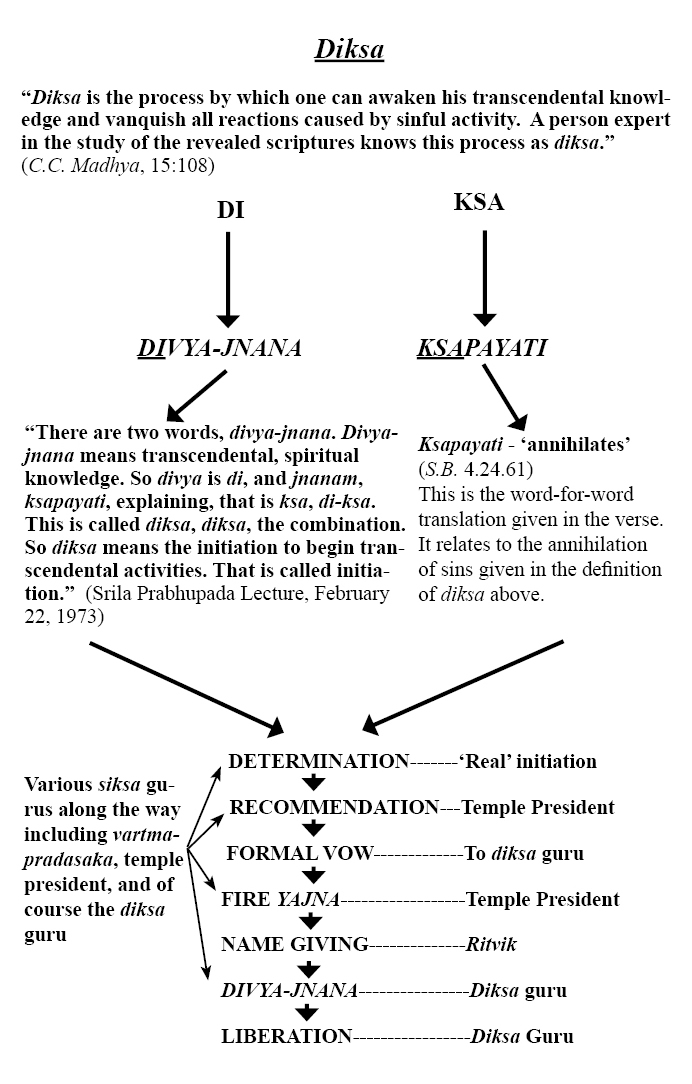
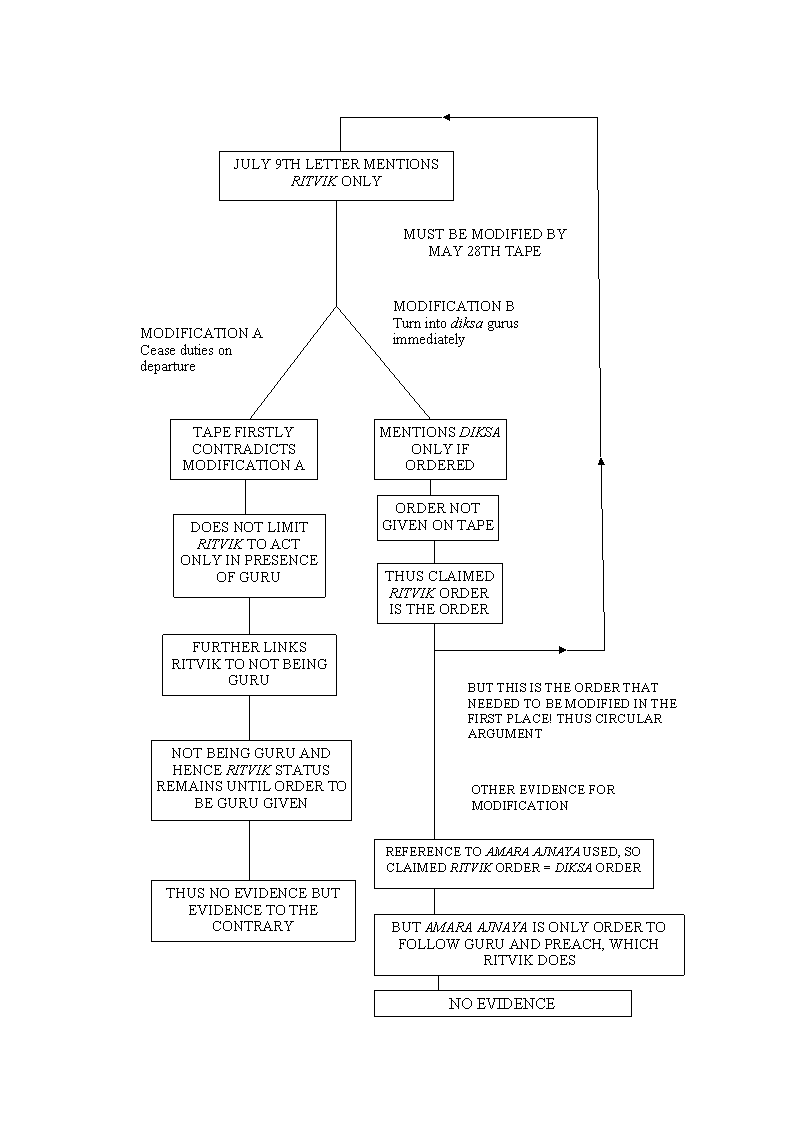
Does the Guru have to be Physically Present?
"Physical presence is immaterial; presence of the transcendental sound received from the spiritual master should be the guidance of life. That will make our spiritual life successful. If you feel very strongly about my absence you may place my pictures on my sitting places and this will be source of inspiration for you."
(Srila Prabhupada Letter to Brahmananda and other students, 19/1/1967)
"But always remember that I am always with you. As you are always thinking of me I am always thinking of you also. Although physically we are not together, we are not separated spiritually. So we should be concerned only with this spiritual connection."
(Srila Prabhupada Letter to Gaurasundara, 13/11/1969)
"So we should associate by the vibration, and not by the physical presence. That is real association."
(Srila Prabhupada Lecture, SB, 18/08/1968)
"There are two conceptions of presence — the physical conception and the vibrational conception. The physical conception is temporary, whereas the vibrational conception is eternal. [...] When we feel separation from Krishna or the spiritual master, we should just try to remember their words of instructions, and we will no longer feel that separation. Such association with Krishna and the spiritual master should be association by vibration, not physical presence. That is real association."
(Elevation to Krsna Consciousness, Chapter 4)
"Although according to material vision His Divine Grace Srila Bhaktisiddhanta Sarsavati Thakura Prabhupada passed away from this material world on the last day of December, 1936, I still consider His Divine Grace to be always present with me by his vani, his words. There are two ways of association—by vani and by vapu. Vani means words and vapu means physical presence. Physical presence is sometimes appreciable and sometimes not, but vani continues to exist eternally. Therefore we must take advantage of the vani, not the physical presence."
(Cc. Antya-lila, concluding words)
"Therefore we should take advantage of the vani, not the physical presence".
(Srila Prabhupada Letter to Suci Devi Dasi, 4/11/1975)
"I shall remain your personal guidance, physically present or not physically, as I am getting personal guidance from my Guru Maharaja."
(Srila Prabhupada Room Conversation, Vrindavan, 14/7/1977)
"It is sometimes misunderstood that if one has to associate with persons engaged in devotional service, he will not be able to solve the economic problem. To answer this argument, it is described here that one has to associate with liberated persons not directly, physically, but by understanding, through philosophy and logic, the problems of life."
(SB, 3.31.48, purport)
"I'm always with you never mind if I am physically absent."
(Srila Prabhupada Letter to Jayananda, 16/9/1967)
Paramananda: "We're always feeling your presence very strongly, Srila Prabhupada [...] simply by your teachings and your instructions. We're always meditating on your instructions."
Srila Prabhupada: "Thank you. That is the real presence. Physical presence is not important."
(Room Conversation, 6/10/1977, Vrndavana)
"You write that you have desire to avail of my association again, but why do you forget that you are always in association with me? When you are helping my missionary activities I am always thinking of you and you are always thinking of me. That is real association. Just like I always think of my Guru Maharaj every moment, although He is not physically present, and because I am trying to serve Him to my best capacity, I am sure He is helping me by His spiritual blessings. So there are two kinds of association: physical and preceptorial. Physical association is not so important as preceptorial association."
(Srila Prabhupada Letter to Govinda Dasi, 17/8/1969)
"As far as my blessing is concerned it does not require my physical presence. If you are chanting Hare Krishna there and following my instructions, reading the books, taking only Krsna prasadam etc. then there is no question of your not receiving the blessings of Lord Caitanya whose mission I am humbly trying to push on."
(Srila Prabhupada Letter to Bal Krsna, 30/6/1974)
""Anyone who has developed unflinching faith in the Lord and the Spiritual Master can understand the revealed scripture unfold before him. So continue your present apptitude [sic] and you will be successful in your spiritual progress. I am sure that even if I am not physically present before you. Still you will be able to execute all spiritual duties in the matter of Krishna Consciousness; if you follow the above principles."
(Srila Prabhupada Letter to Subala, 29/9/1967)
"So although a physical body is not present, the vibration should be accepted as the presence of the spiritual master, vibration. What we have heard from the spiritual master, that is living."
(Srila Prabhupada Lecture, 13/1/1969, Los Angeles)
Revati-nandana: "... so sometimes the spiritual master is far, far away. He may be in Los Angeles. Somebody is coming to Hamburg Temple. He thinks 'How will the spiritual master be pleased?'"
Srila Prabhupada: "Just follow his order. Spiritual master is along with you by his words. Just like my spiritual master is not physically present, but I am associating with him by his words."
(Srila Prabhupada Lecture, 18/8/1971)
"Just like I am working, so my Guru Maharaja is there, Bhaktisiddhanta Sarasvati. Physically he may not be, but in every action he is there."
(Srila Prabhupada Room Conversation, 27/5/1977, Vrndavana)
"So that is called prakata, physically present. And there is another phase, which is called aprakata, not physically present. But that does not mean, Krsna is dead or God is dead. That does not mean, prakata or aprakata, physically present or not present, it doesn't matter."
(Srila Prabhupada Lecture, 11/12/1973, Los Angeles)
"So, spiritually there is no question of separation, even physically we may be in far distant place."
(Srila Prabhupada Letter to Syama Dasi, 30/08/1968)
"I went to your country for spreading this information of Krishna Consciousness & you are helping me in my mission although I am not physically present there but spiritually I am always with you."
(Srila Prabhupada Letter to Nandarani, Krsna Devi, Subala & Uddava, 3/10/67)
"We are not separated actually. There are two—vani or vapu. So vapu is physical presence and vani is presence by the vibration, but they are all the same."
(Srila Prabhupada Letter to Hamsadutta, 22/6/1970)
"So in the absence of physical presentation of the Spiritual Master the vaniseva is more important. My Spiritual Master, Sarasvati Gosvami Thakur, may appear to be physically not present, but still because I try to serve His instruction I never feel separated from Him."
(Srila Prabhupada Letter to Karandhara, 22/8/1970)
"I also do not feel separation from my Guru Maharaj. When I am engaged in His service His pictures give me sufficient strength. To serve the Spiritual Master's word is more important than to serve him physically."
(Srila Prabhupada Letter to Syamasundara, 19/7/1970)
Follow the Instruction, not the Body.
"So far personal association with the Guru is concerned, I was only with my Guru Maharaj four or five times, but I have never left his association, not even for a moment. Because I am following his instructions, I have never felt any separation. There are some of my Godbrothers here in India who had constant personal association with Guru Maharaj, but who are neglecting his orders. This is just like the bug who is sitting on the lap of the king. He may be very puffed-up by his position, but all he can succeed in doing is biting the king. Personal association is not so important as association through service."
(Srila Prabhupada Letter to Satadhanya, 20/2/1972)
"So spiritually, appearance and disappearance, there is no difference ... spiritually, there is no such difference, appearance or disappearance. So although this is the disappearance day of Om Visnupada Sri Srimad Bhaktisiddhanta Sarasvati Thakura, so there is nothing to be lamented. Although we feel separation..."
(Srila Prabhupada Lecture, Los Angeles, 13/12/1973)
"So my Guru Maharaja will be very, very much pleased upon you [...] It is not that he is dead and gone. That is not spiritual understanding [...] He is seeing. I never feel that I am alone."
(Srila Prabhupada Lecture, 2/3/1975, Atlanta)
"Vani is more important than bopu."
(Srila Prabhupada Letter to Tusta Krishna Das, 14/12/1972)
"Yes, I am so glad that your center is doing so well and all the devotees are now appreciating the presence of their Spiritual Master by following His instructions although He is no longer physically present—this is the right spirit."
(Srila Prabhupada Letter to Karandhara, 13/9/1970)
"The spiritual master by his words can penetrate into the heart of the suffering person and inject knowledge transcendental, which alone can extinguish the fire of material existence."
(SB, 1.7.22, purport)
"There are two words, vani and vapuh. Vani means words, and vapuh means this physical body. [...] Vapuh will be finished. This is material body. It will be finished. That is the nature. But if we keep to the vani, to the words of spiritual master, then we remain very fixed up. [...] if you always keep intact, in link with the words and instruction of the superior authorities, then you are always fresh. This is spiritual understanding."
(Srila Prabhupada Lecture, 2/3/1975, Atlanta)
"So we should give more stress on the sound vibration, either of Krsna or of the Spiritual Master."
(Srila Prabhupada Lecture, 18/8/1968, Montreal)
"Never think that I am absent from you. Physical presence is not essential; presence by message (or hearing) is real touch."
(Srila Prabhupada Letter to students, 2/8/1967)
"Reception of spiritual knowledge is never checked by any material condition."
(SB, 7.7.1, purport)
"The potency of transcendental sound is never minimized because the vibrator is apparently absent."
(SB, 2.9.8, purport)
"The disciple and spiritual master are never separated because the spiritual master always keeps company with the disciple as long as the disciple follows strictly the instructions of the spiritual master. This is called the association of vani (words). Physical presence is called vapuh. As long as the spiritual master is physically present, the disciple should serve the physical body of the spiritual master, and when the spiritual master is no longer physically existing, the disciple should serve the instructions of the spiritual master."
(SB, 4:28:47, purport)
"If there is no chance to serve the spiritual master directly, a devotee should serve him by remembering his instructions. There is no difference between the spiritual master's instructions and the spiritual master himself. In his absence , therefore, his words of direction should be the pride of the disciple."
(Cc. Adi-lila 1.35, purport)
"He lives forever by his divine instructions and the follower lives with him."
(SB, Preface)
"He reasons ill who tells that Vaisnavas die, when thou art living still in sound."
(Bhaktivinoda Thakura)
"Yes, the ecstasy of separation of Spiritual Master is even greater ecstasy than meeting with Him."
(Srila Prabhupada Letter to Jadurani, 13/1/1968)
"Krishna and His representative is the same. Just like Krishna can be present simultaneously in millions of places. Similarly, the Spiritual Master also can be present wherever the disciple wants. A Spiritual Master is the principle, not the body. Just like a television can be seen in thousands of places by the principle of relay monitoring."
(Srila Prabhupada Letter to Malati, 28/5/1968)
"It is better service to Krishna and Spiritual Master in a feeling of separation; sometimes there is risk in the matter of direct service."
(Srila Prabhupada Letter to Madhusudana, 30/12/1967)
Devotee: "Srila Prabhupada, when you are not present with us, how is it possible to receive instructions, for example, on questions that may arise?"
Srila Prabhupada: "Well, the questions... Answers are there in my books."
(Morning Walk, 13/5/1973, Los Angeles)
"So utilize whatever time you find to make a thorough study of my books. Then
all your questions will be answered."
(Srila Prabhupada Letter to Upendra, 7/1/1976)
"If it is possible to go to the temple, then take advantage of the temple. A temple is a place where by one is given the opportunity to render direct devotional service to the Supreme Lord Sri Krishna. In conjunction with this you should always read my books daily and all your questions will be answered and you will have a firm basis of Krishna Consciousness. In this way your life will be perfect."
(Srila Prabhupada Letter to Hugo Salemon, 22/11/1974)
"Every one of you must regularly read our books at least twice—in the morning and evening, and automatically all questions will be answered."
(Srila Prabhupada Letter to Randhir, 24/01/1970)
"In my books the philosophy of Krishna Consciousness is explained fully so if there is anything which you do not understand, then you simply have to read again and again. By reading daily the knowledge will be revealed to you and by this process your spiritual life will develop."
(Srila Prabhupada Letter to Bahurupa Dasa, 22/11/1974)
Srila Prabhupada: "'Even a moment's association with a pure devotee— all success!'" [...]
Revatinandana: "Does that also apply to reading the words of a pure devotee?"
Srila Prabhupada: "Yes."
Revatinandana: "Even a little association with your books has the same effect?"
Srila Prabhupada: "Effect, of course, it requires both the things. One must be very eager to take it."
(Room Conversation, 13/12/1970)
Paramahamsa: "My question is: A pure devotee, when he comments Bhagavad-Gita, someone who never sees him physically, but he just comes in contact with his commentary, explanation, is this the same thing?"
Srila Prabhupada: "Yes. You can associate with Krsna by reading Bhagavad-Gita. And these saintly persons, they have given their explanations, comments. So where is the difficulty?"
(Morning Walk, 11/6/1974, Paris)
"So there is nothing to be said new. Whatever I have to speak, I have spoken in my books. Now you try to understand it and continue your endeavor. Whether I am present or not present doesn't matter."
(Srila Prabhupada Arrival Conversation, 17/5/1977, Vrndavana)
Srila Prabhupada is our Eternal Guru
Reporter: "What will happen to the movement in the United States when you die?"
Srila Prabhupada: "I will never die."
Devotees: "Jaya! Haribol! (Laughter)."
Srila Prabhupada: "I shall live for my books, and you will utilise."
(Srila Prabhupada Press Conference, 16/7/1975, San Francisco, emphasis added)
Indian Lady: "... is that spiritual master still guiding after the death?"
Srila Prabhupada: "Yes, yes. Just like Krsna is guiding us, similarly, spiritual master will guide.
(Srila Prabhupada Lecture, 3/9/1971, London)
"The eternal bond between disciple and spiritual master begins from the first day he hears."
(Srila Prabhupada Letter to Jadurani, 4/9/1972)
"The influence of a pure devotee is such that if someone comes to associate with him with a little faith, he gets the chance of hearing about the Lord from authoritative scriptures like the Bhagavad-gita and Srimad-Bhagavatam. [...] This is the first stage of association with pure devotees."
(The Nectar of Devotion, Chapter 19, [Pre-1977 Ed.])
"These are not ordinary books. It is recorded chanting. Anyone who reads, he is hearing."
(Letter to Rupanuga Das, 19/10/1974)
"Regarding parampara system: there is nothing to wonder for big gaps. [...] We have to pick up the prominent acharyas, and follow from him."
(Letter to Dayananda, 12/4/1968)
Narayana: "So those disciples who don't have opportunity to see you or speak with you..."
Srila Prabhupada: "That he was speaking, vani and vapuh. Even if you don't see his body, you take his word, vani."
Narayana: "But how do they know they're pleasing you, Srila Prabhupada?"
Srila Prabhupada: "If you actually follow the words of guru, that means he is pleased. And if you do not follow, how he can be pleased?"
Sudama: "Not only that, but your mercy is spread everywhere, and if we take advantage, you told us once, then we will feel the result."
Srila Prabhupada: "Yes."
Jayadvaita: "And if we have faith in what the guru says, then automatically we'll do that."
Srila Prabhupada: "Yes. My Guru Maharaja passed in 1936, and I started this movement in 1965, thirty years after. Then? I am getting the mercy of guru. This is vani. Even the guru is not physically present, if you follow the vani, then you are getting help."
Sudama: "So there's no question of ever separation as long as the disciple follows the instruction of guru."
Srila Prabhupada: "No. Cakhu-dano-dilo-jei. What is that, next one?"
Sudama: "Cakhu-dan-dilo-jei, janme janme prabhu sei."
Srila Prabhupada: "Janme janme prabhu sei. So where there is separation? Who has opened your eyes, he is birth after birth your prabhu."
(Morning walk, 21/7/1975, San Francisco)
Madhudvisa: "Is there any way for a Christian to, without the help of a spiritual master, to reach the spiritual sky through believing in the words of Jesus Christ and trying to follow his teachings?"
Srila Prabhupada: "I don't follow."
Tamal Krsna: "Can a Christian in this age, without a spiritual master, but by reading the Bible and following Jesus's words, reach the..."
Srila Prabhupada: "When you read Bible, you follow spiritual master. How can you say without? As soon as you read Bible, that means you are following the instruction of Lord Jesus Christ, that means you are following spiritual master. So where is the opportunity of being without spiritual master?"
Madhudvisa: "I was referring to a living spiritual master."
Srila Prabhupada: "Spiritual master is not the question of... Spiritual master is eternal. Spiritual master is eternal. So your question is without spiritual master. Without spiritual master you cannot be, at any stage of your life. You may accept this spiritual master or that spiritual master. That is a different thing. But you have to accept. As you say that "by reading Bible," when you read Bible that means you are following the spiritual master represented by some priest or some clergyman in the line of Lord Jesus Christ."
(Srila Prabhupada Lecture, 2/10/1968, Seattle, emphases added)
"You have asked if it is true that the Spiritual Master remains in the material universe until all of His disciples are transferred to the Spiritual Sky. The answer is yes, this is the rule."
(Srila Prabhupada Letter to Jayapataka, 11/7/1969)
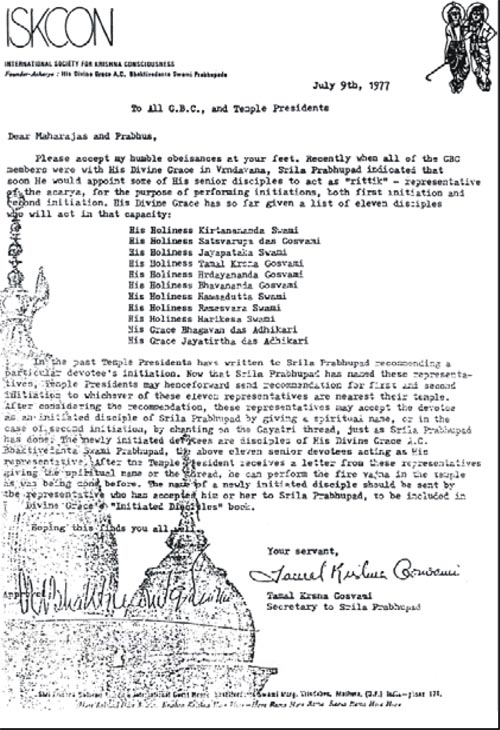
ISKCON
INTERNATIONAL SOCIETY FOR KRISHNA CONSCIOUSNESS
Founder-Acharya: His Divine Grace A.C. Bhaktivedanta Swami Prabhupada
July 9th, 1977
To All G.B.C., and Temple Presidents
Dear Maharajas and Prabhus,
Please accept my humble obeisances at your feet. Recently when all of the GBC members were with His Divine Grace in Vrndavana, Srila Prabhupad indicated that soon He would appoint some of His senior disciples to act as "rittik"—representative of the acarya, for the purpose of performing initiations, both first initiation and second initiation. His Divine Grace has so far given a list of eleven disciples who will act in that capacity:
His Holiness Kirtanananda Swami
His Holiness Satsvarupa das Gosvami
His Holiness Jayapataka Swami
His Holiness Tamal Krsna Gosvami
His Holiness Hrdayananda Gosvami
His Holiness Bhavananda Gosvami
His Holiness Hamsadutta Swami
His Holiness Ramesvara Swami
His Holiness Harikesa Swami
His Grace Bhagavan das Adhikari
His Grace Jayatirtha das Adhikari
In the past Temple Presidents have written to Srila Prabhupad recommending a particular devotee's initiation. Now that Srila Prabhupad has named these representatives, Temple Presidents may henceforward send recommendation for first and second initiation to whichever of these eleven representatives are nearest their temple. After considering the recommendation, these representatives may accept the devotee as an initiated disciple of Srila Prabhupad by giving a spiritual name, or in the case of second initiation, by chanting on the Gayatri thread, just as Srila Prabhupad has done. The newly initiated devotees are disciples of His Divine Grace A.C. Bhaktivedanta Swami Prabhupad, the above eleven senior devotees acting as His representative. After the Temple President receives a letter from these representatives giving the spiritual name or the thread, he can perform the fire yajna in the temple as was being done before. The name of a newly initiated disciple should be sent by the representative who has accepted him or her to Srila Prabhupad, to be included in His Divine Grace's "Initiated Disciples" book.
Hoping this finds you all well.
Approved
|
Your servant, Tamal Krsna Gosvami
[Srila Prabhupada's signature from original] |

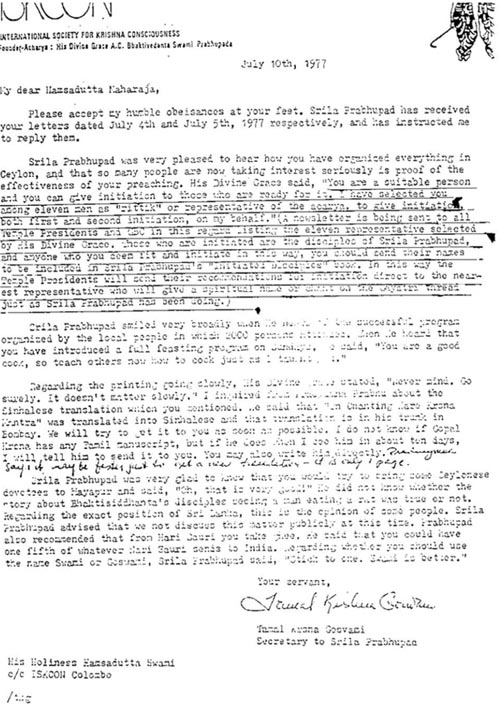
ISKCON
INTERNATIONAL SOCIETY FOR KRISHNA CONSCIOUSNESS
Founder-Acharya: His Divine Grace A.C. Bhaktivedanta Swami Prabhupada
July 10th, 1977
My dear Hamsadutta Maharaja,
Please accept my humble obeisances at your feet. Srila Prabhupad has received your letters dated July 4th and July 5th, 1977 respectively, and has instructed me to reply them.
Srila Prabhupad was very pleased to hear how you have organized everything in Ceylon, and that so many people are now taking interest seriously is proof of the effectiveness of your preaching. His Divine Grace said, "You are a suitable person and you can give initiation to those who are ready for it. I have selected you among eleven men as "rittik" or representative of the acarya, to give initiations, both first and second initiation, on my behalf." (A newsletter is being sent to all Temple Presidents and GBC in this regard listing the eleven representative selected by His Divine Grace. Those who are initiated are the disciples of Srila Prabhupad, and anyone who you deem fit and initiate in this way, you should send their names to be included in Srila Prabhupad's "Initiated Disciples" book. In this way the Temple Presidents will send their recommendations for initiation direct to the nearest representative who will give a spiritual name or chant on the Gayatri thread just as Srila Prabhupad has been doing.)
Srila Prabhupad smiled very broadly when he heard of the successful program organized by the local people in which 2000 persons attended. When he heard that you have introduced a full feasting program on Sundays, he said, "You are a good cook, so teach others now how to cook just as I taught you."
Regarding the printing going slowly, His Divine Grace stated, "Never mind. Go surely. It doesn't matter slowly." I inquired from Pradyumna Prabhu about the Sinhalese translation which you mentioned. He said that "On Chanting Hare Krsna Mantra" was translated into Sinhalese and that translation is in his trunk in Bombay. We will try to get it to you as soon as possible. I do not know if Gopal Krsna has any Tamil manuscript, but if he does when I see him in about ten days, I will tell him to send it to you. You may also write him directly. Pradyumna says it may be faster just to get a new translation – it is only 1 page.
Srila Prabhupad was very glad to know that you would try to bring some Ceylonese devotees to Mayapur and said, "Oh, that is very good!" He did not know whether the story about Bhaktisiddhanta's disciples seeing a man eating a rat was true or not. Regarding the exact position of Sri Lanka, this is the opinion of some people. Srila Prabhupad advised that we not discuss this matter publicly at this time. Prabhupad also recommended that from Hari Sauri you take ghee. He said that you could have one fifth of whatever Hari Sauri sends to India. Regarding whether you should use the name Swami or Goswami, Srila Prabhupad said, "Stick to one. Swami is better."
His Holiness Hamsadutta Swami |
Your servant, (signature appears on the original document) |
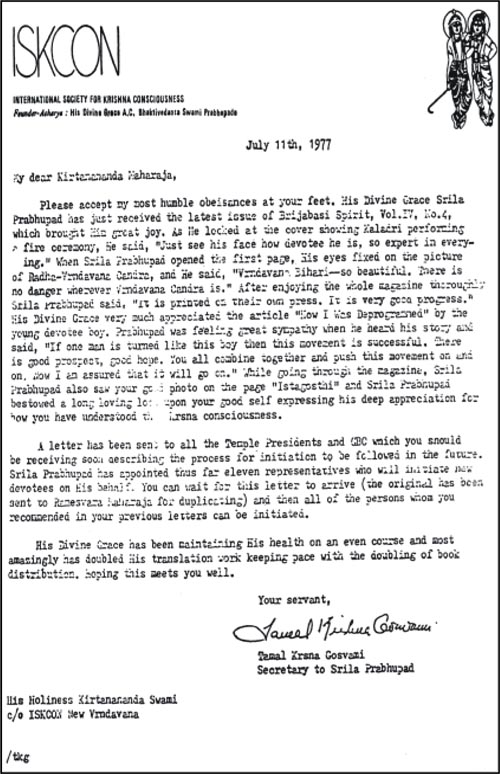
ISKCON
INTERNATIONAL SOCIETY FOR KRISHNA CONSCIOUSNESS
Founder-Acharya: His Divine Grace A.C. Bhaktivedanta Swami Prabhupada
July 11th, 1977
My dear Kirtanananda Maharaja,
Please accept my most humble obeisances at your feet. His Divine Grace Srila Prabhupad has just received the latest issue of Brijabasi Spirit, Vol.IV, No.4, which brought Him great joy. As He looked at the cover showing Kaladri performing a fire ceremony, He said, "Just see his face how devotee he is, so expert in everything". When Srila Prabhupad opened the first page, His eyes fixed on the picture of Radha-Vrndavana Candra, and He said, "Vrndavana Bihari — so beautiful. There is no danger wherever Vrndavana Candra is." After enjoying the whole magazine throughly Srila Prabhupad said, "It is printed on their own press. It is very good progress." His Divine Grace very much appreciated the article "How I Was Deprogrammed" by the young devotee boy. Prabhupad was feeling great sympathy when he heard his story and said, "If one man is turned like this boy then this movement is successful. There is good prospect, good hope. You all combine together and push this movement on and on. Now I am assured that it will go on." While going through the magazine, Srila Prabhupad also saw your good photo on the page "Istagosthi" and Srila Prabhupad bestowed a long loving look upon your good self expressing his deep appreciation for how you have understood this Krsna Consciousness.
A letter has been sent to all the Temple Presidents and GBC which you should be receiving soon describing the process for initiation to be followed in the future. Srila Prabhupad has appointed thus far eleven representatives who will initiate new devotees on His behalf. You can wait for this letter to arrive (the original has been sent to Ramesvara Maharaja for duplicating) and then all of the persons whom you recommended in your previous letters can be initiated.
His Divine Grace has been maintaining His health on an even course and most amazingly has doubled His translation work keeping pace with the doubling of book distribution. Hoping this meets you well.
His Holiness Kirtanananda Swami |
Your servant, (signature appears on the original document) |
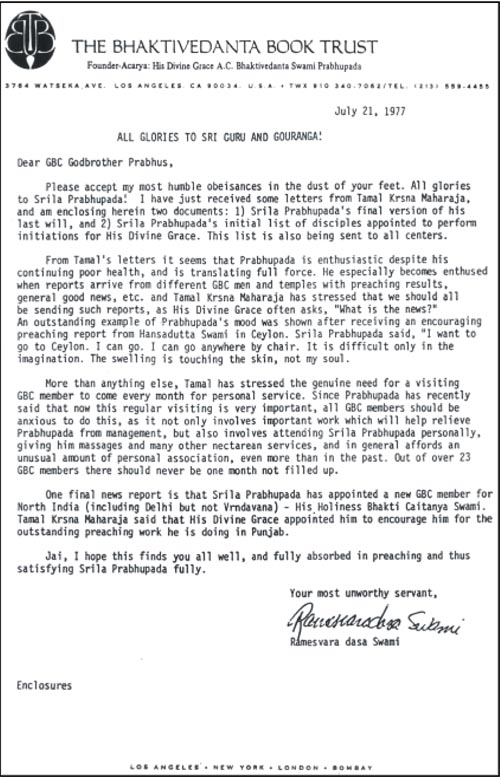
BBT
THE BHAKTIVEDANTA BOOK TRUST
Founder-Acarya: His Divine Grace A.C.Bhaktivedanta Swami Prabhupada
July 21, 1977
ALL GLORIES TO SRI GURU AND GOURANGA!
Dear GBC Godbrother Prabhus,
Please accept my most humble obeisances in the dust of your feet. All glories to Sril Prabhupada! I have just received some letters from Tamal Krsna Maharaja, and am enclosing herein two documents: 1) Srila Prabhupada's final version of his last will, and 2) Srila Prabhupada's initial list of disciples appointed to perform initiations for His Divine Grace. This list is also being sent to all centers.
From Tamal's letters it seems that Prabhupada is enthusiastic despite his continuing poor health, and is translating full force. He especially becomes enthused when reports arrive from different GBC men and temples with preaching results, general good news, etc. and Tamal Krsna Maharaja has stressed that we should all be sending such reports, as His Divine Grace often asks, "What is the news?" An outstanding example of Prabhupada's mood was shown after receiving an encouraging preaching report from Hansadutta Swami in Ceylon. Srila Prabhupada said, "I want to go to Ceylon. I can go. I can go anywhere by chair. It is difficult only in the imagination. The swelling is touching the skin, not my soul.
More than anything else, Tamal has stressed the genuine need for a visiting GBC member to come every month for personal service. Since Prabhupada has recently said that now this regular visiting is very important, all GBC members should be anxious to do this, as it not only involves important work which will help relieve Prabhupada from management, but also involves attending Srila Prabhupada personally, giving him massages and many other nectarean services, and in general affords an unusual amount of personal association, even more than in the past. Out of over 23 GBC members there should never be one month not filled up.
One final news report is that Srila Prabhupada has appointed a new GBC member for North India (including Delhi but not Vrndavana) - His Holiness Bhakti Caitanya Swami. Tamal Krsna Maharaja said that His Divine Grace appointed him to encourage him for the outstanding preaching work he is doing in Punjab.
Jai, I hope this finds you all well, and fully absorbed in preaching and thus satisfying Srila Prabhupada fully.
Enclosures |
Your most unworthy servant, |
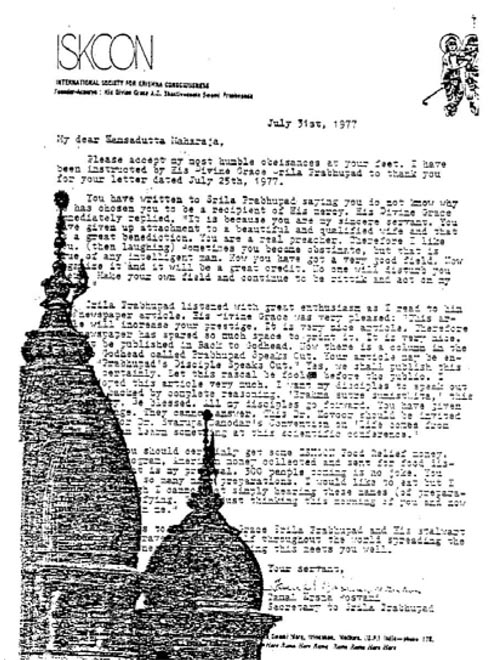
[Letter from Tamal Krsna Goswami to Hansadutta, on Srila Prabhupada's behalf .]
ISKCON
INTERNATIONAL SOCIETY FOR KRISHNA CONSCIOUSNESS
Founder-Acharya: His Divine Grace A.C. Bhaktivedanta Swami Prabhupada
July 31st, 1977
My Dear Hamsadutta Maharaja,
Please accept my most humble obeisances at your feet. I have been instructed by His Divine Grace Srila Prabhupad to thank you for your letter dated July 25th, 1977.
You have written to Srila Prabhupad saying you do not know why he has chosen you to be a recipient of His mercy. His Divine Grace immediately replied, "It is because you are my sincere servant. You have given up attachment to a beautiful and qualified wife and that is a great benediction. You are a real preacher. Therefore I like you. (then laughing) Sometimes you become obstinate, but that is true of any intelligent man. Now you have got a very good field. Now organize it and it will be a great credit. No one will disturb you there. Make your own field and continue to be rittik and act on my behalf."
Srila Prabhupad listened with great enthusiasm as I read to him the newspaper article. His Divine Grace was very pleased: 'This article will increase your prestige. It is very nice article. Therefore the newspaper has spared so much space to print it. It is very nice. It must be published in Back to Godhead. Now there is a column in the Back to Godhead called Prabhupad Speaks Out. Your article may be entitled "Prabhupad's Disciple Speaks Out". Yes, we shall publish this article certainly. Let this rascal be fool before the public. I have enjoyed this article very much. I want my disciples to speak out...backed by complete reasoning. 'Brahma sutra sunisthita', this is preaching. Be blessed. All my disciples go forward. You have given the challenge. They cannot answer. This Dr. Kovoor should be invited ... For Dr. Svarupa Damodar's Convention on 'Life comes from Life'. He can learn something at this scientific conference."
Yes, you should certainly get some ISKCON Food Relief money. For your program, American money collected and sent for food distribution. That is my proposal. 300 people coming is no joke. You mentioned so many nice preparations. I would like to eat but I ... I cannot. At simply hearing these names (of preparations) it is satisfying. Just thinking this morning of you and now you have written me.
(last paragraph illegible)
|
Your Servant, |
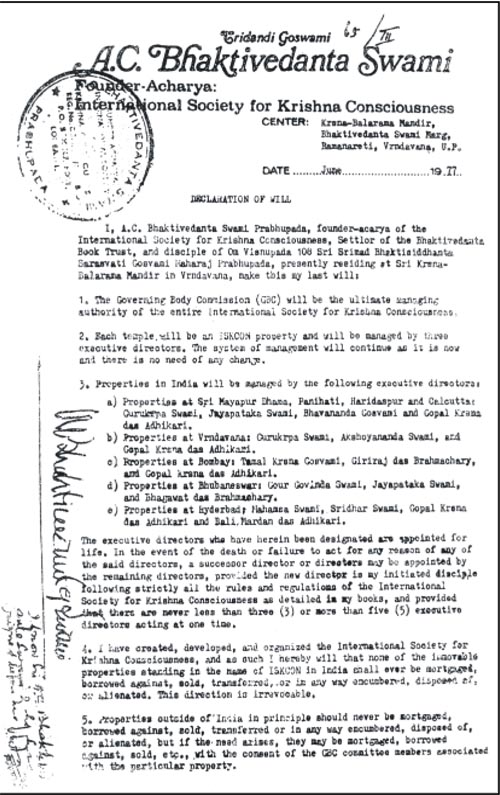
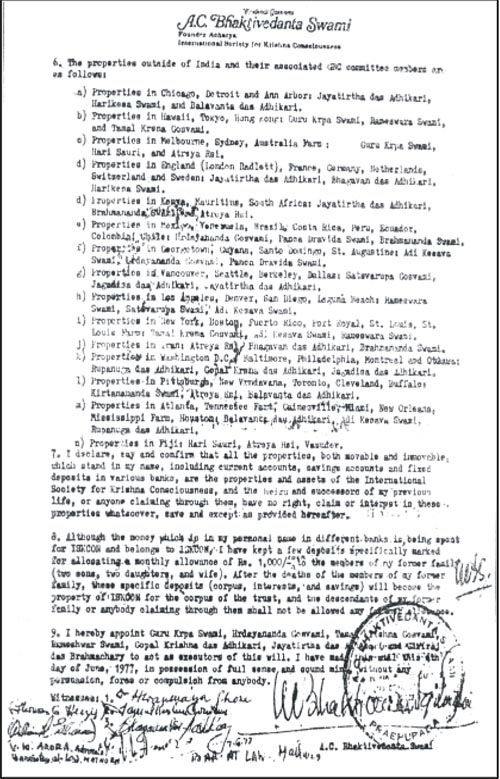
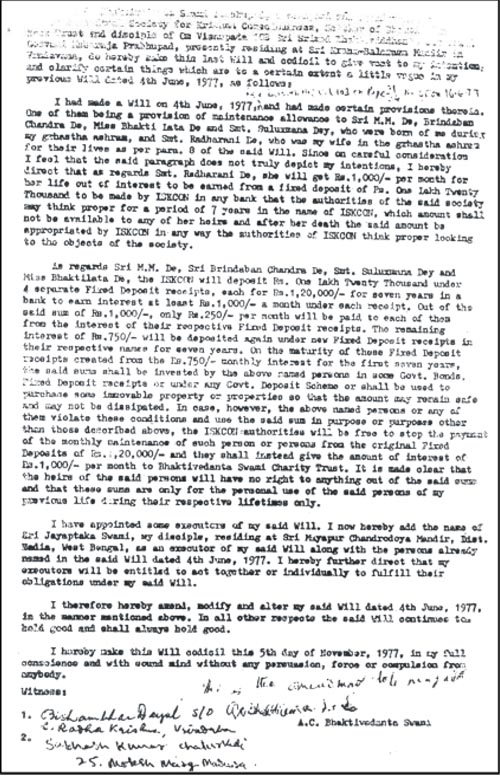
Tridandi Goswami
A.C. Bhaktivedanta Swami
Founder-Acharya:
International Society for Krishna Consciousness
CENTER: Krsna-Balarama Mandir,
Bhaktivedanta Swami Marg,
Ramanareti, Vrndavana, U.P.
DATE: June, 1977
DECLARATION OF WILL
I, A.C. Bhaktivedanta Swami Prabhupada, founder-acarya of the International Society for Krishna Consciousness, Settlor of the Bhaktivedanta Book Trust, and disciple of Om Visnupada 108 Sri Srimad Bhaktsiddhanta Sarasvati Gosvami Maharaj Prabhupada, presently residing at Sri Krsna-Balarama Mandir in Vrndavana, make this my last will:
1. The Governing Body Commission (GBC) will be the ultimate managing authority of the entire International Society for Krishna Consciousness.
2. Each temple will be an ISKCON property and will be managed by three executive directors. The system of management will continue as it is now and there is no need of any change.
3. Properties in India will be managed by the following executive directors:
a) Properties at Sri Mayapur Dhama, Panihati, Haridaspur and Calcutta: Gurukrpa Swami, Jayapataka Swami, Bhavananda Gosvami and Gopal Krsna das Adhikari.
b) Properties at Vrndavana: Gurukrpa Swami, Akshoyananda Swami, and Gopal Krsna das Adhikari.
c) Properties at Bombay: Tamal Krsna Gosvami, Giriraj das Brahmachary, and Gopal Krsna das Adhikari.
d) Properties at Bhubaneswar: Gour Govinda Swami, Jayapataka Swami, and Bhagawat das Brahmachary.
e) Properties at Hyderbad: Mahamsa Swami, Sridhar Swami, Gopal Krsna das Adhikari and Bali Mardan das Adhikari.
The executive directors who have herein been designated are appointed for life. In the event of the death or failure to act for any reason of any of the said directors, a successor director or directors may be appointed by the remaining directors, provided the new director is my initiated disciple following strictly all the rules and regulations of the International Society for Krishna Consciousness as detailed in my books, and provided that there are never less than three (3) or more than five (5) executive directors acting at one time.
4. I have created, developed and organized the International Society for Krishna Consciousness, and as such I hereby will that none of the immovable properties standing in the name of ISKCON in India shall ever be mortgaged, borrowed against, sold, transferred, or in any way encumbered, disposed of, or alienated. This direction is irrevocable.
5. Properties outside of India in principle should never be mortgaged, borrowed against, sold, transferred or in any way encumbered, disposed of, or alienated, but if the need arises, they may be mortgaged, borrowed against, sold, etc., with the consent of the GBC committee members associated with the particular property.
6. The properties outside of India and their associated GBC committee members are as follows:
a) Properties in Chicago, Detroit and Ann Arbor: Jayatirtha das Adhikari, Harikesa Swami, and Balavanta das Adhikari..
b) Properties in Hawaii, Tokyo, Hong Kong: Guru Krpa Swami, Rameswara Swami, and Tamal Krsna Gosvami.
c) Properties in Melbourne, Sydney, Australia Farm: Guru Krpa Swami, Hari Sauri, and Atreya Rsi.
d) Properties in England (London Radlett), France, Germany, Netherlands, Switzerland and Sweden: Jayatirtha das Adhikari, Bhagavan das Adhikari, Harikesa Swami.
d) Properties in Kenya, Mauritius, South Africa: Jayatirtha das Adhikari, Brahmananda Swami, and Atreya Rsi.
e) Properties in Mexico, Venezuela, Brazil, Costa Rica, Peru, Ecuador, Colombia, Chile: Hrdayananda Gosvami, Panca Dravida Swami, Brahmananda Swami.
f) Properties in Georgetown, Guyana, Santo Domingo, St. Augustine: Adi Kesava Swami, Hrdayananda Gosvami, Panca Dravida Swami.
g) Properties in Vancouver, Seattle, Berkeley, Dallas: Satsvarupa Gosvami, Jagadisa das Adhikari, Jayatirtha das Adhikari.
h) Properties in Los Angeles, Denver, San Diego, Laguna Beach: Rameswara Swami, Satsvarupa Swami, Adi Kesava Swami.
i) Properties in New York, Boston, Puerto Rico, Port Royal, St. Louis, St Louis Farm: Tamal Krsna Gosvami, Adi Kesava Swami, Rameswara Swami.
j) Properties in Iran: Atreya Rsi, Bhagavan das Adhikari, Brahmananda Swami.
k) Properties in Washington D.C., Baltimore, Philadelphia, Montreal and Ottawa: Rupanuga das Adhikari, Gopal Krsna das Adhikari, Jagadisa das Adhikari.
l) Properties in Pittsburgh, New Vrndavana, Toronto, Cleveland, Buffalo: Kirtanananda Swami, Atreya Rsi, Balavanta das Adhikari.
m) Properties in Atlanta, Tennessee Farm, Gainesville, Miami, New Orleans, Mississippi Farm, Houston: Balavanta das Adhikari, Adi Kesava Swami, Rupanuga das Adhikari.
n) Properties in Fiji: Hari Sauri, Atreya Rsi, Vasudev.
7. I declare, say and confirm that all the properties, both movable and immovable, which stand in my name, including current accounts, savings accounts and fixed deposits in various banks, are the properties and assets of the International Society for Krishna Consciousness, and the heirs and successors of my previous life, or anyone claiming through them, have no right, claim or interest in these properties whatsoever, save and except as provided hereafter.
8. Although the money which is in my personal name in different banks is being spent for ISKCON and belongs to ISKCON, I have kept a few deposits specifically marked for allocating a monthly allowance of Rs. 1,000/- [unreadable addition] to the members of my former family (two sons, two daughters, and wife). After the deaths of the members of my former family, these specific deposits (corpus, interest, and savings) will become the property of ISKCON for the corpus of the trust, and the descendants of my former family or anybody claiming through them shall not be allowed any further allowance.
9. I hereby appoint Guru Krpa Swami, Hrdayananda Gosvami, Tamal Krishna Gosvami, Rameshwar Swami, Gopal Krishna das Adhikari, Jayatirtha das Adhikari and Giriraj das Brahmachary to act as executors of this will. I have made this will this 4th day of June, 1977, in possession of full sense and sound mind, without any persuasion, force or compulsion from anybody.
Witnesses:
A.C. Bhaktivedanta Swami
The above will was signed by Srila Prabhupada and sealed and witnessed by the following: Tamal Krsna Goswami, Bhagavan das Adhikari and several other witnesses (signatures appear on the original document).
I, A.C. Bhaktivedanta Swami Prabhupad, a sannyasi and Founder-Acharya of the International Society for Krishna Consciousness, Settlor of Bhaktivedanta Book Trust and disciple of Om Visnupada 108 Sri Srimad Bhaktisiddhanta Saraswati Gosvami Maharaja Prabhupad, presently residing at Sri Krsna-Balarama Mandir in Vrndavana, do hereby make this last Will and codicil to give vent to my intention, and clarify certain things which are to a certain extent a little vague in my previous Will dated 4th June, 1977, as follows:
I had made a Will on 4th June, 1977, and had made certain provisions therein. One of them being a provision of maintenance allowance to Sri M.M. De, Brindaban Chandra De, Miss Bhakti Lata De and Smt. Sulurmana Dey, who were born of me during my grhastha ashram, and Smt. Radharani De, who was my wife in the grhastha ashram for their lives as per para. 8 of the said Will. Since on careful consideration I feel that the said paragraph does not truly depict my intentions, I hereby direct that as regards Smt. Radharani De, she will get Rs. 1,000/- per month for her life out of interest to be earned from a fixed deposit of Rs. One Lakh Twenty Thousand to be made by ISKCON in any bank that the authorities of the said society may think proper for a period of 7 years in the name of ISKCON, which amount shall not be available to any of her heirs and after her death the said amount be appropriated by ISKCON in any way the authorities of ISKCON think proper looking to the objects of the society.
As regards Sri M.M. De, Sri Brindaban Chandra De, Smt. Sulurmana Dey and Miss Bhaktilata De, the ISKCON will deposit Rs. One Lakh Twenty Thousand under 4 separate Fixed Deposit receipts, each for Rs. 1,20,000/- for seven years in a bank to earn interest at least Rs. 1,000/- a month under each receipt. Out of the said sum of Rs. 1,000/-, only Rs. 250/- per month will be paid to each of them from the interest of their respective Fixed Deposit receipts. The remaining interest of Rs. 750/- will be deposited again under new Fixed Deposit receipts in their respective names for seven years. On the maturity of these Fixed Deposit receipts created from the Rs. 750/- monthly interest for the first seven years, the said sums shall be invested by the above named persons in some Govt. Bonds, Fixed Deposit receipts or under any Govt. Deposit Scheme or shall be used to purchase some immovable property or properties so that the amount may remain safe and may not be dissipated. In case, however, the above named persons or any of them violate these conditions and use the said sum in purpose or purposes other than those described above, the ISKCON authorities will be free to stop the payment of the monthly maintenance of such person or persons from the original Fixed Deposits of Rs. 1,20,000/- and they shall instead give the amount of interest of Rs. 1,000/- per month to Bhaktivedanta Swami Charity Trust. It is made clear that the heirs of the said persons will have no right to anything out of the said sums and that these sums are only for the personal use of the said persons of my previous life during their respective lifetimes only.
I have appointed some executors of my said Will. I now hereby add the name of Sri Jayapataka Swami, my disciple, residing at Sri Mayapur Chandrodoya Mandir, Dist. Nadia, West Bengal, as an executor of my said Will along with the persons already named in the said Will dated 4th June, 1977. I hereby further direct that my executors will be entitled to act together or individually to fulfill their obligations under my said Will.
I therefore hereby amend, modify and alter my said Will dated 4th June, 1977, in the manner mentioned above. In all other respects the said Will continues to hold good and shall always hold good.
I hereby make this Will codicil this 5th day of November, 1977, in my full conscience and with sound mind without any persuasion, force or compulsion from anybody.
Witness:
(signatures appear on the original document)
A.C.Bhaktivedanta Swami
| ROOM CONVERSATION - APRIL 22, 1977, Bombay |
| Srila Prabhupada: | "I told him that "You cannot do so independent. You are doing nice, but not to do in the... You admit." People complained against Hamsaduta. Did you know that?" |
| Tamala Krishna: | "I'm not sure of the particular incidences, but I've heard general..." |
| Srila Prabhupada: | "In Germany. In Germany." |
| Tamala Krishna: | "The devotees there." |
| Srila Prabhupada: | "So many complaints." |
| Tamala Krishna: | "Therefore, change is good." |
| Srila Prabhupada: | "No, you become guru, but you must be qualified first of all. Then you become." |
| Tamala Krishna: | "Oh, that kind of complaint was there." |
| Srila Prabhupada: | "Did you know that?" |
| Tamala Krishna: | "Yeah, I heard that, yeah." |
| Srila Prabhupada: | "What is the use of producing some rascal guru?" |
| Tamala Krishna: | "Well, I have studied myself and all of your disciples, and it's clear fact that we are all conditioned souls, so we cannot be guru. Maybe one day it may be possible..." |
| Srila Prabhupada: | "Hm." |
| Tamala Krishna: | "...but not now." |
| Srila Prabhupada: | "Yes. I shall choose some guru. I shall say, "Now you become acarya. You become authorized." I am waiting for that. You become all acarya. I retire completely. But the training must be complete." |
| Tamala Krishna: | "The process of purification must be there." |
| Srila Prabhupada: | "Oh, yes, must be there. Caitanya Mahaprabhu wants that. Amara ajnaya guru hana [Cc. Madhya 7.128]. "You become guru." (Laughs.) But be qualified. Little thing, strictly follower..." |
| Tamala Krishna: | "Not rubber stamp." |
| Srila Prabhupada: | "Then you'll not be effective. You can cheat, but it will not be effective. Just see our Gaudiya Matha. Everyone wanted to become guru, and a small temple and "guru." What kind of guru? No publication, no preaching, simply bring some foodstuff... My Guru Maharaja used to say, "Joint mess," a place for eating and sleeping. Amar amar ara takana [?]: "Joint mess." He said this." |
| ROOM CONVERSATION - May 27th, 1977, Vrindavana |
| Bhavananda: | "There will be men, I know. There will be men who will want to try and pose themselves as guru." |
| Tamal Krsna: | "That was going on many years ago. Your Godbrothers were thinking like that. Madhava Maharaja . . ." |
| Bhavananda: | "Oh, yes, Oh, ready to jump." |
| Srila Prabhupada: | "Very strong management required, and vigilant observation." |
| ROOM CONVERSATION - May 28th, 1977, Vrindavana * |
| Satsvarupa: | "Then our next question concerns initiation(s) in the future, particularly at that time when you are (you're) no longer with us. We want to know how (a) first and second initiation(s) would be conducted." |
| Srila Prabhupada: | "Yes. I shall recommend some of you. After this is settled up I shall recommend some of you to act as officiating acarya(s)." |
| Tamala Krishna: | "Is that called ritvik acarya?" |
| Srila Prabhupada: | "Ritvik. Yes. (Yes, ritvik)" |
| Satsvarupa: | "(Then) What is the relationship of that person who gives the initiation and (the)..." |
| Srila Prabhupada: | "He's guru. He's guru. (He is guru.)" |
| Satsvarupa: | "But he does it on your behalf." |
| Srila Prabhupada: | "Yes. That is formality. Because in my presence one should not become guru, so on my behalf. On my order, amara ajnaya guru (hana), (he is) (be) actually guru. But by (on) my order." |
| Satsvarupa: | "So (then) (they) (they'll) (may) also be considered your disciples?" |
| Srila Prabhupada: | "Yes, they are (their) disciples, (but) (why) consider who" |
| Tamala Krishna: | "No. He's (he is) asking that these ritvik acaryas, they are (they're) officiating, giving diksa, (Their)... the people who they give diksa to, whose disciples are they?" |
| Srila Prabhupada: | "They are (They're) his disciples (the disciples of the one who is initiating)." |
| Tamala Krishna: | "They are (They're) his disciples (?)" |
| Srila Prabhupada: | "Who is initiating. (And they are my) (his) (he is) granddisciple(s)..." |
| Satsvarupa: | (Yes) |
| Tamala Krishna | (That's clear) (Let's go on) |
| Satsvarupa: | "Then we have a question concerning ..." |
| Srila Prabhupada: | "When I order you (to) become guru, he (you) become(s) regular guru. That's all. He (And they) become(s) (the) disciple(s) of my disciple. (That's it). (Just see)." |
* The above is a composite of four different transcripts given by the GBC in the following publications:
1983: Srila Prabhupada-Lilamrita, Vol 6 (Satsvarupa das Goswami, BBT)
1985: Under My Order (Ravindra Svarupa das)
1990: ISKCON Journal (GBC)
1995: Gurus and Initiation in ISKCON (GBC)
| ROOM CONVERSATION - July 7th, 1977, Vrindavana |
| Tamala Krishna: | "Srila Prabhupada? We're receiving a number of letters now, and these are people who want to get initiated. So up until now, since your becoming ill, we asked them to wait." |
| Srila Prabhupada: | "The local, mean, senior sannyasis can do that." |
| Tamala Krishna: | "That's what we were doing... I mean, formerly we were..., the local GBC, sannyasis, were chanting on their beads, and they were writing to Your Divine Grace, and you were giving a spiritual name. So should that process be resumed, or should we...? I mean, one thing is that it's said that the spiritual master takes on the... You know, he takes on the... He has to cleanse the disciple by... So we don't want that you should have to... Your health is not so good, so that should not be... That's why we've been asking everybody to wait. I just want to know if we should continue to wait some more time." |
| Srila Prabhupada: | "No, the senior sannyasis..." |
| Tamala Krishna: | "So they should continue to..." |
| Srila Prabhupada: | "You can give me a list of sannyasis. I will mark who will..." |
| Tamala Krishna: | "Okay." |
| Srila Prabhupada: | "You can do. Kirtanananda can do. And our Satsvarupa can do. So these three, you can give, begin." |
| Tamala Krishna: | "So supposing someone is in America, should they simply write directly to Kirtanananda or Satsvarupa?" |
| Srila Prabhupada: | "Nearby. Jayatirtha can give." |
| Tamala Krishna: | "Jayatirtha." |
| Srila Prabhupada: | "Bhavanan..., er, Bhagavan." |
| Tamala Krishna: | "Bhagavan." |
| Srila Prabhupada: | "And he can do also...Harikesa." |
| Tamala Krishna: | "Harikesa Maharaja." |
| Srila Prabhupada: | "And... Five, six men, you divide who is nearest." |
| Tamala Krishna: | "Who is nearest. So persons wouldn't have to write to Your Divine Grace. They could write directly to that person?" |
| Srila Prabhupada: | "Hmm." |
| Tamala Krishna: | "Actually they are initiating the person on Your Divine Grace's behalf. Those persons who are initiated are still your..." |
| Srila Prabhupada: | "Second initiation we shall think over, second initiation." |
| Tamala Krishna: | "This is for first initiation. Okay. And for second initiation, for the time being they should..." |
| Srila Prabhupada: | "No, they have to wait. Second initiation, that should be given..." |
| Tamala Krishna: | "Should... Some devotees are writing you now for second initiation, and I'm writing them to wait a while because you're not well. So can I continue to tell them that?" |
| Srila Prabhupada: | "They can do second initiation." |
| Tamala Krishna: | "By writing you." |
| Srila Prabhupada: | "No. These men." |
| Tamala Krishna: | "These men, they can also do second initiation. So there's no need for devotees to write to you for first and second initiation. They can write to the man nearest them. But all these persons are still your disciples. Anybody who gives initiation is doing so on your behalf." |
| Srila Prabhupada: | "Yes." |
| Tamala Krishna: | "You know that book I'm maintaining of all of your disciples' names? Should I continue that?" |
| Srila Prabhupada: | "Hmm." |
| Tamala Krishna: | "So if someone gives initiation, like Harikesa Maharaja, he should send the person's name to us here, and I'll enter it in the book. Okay. Is there someone else in India that you want to do this?" |
| Srila Prabhupada: | "India, I am here. We shall see. In India, Jayapataka." |
| Tamala Krishna: | "Jayapataka Maharaja." |
| Srila Prabhupada: | "You are also in India." |
| Tamala Krishna: | "Yes." |
| Srila Prabhupada: | "You can note down these names." |
| Tamala Krishna: | "Yes, I have them." |
| Srila Prabhupada: | "Who are they?" |
| Tamala Krishna: | "Kirtanananda Maharaja, Satsvarupa Maharaja, Jayatirtha Prabhu, Bhagavan Prabhu, Harikesa Maharaja, Jayapataka Maharaja and Tamal Krsna Maharaja." |
| Srila Prabhupada: | "That's nice. Now you distribute." |
| Tamala Krishna: | "Seven. There's seven names." |
| Srila Prabhupada: | "For the time being, seven names, sufficient. You can make Ramesvara." |
| Tamala Krishna: | "Ramesvara Maharaja." |
| Srila Prabhupada: | "And Hrdayananda." |
| Tamala Krishna: | "Oh, yeah. South America." |
| Srila Prabhupada: | "So without waiting for me, wherever you consider it is right... That will depend on discretion." |
| Tamala Krishna: | "On discretion." |
| Srila Prabhupada: | "Yes." |
| Tamala Krishna: | "That's for first and second initiations." |
| Srila Prabhupada: | "Hmm." |
| Tamala Krishna: | "Okay. Shall I send a kirtana party, Srila Prabhupada?" |
| ROOM CONVERSATION - July 19th, 1977, Vrindavana |
| Tamala Krishna: | "Upendra and I could see it for the last... (Break)." |
| Srila Prabhupada: | "And nobody is going to disturb you there. Make your own field and continue to become rttvik and act on my charge. People are becoming sympathetic there. The place is very nice." |
| Tamala Krishna: | "Yeah. He says, 'The introduction of Bhagavad-gita has been translated into Tamil, and I will have the second chapter done next. Then publish a small booklet for immediate distribution.'" |
| ROOM CONVERSATION - October 18th, 1977, Vrindavana |
| Srila Prabhupada: |
"Hare Krsna. One Bengali gentleman has come from New York?" (One man had travelled from New York to be initiated by Srila Prabhupada). |
| Tamala Krishna: | "Yes. Mr. Sukamal Roy Chowdury." |
| Srila Prabhupada: | "So I have deputed some of you to initiate. Hmm?" |
| Tamala Krishna: | "Yes. Actually... Yes, Srila Prabhupada." |
| Srila Prabhupada: | "So I think Jayapataka can do that if he likes. I have already deputed. Tell him." |
| Tamala Krishna: | "Yes." |
| Srila Prabhupada: | "So, deputies, Jayapataka's name was there?" |
| Bhagavan: | "It is already on there, Srila Prabhupada. His name was on that list." |
| Srila Prabhupada: | "So I depute him to do this at Mayapur, and you may go with him. I stop for the time being. Is that all right?" |
| Tamala Krishna: | "Stopped doing what, Srila Prabhupada?" |
| Srila Prabhupada: | "This initiation. I have therefore deputed the..., my disciples. Is it clear or not?" |
| Tamala Krishna: | "It's clear." |
| Srila Prabhupada: | "You have got the list of the names?" |
| Tamala Krishna: | "Yes, Srila Prabhupada." |
| Srila Prabhupada: | "And if by Krsna's grace I recover from this condition, then I shall begin again, or I may not be pressed in this condition to initiate. It is not good." |
| ROOM CONVERSATION - November 2nd, 1977, Vrindavana |
(Srila Prabhupada is explaining what was discussed with the guests)
| Srila Prabhupada: | "...that "After you, who will take the leadership?" And "Everyone will take, all my disciples. If you want, you can take also. (Laughter.) But if you follow. They are prepared to sacrifice everything, so they'll take the leadership. I may, one, go away, but there will be hundreds, and they'll preach. If you want, you can also become a leader. We have no such thing, that 'Here is leader.' Anyone who follows the previous leadership, he's a leader." |
| Tamala Krishna: | "Hmm." |
| Srila Prabhupada: | "'Indian,' we have no such distinction, 'Indian,' 'European.'" |
| Devotee: | "They wanted an Indian to be the leader?" |
| Srila Prabhupada: | "Yes. (Laughs.) "Everyone, all my disciples, they are leaders. As purely as they follow, they become leader. If you want to follow, you can become a leader—you are Indian—but you don't want." I told them that." |
| Tamala Krishna: | "Yes, they probably wanted to propose somebody who would take over our Movement." |
| Srila Prabhupada: | "Yes. Leaders. All nonsense. Leader means one who has become first-class disciple. He is leader. Evam parampara-prapta... One who is perfectly following... Our instruction is ara na kariha mane asa. You know this? What is that? Guru-mukha-padma-vakya, cittete kariya aikya, ara na kariha mane asa. Who is leader? A leader..., to become leader is not very difficult, provided one is prepared to follow the instructions of a bona fide guru." |
Tamala Krishna Maharaja:
"I've had a certain realization a few days ago. [...] There are obviously so many statements by Srila Prabhupada that his Guru Maharaja did not appoint any successors. [...] Even in Prabhupada's books he says guru means by qualification. [...]
The inspiration came because there was a questioning on my part, so Krishna spoke. Actually, Prabhupada never appointed any gurus. [...] He appointed eleven ritviks. He never appointed them gurus. Myself and the other GBC have done the greatest disservice to this movement the last three years because we interpreted the appointment of ritviks as the appointment of gurus.
What actually happened I'll explain. I explained it, but the interpretation is wrong. What actually happened was that Prabhupada mentioned he might be appointing some ritviks, so the GBC met for various reasons, and they went to Prabhupada, five or six of us. (This refers to the meeting of May 28th,1977). We asked him, 'Srila Prabhupada, after your departure, if we accept disciples, whose disciples will they be, your disciples or mine?'
Later on there was a piled up list for people to get initiated, and it was jammed up. I said, 'Srila Prabhupada, you once mentioned about ritviks. I don't know what to do. We don't want to approach you, but there's hundreds of devotees named, and I'm just holding all the letters. I don't know what you want to do'.
Srila Prabhupada said, 'All right, I will appoint so many...,' and he started to name them [...] He made it very clear that they are his disciples. At that point it was very clear in my mind that they were his disciples. Later on I asked him two questions, one: 'What about Brahmananda Swami?' I asked him this because I happened to have an affection for Brahmananda Swami. [...] So Srila Prabhupada said, 'No, not unless he is qualified'. Before I got ready to type the letter, I asked him, two: 'Srila Prabhupada is this all or do you want to add more?'. He said, 'As is necessary, others may be added.' Now I understand that what he did was very clear. He was physically incapable of performing the function of initiation physically; therefore he appointed officiating priests to initiate on his behalf. He appointed eleven, and he said very clearly, 'Whoever is nearest, he can initiate'. This is a very important point, because when it comes to initiating, if it isn't whoever is nearest, it's wherever your heart goes. Who (you) repose your faith on, you take initiation from him. But when it's officiating, it's whoever is nearest, and he was very clear. He named them. They were spread out all over the world, and he said, 'Whoever you're nearest, you just approach that person, and they'll check you out. Then, on my behalf, they'll initiate.'
It is not a question that you repose your faith in that person—nothing. That's a function for the guru. 'In order for me to manage this movement', Prabhupada said, 'I have to form a GBC and I will appoint the following people. In order to continue the process of people joining our movement and getting initiated, I have to appoint some priests to help me because just like I cannot physically manage everyone myself, I physically cannot initiate everyone myself."
And that's all that it was, and it was never any more than that. If it had been more than that, you can bet your bottom dollar that Prabhupada would have spoken for days and hours and weeks on end about how to set up this thing with the gurus, but he didn't because he already had said it a million times. He said: My Guru Maharaja did not appoint anyone. It's by qualification.' We made a great mistake. After Prabhupada's departure, what is the position of these eleven people? [...]
Prabhupada showed that it is not just sannyasis. He named two people who were grihastas, who could at least be ritviks, showing that they were equal to any sannyasi. So anyone who is spiritually qualified—it's always been understood that you cannot accept disciples in the presence of your guru, but when the guru disappears, you can accept disciples if you are qualified and someone can repose their faith. Of course, they (prospective disciples) should be fully appraised at how to distinguish who is a proper guru. But if you are a proper guru, and your guru is no longer present, that is your right. It's like a man can procreate [...] Unfortunately, the GBC did not recognize this point. They immediately (assumed, decided) these eleven people are the selected gurus. I can definitely say for myself, and for which I humbly beg forgiveness from everybody, that there was definitely some degree of trying to control [...] This is the conditioned nature, and it came out in the highest position of all, "Guru, oh wonderful! Now I'm a guru, and there is only eleven of us" [...] I feel that this realization or this understanding is essential if we are to avoid further things from happening, because, believe me, it's going to repeat. It's just a question of time until things have a little bit faded out and again another incident is going to happen, whether it's here in L.A. or somewhere else. It's going to continuously happen until you allow the actual spiritual force of Krishna to be exhibited without restriction. [...] I feel that the GBC body, if they don't adopt this point very quickly, if they don't realize this truth: You cannot show me anything on tape or in writing where Prabhupada says: "I appoint these eleven as gurus". It does not exist because he never appointed any gurus. This is a myth. [...] The day you got initiated you get the right to become a father when your father disappears, if you are qualified. No appointment. It doesn't require an appointment, because there isn't one."
Subscribe to the magazine of the IRM - it's FREE!
To receive a free quarterly subscription, please email your
full name and mailing (postal) address to: